
Months have passed since the accident, the explosion, the attack or the night everything changed. Most days you get through. But a loud noise still sends your heart racing, you avoid certain streets, and some nights you wake up drenched, as if it were happening again. Is this just stress, the kind everyone carries? Or is it something more? Understanding PTSD vs stress matters, because the two can feel similar from the inside, yet they call for different kinds of support.
This guide explains what everyday stress is, what post-traumatic stress disorder (PTSD) involves, the key differences between them, what is normal in the weeks after a frightening event, and when it is time to seek help. It is written to inform, not to diagnose. Only a qualified professional can assess what you are experiencing.
PTSD vs Stress: The Short Answer
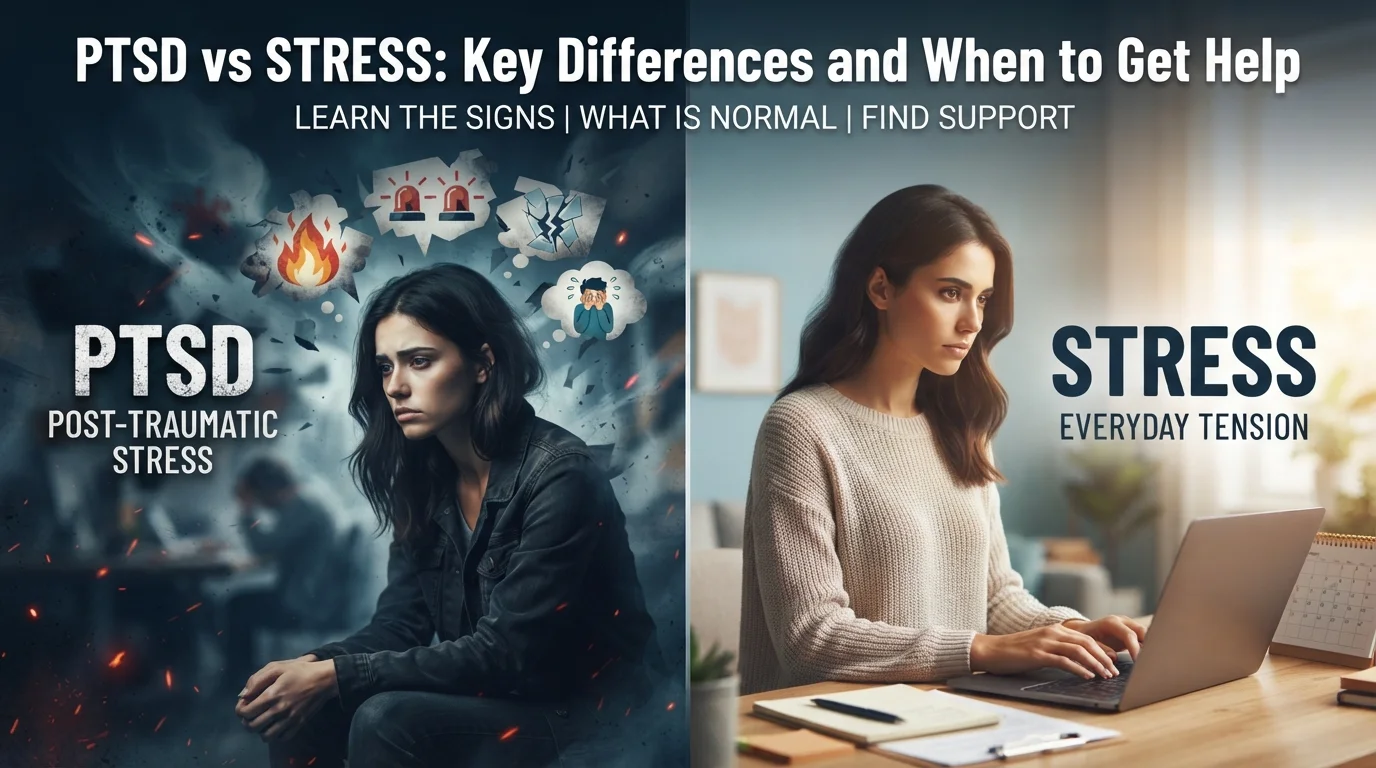
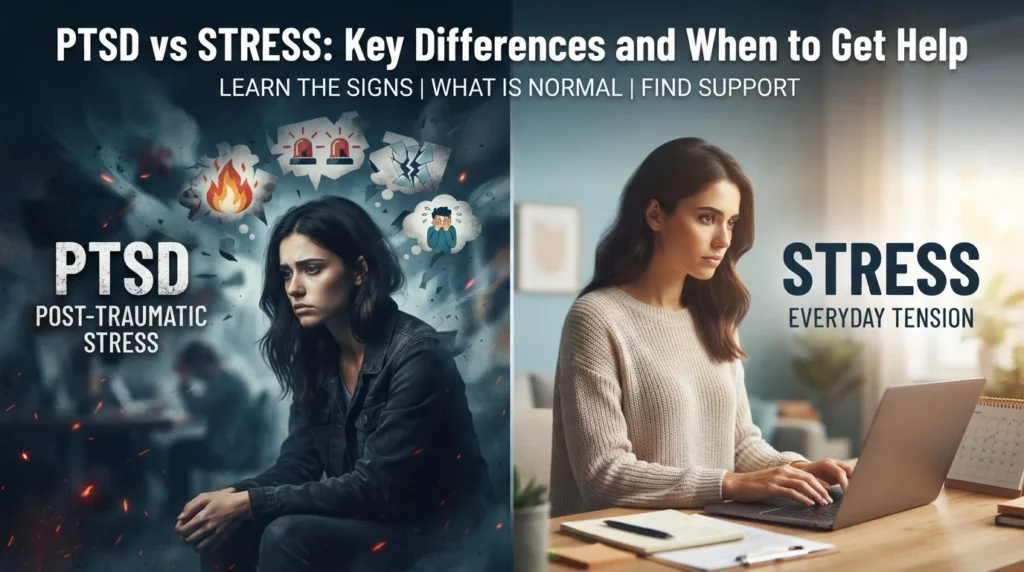
Everyday stress is a response to ongoing pressures and demands, such as work, finances, family or health. It tends to rise and fall with those pressures and usually eases when they lift. PTSD is a specific condition that can develop after experiencing or witnessing a traumatic event involving actual or threatened death, serious injury or sexual violence. Its hallmark is that the event does not stay in the past: it keeps returning through intrusive memories, nightmares or flashbacks, and the person’s nervous system remains on high alert as if the danger were still present.
Put simply, stress is usually about what is happening now or what might happen next. PTSD is about something that already happened but has not stopped feeling present.
What Is Everyday Stress?
Stress is the body’s natural reaction to challenges. It sharpens focus and gives energy in the short term. When pressures continue for weeks or months, stress can become chronic, leading to tension, irritability, poor sleep, headaches and exhaustion. Chronic stress is real and deserves attention, but it is not the same as post-traumatic stress. Our guide to coping with chronic stress covers long-term stress in depth, and our article on stress vs burnout explains how prolonged stress can turn into exhaustion.
What Is PTSD?
Post-traumatic stress disorder is a recognised mental health condition described in the American Psychiatric Association’s DSM-5-TR and the World Health Organization’s ICD-11. It can develop after someone experiences a traumatic event directly, witnesses it happening to others, learns that it happened to a close family member or friend in a violent or accidental way, or, in some professions such as emergency work, is repeatedly exposed to distressing details of traumatic events.
The Four Groups of PTSD Symptoms
The DSM-5-TR describes four groups of PTSD symptoms that persist for more than a month and cause significant distress or difficulty functioning:
- Re-experiencing: intrusive memories, nightmares or flashbacks of the event.
- Avoidance: avoiding reminders, places, people or thoughts linked to it.
- Negative changes in thinking and mood: persistent fear, guilt, shame, detachment or difficulty feeling positive emotions.
- Changes in arousal and reactivity: being easily startled, on guard, irritable, or unable to sleep or concentrate.
These are the core signs of PTSD, but having one or two of them after a frightening event does not mean someone has the condition. Our article What Is Trauma? explains more broadly how trauma affects the mind and body.
Key Differences Between PTSD and Stress
When comparing PTSD vs stress, several features help clinicians tell them apart.
What Triggered It
Stress can arise from almost any demand or pressure. PTSD is linked to a specific traumatic event or series of events involving serious threat. A demanding job, an argument or financial difficulty can cause intense stress, but they would not, on their own, lead to a PTSD diagnosis.
Remembering vs. Re-Living
This is perhaps the clearest difference. Someone under stress may think about their problems a great deal, but they experience those thoughts as thoughts. In PTSD, memories of the trauma often feel vivid, sensory and present, as though the event were happening again. A smell, a sound or a sight can bring back the fear, physical sensations and even images of the moment with startling intensity.
Avoidance
People under stress may avoid tasks they dread. In PTSD, avoidance centres on reminders of the trauma: certain places, conversations, news stories, people or even thoughts. Over time, this avoidance can shrink a person’s world considerably.
The Body on High Alert
Stress raises tension, but PTSD often keeps the nervous system in a state of constant vigilance. Common trauma symptoms include an exaggerated startle response, scanning surroundings for danger, difficulty relaxing even in safe places, and sleep disturbed by nightmares. Sudden waves of fear can also resemble panic attacks; our article on panic attack vs anxiety attack explains what happens in the body during those surges.
How Long It Lasts
Stress usually eases when the pressure eases. PTSD symptoms, by definition, last more than a month, and without support they can persist for months or years, sometimes long after daily life has returned to normal. In some people, symptoms appear only months after the event, which clinicians describe as delayed expression.
What Is Normal After a Traumatic Event?
It is very common to feel shaken after something frightening. In the first days and weeks, many people experience intrusive memories, poor sleep, jumpiness, irritability, numbness or difficulty concentrating. These reactions are the mind’s way of processing what happened, and for many people they gradually ease over the following weeks with rest, support and time.
When significant symptoms appear between three days and one month after a trauma, clinicians may use the term acute stress disorder. When symptoms continue beyond a month and interfere with daily life, PTSD may be considered. Importantly, most people who go through traumatic events do not develop PTSD. Being affected does not mean you are weak, and not being badly affected does not mean the event did not matter.
Clinical guidelines from the UK’s National Institute for Health and Care Excellence (NICE) recommend that people with distressing symptoms in the first month after a trauma be monitored and offered support, and advise against single-session “debriefing” that pushes people to recount the event in detail immediately afterward.
Complex PTSD
ICD-11 also recognises complex PTSD, which can develop after prolonged or repeated trauma, often from which escape was difficult, such as ongoing abuse. Alongside the core PTSD symptoms, people may experience difficulty managing emotions, a deeply negative view of themselves and persistent problems in relationships. Complex PTSD often requires longer-term, carefully paced therapy.
Trauma, Stress and Life in Lebanon
Many people in Lebanon have lived through frightening events, including the 2020 Beirut port explosion, periods of conflict, displacement and personal tragedies such as accidents or violence, often on top of prolonged economic and daily stress. This layering can make it hard to tell where ongoing stress ends and post-traumatic symptoms begin. A person may live with chronic stress, carry specific traumatic memories, and grieve losses all at once.
Recognising which strands are present, and where the line between PTSD vs stress falls for you, helps guide support. Our articles on coping with stress in Lebanon and grief and loss look at those other strands in more detail.
An Illustrative Example
The following is a composite based on common patterns, not a real client. Joelle, 31, works in Beirut. A year ago, she was caught in a serious car accident on the coastal highway. Physically, she recovered. But she still takes long detours to avoid that road, freezes when she hears screeching tyres, and wakes several nights a week from nightmares in which the crash replays in detail. She feels detached from friends and blames herself for not reacting faster. She assumed she was simply “stressed,” like everyone around her.
During an assessment, her psychologist noted that Joelle’s symptoms centred on a specific traumatic event, involved vivid re-experiencing, clear avoidance and constant alertness, and had lasted far longer than a month. On the question of PTSD vs stress, this pattern pointed toward post-traumatic stress rather than ordinary stress. Through trauma-focused CBT, Joelle gradually processed the memory at a pace she could manage, challenged her belief that the accident was her fault, and step by step returned to the road she had been avoiding. Her nightmares became less frequent, and the memory began to feel like something that happened in the past rather than something still happening.
How PTSD Is Treated?
The encouraging news is that PTSD is treatable. NICE guidelines recommend trauma-focused psychological therapies as first-line treatments for adults, particularly trauma-focused cognitive behavioral therapy (CBT) and eye movement desensitisation and reprocessing (EMDR). Trauma-focused CBT helps people process traumatic memories safely, reduce avoidance and change unhelpful beliefs that developed after the trauma, such as constant danger or self-blame. You can read more about the approach in our introduction What Is CBT?
Medication may also be considered in some cases, particularly when symptoms are severe or accompanied by depression; this is a medical decision made with a psychiatrist. Yusra’s practice offers collaborative care with psychiatry when psychological and medical support work best together.
Trauma also affects relationships and families. In Yusra’s practice, individual psychotherapy combines CBT with the analytical-systemic approach, which considers how trauma reshapes relationships and family patterns. Our article on what to expect from a trauma therapist in Lebanon explains how that process typically unfolds.
When to Seek Help?
Consider speaking with a psychologist if, more than a month after a frightening event, you are still experiencing intrusive memories, nightmares, strong avoidance or constant alertness, or if these symptoms are affecting your sleep, work, relationships or sense of safety. Support is also worth seeking sooner if symptoms are intense, if you feel numb or detached, or if you are relying on alcohol or other substances to cope. You do not need to be certain whether it is PTSD vs stress before reaching out; working that out is part of what an assessment is for.
If you are having thoughts of harming yourself or ending your life, please reach out straight away. In Lebanon, you can call 1564, the national lifeline for psychological support and suicide prevention, available 24/7. If you are in immediate danger, contact local emergency services or go to the nearest hospital.
Frequently Asked Questions
Stress is a response to ongoing pressures and usually eases when they ease. PTSD develops after a traumatic event and involves re-experiencing it through intrusive memories or nightmares, avoiding reminders, negative changes in mood and constant alertness, lasting more than a month.
Ordinary stress does not turn into PTSD on its own, because PTSD is linked to a traumatic event. However, chronic stress can make it harder to recover after a trauma, and the two often occur together.
Symptoms often begin within the first weeks, but PTSD is only considered when they last more than a month. In some people, symptoms appear months later. Many people have strong reactions at first that gradually ease.
Common signs include intrusive memories, nightmares or flashbacks, avoiding reminders of the event, persistent fear, guilt or numbness, feeling constantly on guard, being easily startled and having trouble sleeping or concentrating.
Yes. Trauma-focused psychological therapies such as trauma-focused CBT and EMDR are recommended treatments, and many people experience significant improvement. Medication may also help in some cases.
Understanding What You’re Carrying
When it comes to PTSD vs stress, the key difference is whether the past keeps returning as if it were the present. Both deserve care, and neither is a sign of weakness. Understanding which one you are dealing with, or whether both are present, is the first step toward the right support and toward feeling safe in your own life again.
If a frightening experience is still affecting you, support is available. Learn more about individual psychotherapy in Lebanon, book a confidential consultation, or send a message on WhatsApp with any questions first.
About this article: This content is for general education and does not diagnose or replace individual assessment or treatment. It was reviewed by Yusra Imad, Licensed Clinical Psychologist and CBT Psychotherapist. Decisions about medication should be made with a qualified medical professional. If you are in crisis in Lebanon, call 1564, the national lifeline for psychological support and suicide prevention (available 24/7). If you are in immediate danger, contact local emergency services or go to the nearest hospital.
Reviewed by Yusra Imad, Licensed Clinical Psychologist and CBT Psychotherapist in Lebanon.