
Your heart pounds, your breath feels short and your thoughts race toward the worst. Afterward, shaken, you search for answers and find two phrases used almost interchangeably. Was it a panic attack or an anxiety attack? Does the difference even matter? Understanding panic attack vs anxiety attack is more than a question of labels. It helps you make sense of what happened in your body, reduces the fear of it happening again, and points toward the kind of support that actually helps.
This guide explains how the two experiences differ, where they overlap, the warning signs that deserve a medical check, and when it makes sense to talk to a psychologist.
Panic Attack vs Anxiety Attack: The Short Answer
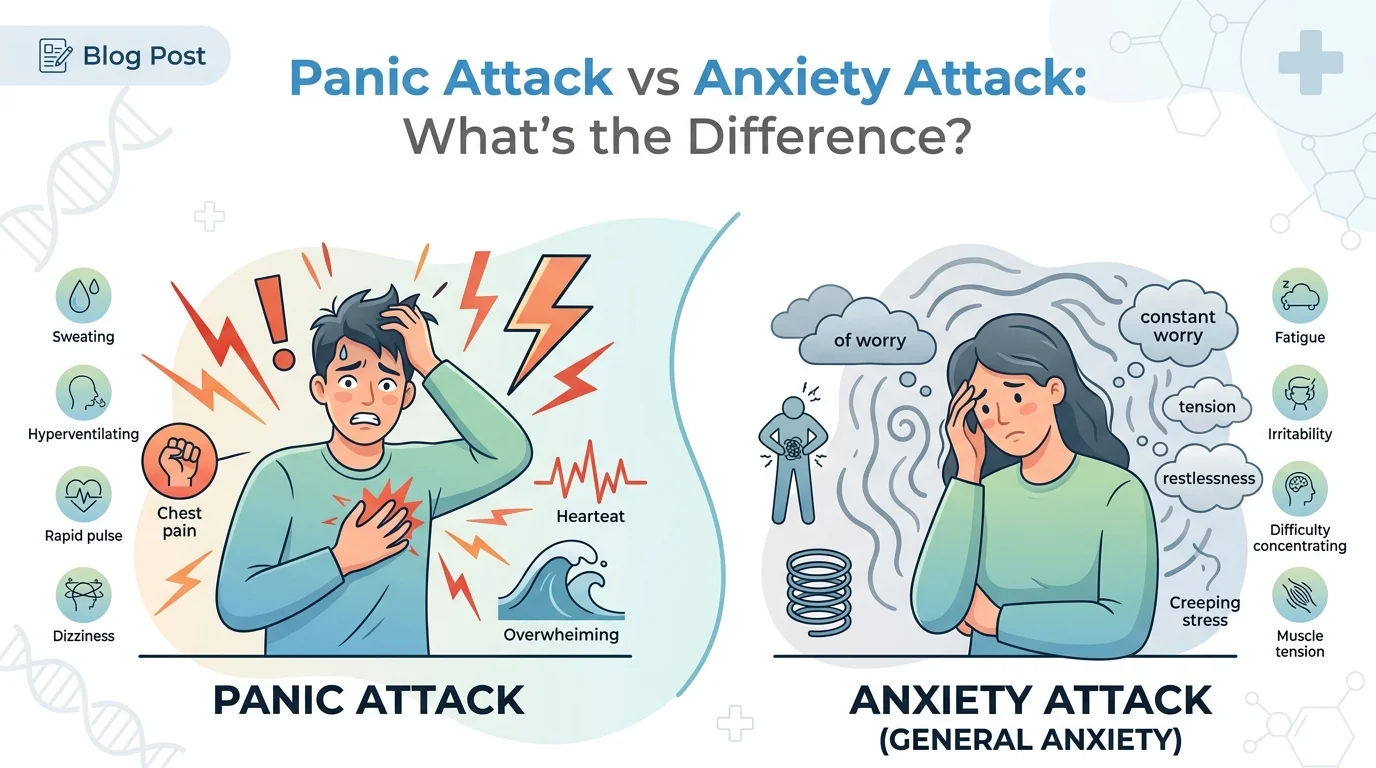
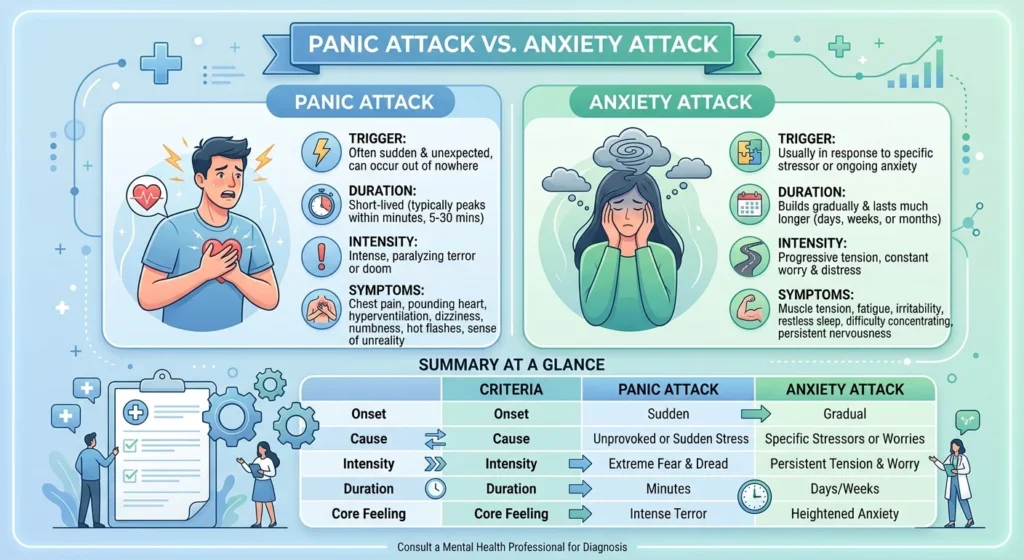
A panic attack is a sudden surge of intense fear or discomfort that peaks within minutes and comes with strong physical symptoms, such as a racing heart, shortness of breath, trembling or dizziness. It is a recognised clinical term, defined in the Diagnostic and Statistical Manual of Mental Disorders (DSM-5), published by the American Psychiatric Association.
“Anxiety attack” is not a formal diagnostic term. People use it to describe a period of intense anxiety that usually builds more gradually, often in response to a stressor, and that may feel overwhelming without reaching the sudden peak of panic. So the core difference between panic and anxiety episodes comes down to onset, intensity and trigger: panic tends to strike fast and hard, while heightened anxiety tends to rise, linger and ease more slowly.
What Is a Panic Attack?
According to the DSM-5, a panic attack is an abrupt rush of intense fear that reaches its peak within minutes and involves at least four of a list of physical and mental symptoms. Many people describe it as the most frightening physical experience they have ever had. It is common for someone having their first panic attack to believe they are having a heart attack, losing their mind or about to die.
The good news, and it is genuinely reassuring for many people, is that panic attacks themselves are not dangerous, even though they feel that way. The UK’s National Health Service notes that most panic attacks last somewhere between 5 and 20 minutes.
Common Signs of a Panic Attack
The signs of a panic attack vary from person to person, but they usually include a cluster of intense physical sensations alongside frightening thoughts. Grouped broadly, they tend to look like this:
- Heart and chest: pounding or racing heartbeat, chest pain or tightness.
- Breathing: shortness of breath, a smothering or choking feeling.
- Body: sweating, trembling, nausea, dizziness, chills or hot flushes, numbness or tingling.
- Mind: a sense of unreality or detachment, fear of losing control, fear of dying.
Not everyone experiences all of these, and the mix can change from one episode to the next.
Expected and Unexpected Panic Attacks
Clinicians distinguish between expected panic attacks, which happen in response to a known trigger such as flying or a crowded space, and unexpected ones, which seem to come out of nowhere, sometimes even during rest or sleep. Unexpected attacks are often the most distressing, precisely because they feel random. In reality, they frequently follow subtle triggers that are easy to miss, such as a slight change in heart rate, a stressful thought or physical exhaustion.
What People Mean by an “Anxiety Attack”?
When someone says they had an anxiety attack, they usually mean that their anxiety climbed to a level that felt unmanageable. They may have felt tense, restless and on edge for hours, with worry looping in their head and their body running on high alert.
Why “Anxiety Attack” Isn’t a Clinical Diagnosis?
Because the term is informal, it means slightly different things to different people. Some use it as a synonym for panic attack. Others use it for a long, intense stretch of worry. That flexibility is fine in everyday conversation, but it can create confusion when you are trying to understand what is happening and what might help. Anxiety in its clinical sense sits within several recognised conditions, including generalized anxiety disorder, social anxiety disorder and specific phobias, each with its own pattern.
Common Anxiety Attack Symptoms
Typical anxiety attack symptoms include persistent worry, a sense of dread, muscle tension, restlessness, irritability, difficulty concentrating, a fast heartbeat and trouble sleeping. Some physical sensations overlap with panic, but they are usually less sudden and less intense, and the experience tends to be tied to a specific concern such as an upcoming exam, a health worry or a conflict at work.
Key Differences Between Panic and Anxiety Episodes
Looking at panic attack vs anxiety attack side by side, four features help most when telling them apart. None of them is absolute, but together they usually give a clear picture.
How Quickly It Starts?
A panic attack comes on abruptly. People often describe going from fine to terrified in moments. Intense anxiety, in contrast, usually builds over a period of minutes, hours or even days as a stressful situation approaches.
How Intense It Feels?
Panic is defined by its intensity. The physical symptoms are often severe enough that people seek emergency care, convinced something is medically wrong. Anxiety can be very distressing too, but it more often feels like an ongoing, heavy state of tension than an overwhelming wave.
What Triggers It?
Anxiety is typically linked to a recognisable worry or anticipated threat. Panic can be triggered by a situation, but it can also appear without any obvious cause. That unpredictability is one reason panic can lead to fear of the next attack.
How Long It Lasts?
A panic attack peaks within minutes and usually subsides within half an hour, though people can feel drained or shaky for some time afterward. Heightened anxiety can last much longer, rising and falling with the stressor and sometimes persisting for days.
Can You Experience Both?
Yes, and many people do. Anxiety can build until it tips into a panic attack. After a frightening panic attack, many people also develop what clinicians call anticipatory anxiety: a constant, low-level worry about when the next one will strike. That worry can lead to avoiding places where an attack happened, carrying “safety items,” or staying close to home.
When panic attacks recur unexpectedly and are followed by at least a month of persistent worry about further attacks or significant changes in behavior to avoid them, a clinician may consider panic disorder. Having a single panic attack does not mean you have panic disorder. Panic attacks can occur in many contexts, including during periods of high stress, alongside depression or within other anxiety conditions. Only a qualified professional can make an assessment, and labels matter less than understanding your own pattern.
When It Might Be Something Medical?
Some symptoms of a panic attack, particularly chest pain, shortness of breath and dizziness, overlap with serious medical conditions such as heart problems. If you are experiencing these symptoms for the first time, if they feel different from your usual pattern, or if you are unsure, seek medical care straight away. It is always better to be checked and reassured than to assume.
Certain medical issues, including thyroid problems and some heart rhythm conditions, as well as caffeine, stimulants and some medications, can also produce anxiety-like symptoms. A doctor can help rule these out. Once physical causes have been excluded, psychological support becomes the main path forward, and in some cases a psychologist and psychiatrist may work together; our article on psychologist vs psychiatrist explains how those roles differ.
Two Illustrative Scenarios
The following examples are composites based on common patterns, not real clients. They show how differently the two experiences can unfold.
Rami, 29, has an important job interview on Thursday. From Monday, he feels a growing tightness in his chest. He sleeps poorly, rehearses answers obsessively and snaps at his sister over small things. By Wednesday night, he feels so tense he can barely eat. This is intense anxiety: tied to a clear stressor, building gradually and easing once the interview is over.
Maya, 35, is sitting in traffic in Beirut after an ordinary workday. Without warning, her heart starts racing, her hands tingle and she feels as though she cannot get enough air. Within minutes she is convinced she is about to faint or die. Twenty minutes later, the wave passes, leaving her exhausted and frightened. Over the following weeks, she starts avoiding driving on the highway. This is a panic attack, followed by anticipatory anxiety and avoidance, a pattern that responds well to targeted therapy.
Why the Difference Matters for Treatment?
Understanding the difference between panic and anxiety is not just academic. It shapes what therapy focuses on. Cognitive behavioral therapy is one of the most widely recommended psychological treatments for both, with clinical guidelines from the UK’s National Institute for Health and Care Excellence (NICE) recommending CBT for panic disorder and generalized anxiety disorder, but the emphasis differs.
For panic, a central idea in CBT, drawn from psychologist David Clark’s influential cognitive model, is that panic attacks are fuelled by catastrophic misinterpretation of body sensations. A slightly faster heartbeat becomes “I’m having a heart attack,” which increases fear, which speeds the heart further. Therapy helps break this cycle by understanding the physiology of fear, testing those frightening interpretations, and gradually reducing avoidance, sometimes by safely bringing on mild sensations so the brain learns they are not dangerous.
For persistent anxiety and worry, CBT focuses more on the thinking habits that keep worry going, such as overestimating danger or underestimating your ability to cope, and on tolerating uncertainty. You can read more about how this works on our page on CBT therapy in Lebanon, or start with the basics in What Is CBT?
What Helps in the Moment?
When panic or intense anxiety hits, the goal is not to force the feeling away, which often makes it stronger, but to ride the wave while reminding yourself that it will pass. Slowing your breathing, naming what you can see and hear around you, and telling yourself “this is panic, it is uncomfortable but not dangerous” can help many people. We cover these strategies step by step in our guide to managing panic attacks with practical coping skills, so we will not repeat them here.
Coping skills are valuable, but if attacks keep returning or you are starting to arrange your life around avoiding them, that is a sign that more structured support could help.
When to Speak to a Psychologist?
Consider reaching out for professional support if panic attacks are happening repeatedly, if you constantly worry about the next one, if you are avoiding places, activities or people because of anxiety, or if anxiety is affecting your sleep, work, studies or relationships. You do not need to wait until things become unbearable. Early support often makes the work shorter and easier.
A psychologist can help you understand your specific pattern, rule out what it is not, and build a plan tailored to you. Panic and anxiety are among the most treatable psychological difficulties, and many people regain a strong sense of control with the right support.
Frequently Asked Questions
A panic attack is usually more intense and sudden, with stronger physical symptoms. However, prolonged intense anxiety can be just as exhausting in a different way, because it lasts longer. Both are valid experiences that deserve attention, and neither is a sign of weakness.
Panic attacks feel frightening but are not physically dangerous in themselves. Because some symptoms overlap with heart and breathing problems, though, it is important to get medical care for new, different or unclear symptoms, especially chest pain.
Unexpected panic attacks often follow triggers that are easy to miss, such as subtle body sensations, accumulated stress, lack of sleep or caffeine. The brain’s alarm system can become oversensitive, firing in response to signals that are not actually dangerous. Therapy helps recalibrate that system.
If anxiety episodes are frequent, intense, difficult to manage or starting to limit your daily life, speaking with a psychologist is a sensible step. The same applies if you notice yourself avoiding situations because you fear an attack.
Yes. Cognitive behavioral therapy is one of the most researched treatments for panic attacks and anxiety-related difficulties. The approach is tailored to your pattern, focusing on body-sensation fears for panic and on worry and avoidance for broader anxiety.
Understanding Your Experience Is the First Step
When it comes to panic attack vs anxiety attack, the clearest difference lies in how the experience arrives and peaks. Panic hits suddenly and intensely; heightened anxiety tends to build and linger. Both can be distressing, both can overlap, and both respond well to the right kind of support. Knowing which one you are dealing with makes the next step clearer.
If panic or anxiety is shaping how you live, you do not have to work it out alone. Learn more about cognitive behavioral therapy in Lebanon, book a confidential consultation, or send a message on WhatsApp to ask any questions first.
About this article: This content is for general education and does not diagnose or replace individual assessment or treatment. It was reviewed by Yusra Imad, Licensed Clinical Psychologist and CBT Psychotherapist, holding CBT certification from ALTCC. If you have chest pain, difficulty breathing or symptoms you are unsure about, seek urgent medical care. If you are in immediate danger or thinking of harming yourself, contact local emergency services or go to the nearest hospital.
Reviewed by Yusra Imad, Licensed Clinical Psychologist and CBT Psychotherapist