

You have booked your appointment, or you are close to it. Now a more practical worry kicks in. Will you have to talk the whole hour? Will the therapist ask about your childhood straight away? What if you go blank? Knowing what happens in a CBT session takes much of that uncertainty away, and it helps you walk in ready to use the time well. This guide walks through a CBT session from the first appointment to the final one: how sessions are structured, what the famous “homework” really involves, and how progress is tracked along the way.
If you are still deciding whether cognitive behavioral therapy is for you at all, start with our introduction, What Is CBT? This article picks up where that one ends, inside the therapy room.
What Happens in a CBT Session? The Overview
Most people picture therapy as an open conversation that drifts wherever it goes. CBT sessions feel different. They are collaborative and warm, but also organised, because cognitive behavioral therapy is built around specific goals you agree on together. A typical session usually lasts around 50 minutes and follows a recognisable rhythm: a brief check-in, an agreed plan for the hour, a look at what you practised since last time, focused work on one issue, and a clear idea of what to try next.
That structure is not rigid. A good therapist bends it when something urgent comes up or when you need more space to talk. But it gives each meeting a purpose, and it means you leave most sessions with something concrete rather than a vague sense that you “talked about stuff.”
Before Your First CBT Session
The process often begins before you sit down. When you first get in touch, you may be asked a few short questions about what brings you to therapy and whether there is anything urgent the therapist should know. This helps confirm that CBT, or the practice more broadly, is the right starting point for you.
You do not need to prepare a speech. It can help to jot down a few notes beforehand: the main things you are struggling with, when they started, and what you hope might change. Some people also note questions about confidentiality, fees or scheduling. Bringing these written points can be a relief if nerves make your mind go quiet. For a broader picture of first appointments in general, our article on what to expect during your first therapy session in Lebanon covers the practical side in more depth.
The First CBT Sessions: Building a Shared Understanding
The first one to three meetings are usually about assessment. Rather than jumping into techniques, the therapist wants to understand your situation properly. Rushing this stage tends to produce generic advice, and generic advice rarely helps for long.
Telling Your Story at Your Own Pace
Expect questions about the difficulties that brought you in, how they show up day to day, what makes them better or worse, and how they affect work, relationships, sleep and mood. Your therapist may also ask about your history and current circumstances. You stay in control of how much you share. If a topic feels too raw for an early session, saying so is completely acceptable, and a skilled therapist will respect it.
Mapping the Problem Together
One of the most useful early steps in CBT session structure is building what clinicians call a formulation: a shared map of how your difficulty works. It usually links five areas, namely the situation, your thoughts, your emotions, your physical sensations and your behaviors. Seeing the pattern laid out on paper can be surprisingly powerful. People often say it is the first time their problem looked understandable instead of chaotic.
For example, a map for persistent worry might show how a trigger (an unanswered email) leads to a thought (“I’ve made a serious mistake”), which produces anxiety and a racing heart, which leads to checking and re-checking, which brings brief relief but teaches the brain that the worry was justified. Once the loop is visible, it becomes clear where to intervene.
Setting Goals You Can Recognise
Before the main work begins, you and your therapist agree on goals. Vague goals like “feel better” are a natural starting point, so the therapist helps translate them into something you could actually notice. “Feel less anxious” might become “attend the weekly team meeting and say at least one thing” or “fall asleep without checking my phone for reassurance.” These goals guide future sessions and make progress easier to see.
A Typical CBT Session, Step by Step
Once assessment is complete, most sessions settle into a familiar shape. This structure is described in standard CBT training texts, including Judith Beck’s widely used clinical guide Cognitive Behavior Therapy: Basics and Beyond. Here is how a typical CBT session tends to unfold.
A Brief Check-In
Sessions usually open with a short update on how your week went and how your mood has been. Some therapists use brief questionnaires every few sessions to track changes in anxiety or low mood over time. These are not tests you can fail; they simply make progress visible, which is useful on days when it feels like nothing has changed.
Agreeing on the Agenda Together
Next, you decide together what to focus on. You might bring a situation from the week that knocked you off balance, while your therapist might suggest continuing work on a skill started last time. Setting the agenda jointly is a core part of what happens in a CBT session, because it keeps the therapy anchored to what matters most to you right now.
Reviewing What You Practised
If you agreed to try something between sessions, you will look at how it went. This review matters more than people expect. What did you notice? What got in the way? Did the outcome match your prediction? Even an attempt that “went wrong” usually contains valuable information.
The Main Work of the Session
The largest part of the hour focuses on one or two agenda items. Depending on your goals, this might mean examining a stressful thought and weighing the evidence for and against it, planning a small behavioral experiment, rehearsing a difficult conversation, practising a calming skill, or exploring a belief about yourself that keeps resurfacing. The therapist will guide, ask questions and offer ideas, but much of the insight comes from you. CBT therapists often use a style called guided discovery, asking questions that help you reach your own conclusions rather than simply telling you what to think.
Summarising and Planning Next Steps
Toward the end, you pull together the key points of the session, sometimes in your own words so they stick. Then you agree on what you will practise before next time. This is collaborative; you should never leave with a task that feels impossible or that you did not agree to.
Feedback on the Session
Many CBT therapists close by asking how the session felt. Was anything unhelpful? Was the pace right? This is your chance to shape the therapy. Honest feedback, even mild criticism, helps your therapist adjust and strengthens the working relationship.
What CBT Homework Actually Looks Like
The word “homework” puts some people off, perhaps because it brings back memories of school. In practice, CBT homework is simply a way of carrying the work into real life, where change actually happens. Research supports its value: a 2010 meta-analysis by Kazantzis and colleagues in Clinical Psychology: Science and Practice found that homework assignments and engagement with them were associated with better therapy outcomes.
Typical between-session tasks are short and specific. A few common examples:
- Thought records: noting a difficult moment, the thought behind it and a more balanced response.
- Behavioral experiments: testing a fearful prediction in a small, planned way.
- Activity scheduling: gradually adding meaningful or enjoyable activities back into the week.
- Skills practice: rehearsing breathing, grounding or problem-solving techniques.
Most tasks take a few minutes a day, not hours. You can see some of these tools applied to worry and nervousness in our guide to CBT techniques for managing anxiety.
What If You Don’t Do the Homework?
It happens to almost everyone at some point. Life gets busy, motivation dips, or the task felt harder than expected. In CBT, a skipped assignment is not a failure; it is information. Your therapist will be curious about what got in the way. Was the task too big? Did a worry make it feel risky? Did a stressful week crowd it out? Those answers often lead straight to the next useful piece of work.
How CBT Sessions Change Over Time
Early sessions focus on understanding and skill-building, so the therapist may teach and guide more actively. As therapy progresses, the balance shifts. You increasingly lead the work, spotting patterns and choosing strategies yourself, with your therapist acting more as a sounding board. The long-term aim of CBT is for you to become, in a sense, your own therapist.
How Many CBT Sessions Will You Need?
This is one of the most common questions people ask, and the honest answer is that it depends. The UK’s National Health Service describes a typical course of CBT as roughly 5 to 20 weekly sessions. A focused problem such as a specific fear may need fewer, while long-standing difficulties, several overlapping concerns or experiences of trauma usually need more. Rather than committing to a fixed number upfront, you and your therapist review progress regularly against your goals and adjust the plan together. Sessions are often weekly at first and may space out as you become more confident.
Ending Therapy Well
CBT plans for its own ending. The last few sessions usually focus on consolidating what has helped, identifying early warning signs that an old pattern is returning, and writing a personal plan for handling setbacks. This is often called relapse prevention. Some people also arrange occasional follow-up sessions after regular therapy ends, which can be a reassuring safety net.
An Illustrative Example: A Mid-Course CBT Session
To show what happens in a CBT session in practice, here is a composite example based on common patterns, not a real client. Imagine a 34-year-old accountant in Beirut working on social anxiety at work. It is her seventh session.
She arrives and says the week was mixed. Her mood score is slightly better than last time. Together they set the agenda: review her experiment from last week, then prepare for a presentation she has coming up. The experiment was to ask one question in a meeting. She did it, though her voice shook, and nobody reacted the way she had feared. Her prediction had been that colleagues would think she was incompetent; what actually happened was that her manager thanked her for raising the point.
The main part of the session turns to the presentation. They map her predictions (“I’ll freeze and everyone will see I’m a fraud”), look at the evidence from past presentations, and plan a rehearsal she will do twice at home. She ends by summarising the session in one sentence: “My anxiety predicts disaster, but my experience keeps disagreeing with it.” Her task for the week is the rehearsal plus a short note on what happens before, during and after the real presentation. The whole hour is focused, practical and paced to what she feels ready for.
How to Get the Most From Your CBT Sessions
A few small habits make a noticeable difference to how much you gain from therapy. Arrive with one or two things you want to discuss, even if they seem minor. Be honest when something is not working, whether that is a technique, the pace or a homework task. Keep a small notebook or phone note for thoughts and situations you want to bring up. And give yourself credit for small steps; CBT tends to build progress in increments that only look significant when you look back.
It is also worth knowing that sessions will not always feel productive. Some weeks are harder, and some conversations stir up difficult emotions. That is a normal part of therapy, not a sign it is failing. If a session leaves you unsettled, mention it next time so your therapist can adjust.
CBT Sessions Within an Integrative Approach
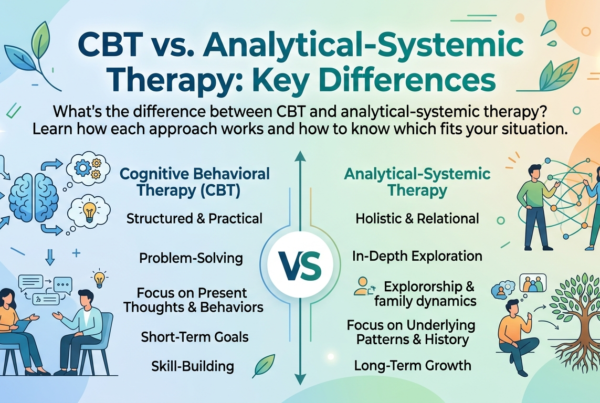
In some practices, CBT is used on its own. In others, it forms part of a broader plan. Yusra’s work combines cognitive behavioral therapy with the analytical-systemic approach, which looks at how family and relationship patterns shape present difficulties. In practice, this means some sessions may follow the structured CBT format closely, while others make room to explore recurring relational themes when they are relevant to your goals. Our comparison of CBT and analytical-systemic therapy explains how the two fit together.
Frequently Asked Questions About CBT Sessions
Most individual CBT sessions last around 50 minutes to an hour. The first assessment session can sometimes be a little longer. Your therapist will confirm the session length and frequency when you book.
Not necessarily. CBT focuses mainly on what is keeping a problem going in the present. Past experiences may come up when they help explain long-standing beliefs, but you decide how much to share and when. You will not be pushed into topics you are not ready for.
Nothing is required. Short notes about your main concerns, when they began and what you hope will change can help, along with any questions about the process. If you have relevant reports, such as a previous psychological assessment, you may bring those too.
Confidentiality is a core part of therapy and is protected within professional and legal limits, for example where there is a serious risk to someone’s safety. Your therapist should explain these limits clearly at the start, and you are welcome to ask about them before sharing anything.
The therapeutic relationship matters a great deal. It is worth raising your concerns directly, because many issues can be resolved with a conversation about pace or approach. If the fit still does not feel right, it is reasonable to look for a different therapist. Feeling safe and respected is essential for therapy to work.
Ready to Start Your First CBT Session?
Knowing what happens in a CBT session removes much of the mystery from starting therapy. Each meeting has a clear purpose, you help set the direction, and the work carries into your everyday life through small, manageable steps. Progress is reviewed openly, and the goal from the beginning is to leave you with skills you can keep using on your own.
If you would like to explore how cognitive behavioral therapy could help with what you are facing, learn more about CBT therapy in Lebanon or book a confidential consultation. You can also send a message on WhatsApp with any questions before your first session.
About this article: This content is for general education and does not replace individual assessment or treatment. It was reviewed by Yusra Imad, Licensed Clinical Psychologist and CBT Psychotherapist, holding CBT certification from ALTCC. If you are in immediate danger or thinking of harming yourself, contact local emergency services or go to the nearest hospital.
Reviewed by Yusra Imad, Licensed Clinical Psychologist and CBT Psychotherapist