

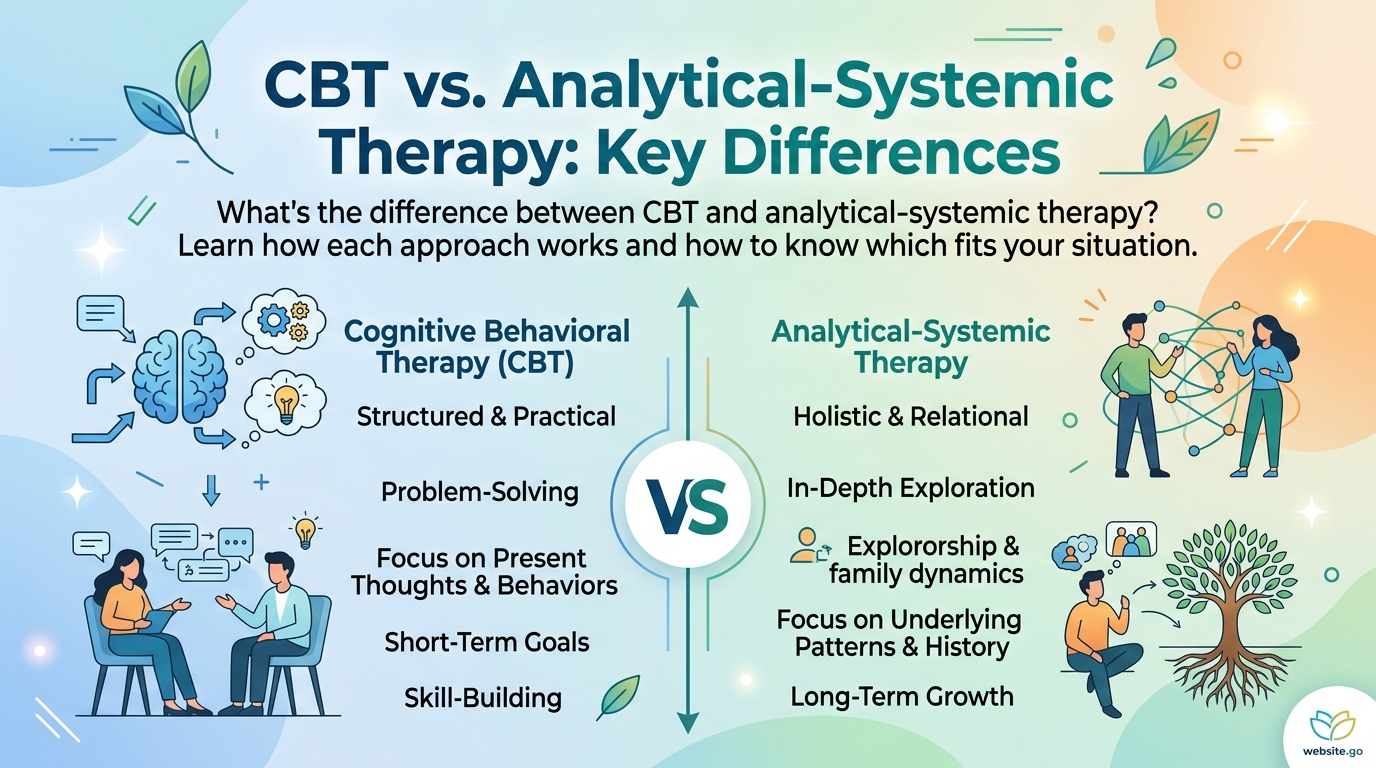
After learning about therapy, you’ll quickly find a variety of methods that promise to alleviate symptoms and a language that doesn’t always clearly differentiate therapy methods. Two types of therapy that are commonly used are the cognitive behavioral therapy (CBT) and the analytical-systemic approach — two very distinctive ways of understanding and resolving psychological issues that are appropriate for certain types of problems.
In this article, we will be examining the different ways in which the two are distinct and which one’s subject matter they are ideally suited to, as well as why they’re sometimes implemented concurrently and not as mutually exclusive choices.
What CBT is All About?
CBT is based on the assumption that thoughts, feelings, and behaviours are linked, and that altering negative patterns of thinking and behaviour will positively affect one’s emotional state. More likely to be organised and action-oriented rather than being diffuse and ruminative; uses identifiable patterns, such as catastrophic thinking, avoidance behaviours that sustain anxiety, or unhelpful beliefs that keep a difficulty alive.
Sessions may include the exploration of our behaviour with these patterns when we see them in everyday life experiences, how accurate and/or constructive the patterns are, and the development of alternative modes of thinking and responding. A fairly straightforward, cognitive skills-based method appropriate for issues such as anxiety, panic attacks, and behavioural patterns that are likely to respond to structured intervention.
CBT Tends to Work in the Present
The characteristic of CBT is that it centers not on a lot of past exploration, but rather on patterns, challenges, and solutions as they are happening. History is definitely taken into account, but the main work is to take place in the now – what is keeping a challenge alive in the present moment, and to deal with it.
What the Analytical-Systemic Approach Focuses On?
The analytical-systemic is a starting-point that differs from the analytical. It is not so much about the present thinking style, but the intention is to examine how longer-standing thinking patterns (often begun in the family context and subsequent relationships) remain present in the way a person thinks, feels and relates in the here and now.
This method is usually more of an exploration of links between previous patterns and present challenges, especially around areas in which the individual might have negative feelings, such as relationships, self worth and repeated emotional reactions without a readily apparent present-day trigger. It tends to be appropriate when someone comes across a similar pattern over time in relationships or situations they are in, rather than just a problem in the moment that they are living through.
Changing some patterns may change the function.Some patterns may be changing, yet the function?
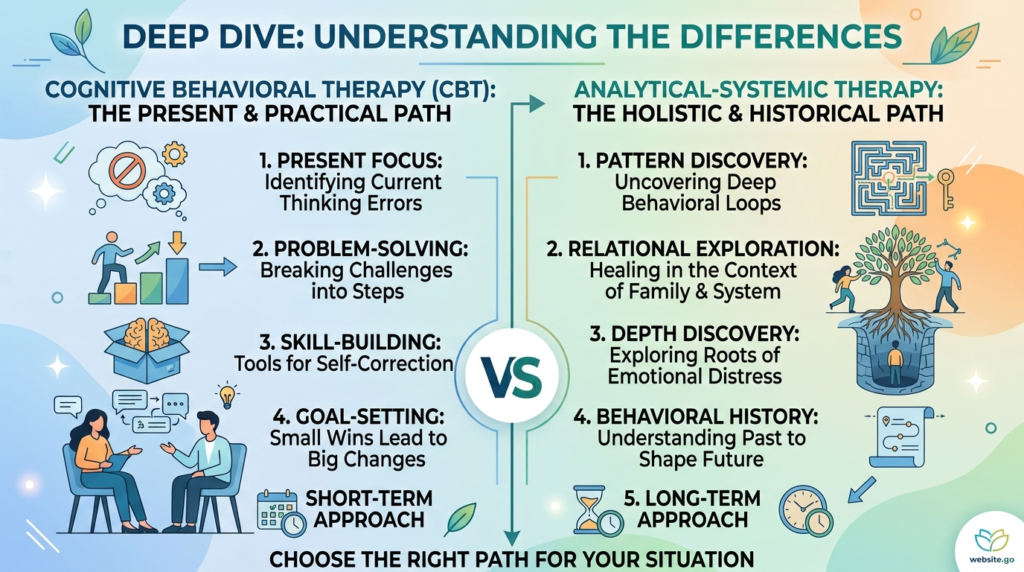
It is important to note that with CBT, the primary focus is on the thoughts and behaviors currently contributing to a difficulty of a challenge, whereas the analytical- systemic approach focuses more on the pattern towards the thoughts/behaviors that have resulted in difficulties in the first place, but have been active for a longer and deeper time. Neither is “correct,” they are at different levels and will often support each other very well.
Anxiety from one who experiences them in the here and now may be best helped directly by the present tools of CBT. If an individual thinks repeatedly of having a hard time with trust in all the close relationships he or she has experienced, he or she may benefit from the analytical-systemic approach to moving through the inceptions of “how they happened”.
Is it possible to have more than one of these approaches working together?
Yes, and really it’s where the best work may occur in this integration. Using CBT’s structured tools to address current symptoms, along with exploring deeper patterns which may contribute to these symptoms, can be both short and long term, addressing the symptom while changing the pattern. For concerns that have an obvious as-of-c Today + a longer relational/historical / undercurrent, this combo can be especially helpful.
How to determine which one is for you?
Limiting a search to a few questions will help you determine where it would be best to begin: Does the difficulty seem relatively new and started at a particular point, or has it been a recurring issue throughout most of your life? Interested in getting practical tools that will help you to attend to a particular symptom or just interested in why a pattern keeps recurring? There’s no “right” answer nor a “wrong” one — rather they offer complementary starting points.
The rule of thumb is “no harm in asking, just as there is no harm in asking questions as a part of a preliminary consultation. As part of the first discussion, you’ll need to decide if it’s the best way, or combination of ways, to address whatever you’re managing.
Learn more about CBT or the analytical-systemic approach to see which resonates more with your situation.
Frequently Asked Questions
They’re not the more effective—both are helpful with different types of problem and different perspectives on a problem. The approach must be able to be implemented in a manner suitable to the particular context in order to be effective, rather than any approach being inherently superior.
Yes. When an approach does not seem to be working or are not getting the changes desired, it is worth talking about directly with the therapist who can adapt the approach or add some of the other approach(s) if necessary.
It depends on what it is that you are looking for. However, if you’re focused on managing a current symptom, a present-focused therapy such as CBT could just be right. If you’re interested in digging deeper into the cycles, a system – analytical approach can be valuable.
Not quite. A well-designed approach is one which works the two complementary models together in a coordinated manner but within the same therapeutic context as opposed to two parallel and non- related systems of therapeutic work.
You can also simply ask your therapist directly to tell you on any given occasion how and why they are using a particular approach. A good therapist will be able to tell you the reason in a way that fits into your situation and makes sense.
Take the Next Step
If you’re weighing which approach fits your situation, that’s a conversation worth having directly rather than deciding in the abstract.
Book a Consultation to discuss which approach — or combination — fits your needs with Yusra Imad.