
It starts with something small. A message left on “seen.” A comment from your manager. A decision you made last week. Within minutes, your mind has built a full courtroom, examined every angle, and reached no verdict, only exhaustion. If that sounds familiar, you are far from alone. Overthinking is one of the most common reasons people look for psychological support, and CBT for overthinking is one of the most practical ways to work with it.
This guide explains what overthinking actually is, why the mind gets stuck in loops, and how cognitive behavioral therapy helps loosen them. You will also find a few small steps you can try now, and signs that it may be time to talk to a professional.
What Is Overthinking, Really?
Everyone thinks things through. Reflecting on a mistake or planning for a difficult conversation is healthy and useful. Overthinking is different: it is repetitive, hard to control and rarely leads anywhere. Instead of producing an answer or a plan, it produces more questions, more doubt and more distress.
Rumination and Worry: Two Faces of Overthinking
Psychologists often describe two main forms. Rumination looks backward. It replays past events, conversations and mistakes, often asking “Why did I do that?” or “Why do I always feel this way?” Research by the late psychologist Susan Nolen-Hoeksema linked this repetitive focus on distress to a higher risk of low mood and depression. Worry looks forward. It runs through possible future problems with endless “What if…?” questions, and it sits at the heart of anxiety conditions such as generalized anxiety.
Many people do both, sometimes in the same evening. The content changes, but the process is the same: the mind circles the same ground again and again.
Problem-Solving or Overthinking? A Simple Test
A useful way to tell the difference is to ask: is this thinking moving me toward an action? Problem-solving ends with a decision, a plan or an acceptance that nothing more can be done. Overthinking ends where it started, only with more tension. If you have thought about the same issue for an hour and you are no closer to a next step, you are probably in an overthinking loop rather than solving a problem.
Why the Mind Gets Stuck in Overthinking Loops
Overthinking is not a character flaw or a sign of weakness. It is usually a coping strategy that made sense at some point, even if it now causes more harm than good. CBT starts by understanding why the loop keeps running.
It Feels Useful
Many overthinkers hold quiet beliefs about their thinking: that it helps them prepare, prevents mistakes, shows they care, or protects them from being caught off guard. Psychologist Adrian Wells, who developed metacognitive therapy, has highlighted how these beliefs about thinking keep worry and rumination going. If part of you believes overthinking keeps you safe, letting go of it can feel risky.
The Search for Certainty
Overthinking often tries to reach a certainty that does not exist. Will this relationship last? Did they mean that comment badly? Will the plan work? The mind keeps searching for a guarantee, and because one never comes, the search never ends. Learning to tolerate reasonable uncertainty is a central part of breaking the cycle.
Stress and Mood Turn Up the Volume
When you are tired, stressed, anxious or low, overthinking tends to intensify. A difficult period at work, financial pressure or ongoing uncertainty in daily life can all make the mind more vigilant. That is why overthinking often feels worse late at night, after a long day, or during demanding seasons of life.
How CBT for Overthinking Works
CBT for overthinking does not try to stop you from thinking, which would be impossible. Instead, it changes your relationship with your thoughts and the habits that keep the loop spinning. If you are new to cognitive behavioral therapy, our introduction What Is CBT? explains the basic approach. Here is how it is commonly applied to overthinking.
Catching the Loop Early
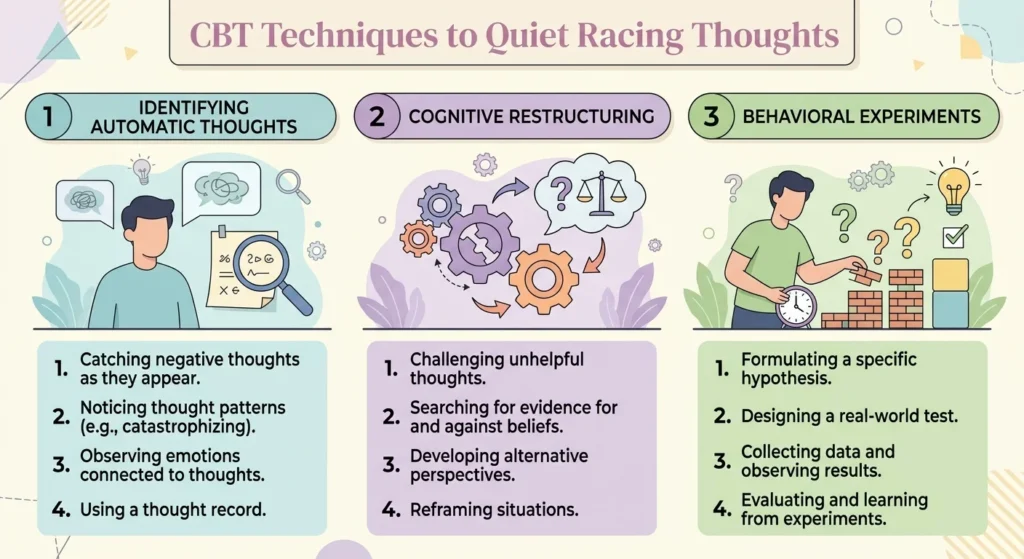
The first skill is awareness. Many people only notice they have been overthinking after an hour has passed. In therapy, you learn to spot the early signs: a familiar question, a tight chest, a pull to reread a message. Simply labelling the moment, “I’m ruminating again” or “This is a what-if spiral,” creates a little distance between you and the thought. That distance is where choice begins.
Questioning the Thoughts and the Process
CBT then works on two levels. The first is the content of the thoughts: is there real evidence that your colleague is angry, or are you filling gaps with the worst interpretation? The second, often more powerful, level is the process itself. Instead of asking only “Is this thought true?”, you also ask “Is thinking about this right now actually helping me?” Often the honest answer is no, and that recognition makes it easier to step away.
Scheduled Worry Time
A widely used technique is worry postponement. Rather than trying to banish worries, you set aside a specific 15 to 20 minutes each day to think about them deliberately. When a worry pops up at other times, you note it and remind yourself it can wait until that slot. Many people find that by the time “worry time” arrives, several concerns no longer feel urgent. Others discover that their worries become more manageable once they are contained rather than spread across the whole day.
From “Why” to “How”
Rumination often gets stuck on abstract “why” questions: “Why am I like this?” “Why did this happen to me?” Research by psychologist Edward Watkins, who developed rumination-focused CBT, suggests that shifting toward concrete, specific thinking (“What exactly happened? What is one thing I could do next?”) tends to be more helpful than abstract self-analysis. In sessions, this often turns a heavy loop into a practical plan.
Shifting Attention and Re-engaging With Life
Overthinking pulls attention inward. CBT helps you practise bringing attention back to the present, to the task in front of you, the conversation you are in or the activity you are doing. When overthinking is linked to low mood, therapy may also involve gradually reintroducing meaningful activities, because withdrawal and inactivity give rumination more room to grow.
Racing Thoughts at Night: Why They Get Louder
For many people, racing thoughts at night are the hardest part. During the day, work and conversation keep the mind occupied. In bed, with no distractions, every unresolved worry rushes in. Trying hard to fall asleep can then create a second layer of worry: “If I don’t sleep now, tomorrow will be a disaster.”
A few CBT-informed habits can help. Writing down worries and possible next steps an hour or two before bed gives the mind a sense that they have been “parked.” If you cannot sleep after a while, getting up and doing something calm in dim light, then returning to bed when sleepy, can weaken the link between bed and mental struggle. Reducing late caffeine and late-night screen use also helps some people. If sleep problems are persistent, a structured therapy approach known as CBT for insomnia (CBT-I) is recommended as a first-line treatment by bodies such as the American College of Physicians, and it is worth discussing with a professional.
An Illustrative Example
The following is a composite based on common patterns, not a real client. Lara, 32, is a project manager in Beirut. After every meeting, she replays what she said, searching for anything that might have sounded wrong. In the evenings, her thoughts move on to the future: missed deadlines, her job security, whether she is good enough. She spends hours on these loops and sleeps poorly.
In therapy, Lara first maps her pattern and notices that her overthinking peaks after meetings and late at night. She discovers she believes that replaying conversations helps her avoid future mistakes. Together with her therapist, she tests that belief: on some days she reviews a meeting for five minutes and writes one concrete lesson; on others she lets it go. Comparing the two, she finds no difference in her performance, but a large difference in how she feels. She starts using a daily worry slot and writing down worries before bed. Over several weeks, the loops do not vanish, but they become shorter, less frequent and much easier to step out of.
How to Stop Overthinking: Small Steps to Try?
If you are wondering how to stop overthinking, the honest answer is that you do not stop it by force. You change how you respond to it. A few steps that many people find helpful:
- Name it: label the loop as soon as you notice it.
- Ask the action question: “Is this leading me to a next step?”
- Postpone it: note the worry and save it for a set worry time.
- Get concrete: swap “why” questions for “what is one thing I can do?”
- Move your attention: return to what is in front of you, ideally something engaging.
These strategies work best when practised regularly, not only in moments of crisis. They are also easier to apply with guidance, especially when overthinking has been part of your life for years.
When Overthinking Points to Something More?
Overthinking can exist on its own, but it is also a common feature of other difficulties. Persistent worry about many areas of life may suggest generalized anxiety; our article on generalized anxiety vs social anxiety explains how that pattern differs from social fears. Constant replaying of interactions and fear of judgment may point toward social anxiety. Heavy, backward-looking rumination combined with low mood, loss of interest or fatigue can be part of depression, which we cover in What Is Depression? And unwanted, distressing thoughts that lead to repeated checking or mental rituals may relate to obsessive-compulsive patterns, explained in our article on CBT for OCD.
You do not need to work out which category applies before seeking help. A psychologist can help you understand what is driving your overthinking and what kind of support fits.
When to Seek Support for Overthinking?
Consider reaching out if overthinking takes up hours of your day, regularly disrupts your sleep, affects your work or studies, strains your relationships, or leaves you feeling exhausted and stuck. The same applies if it comes with persistent low mood or anxiety. Therapy is not only for crises; it can also be a way to build skills before things get harder.
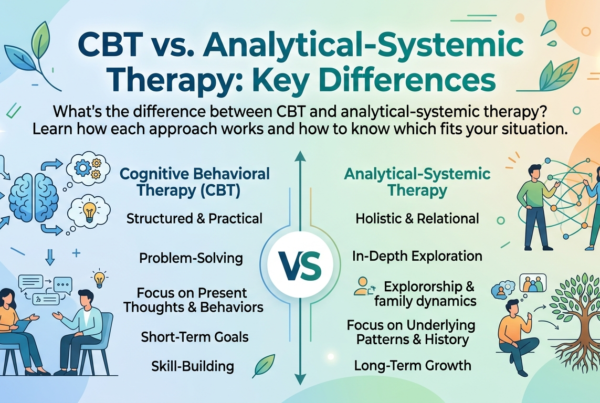
In Yusra’s practice, CBT is often combined with the analytical-systemic approach. That matters for overthinking, because loops sometimes connect to deeper patterns, such as a family environment where mistakes felt dangerous or approval felt conditional. Practical CBT tools ease the loop day to day, while exploring those roots can reduce how often it starts. You can learn more on the CBT therapy in Lebanon page.
Frequently Asked Questions
No, overthinking itself is not a diagnosis. It is a thinking pattern that most people experience at times. However, when it becomes constant and distressing, it can be part of anxiety, depression or other conditions, and it is worth discussing with a professional.
It varies. Some people notice changes, such as catching loops earlier, within a few sessions. Lasting change in long-standing patterns usually takes longer and depends on practice between sessions. Your therapist will review progress with you regularly.
At night there are fewer distractions, so unresolved concerns surface more easily. Tiredness also lowers your ability to reason calmly. Writing worries down earlier in the evening and building a calmer wind-down routine can help reduce racing thoughts at night.
For many people, yes. Mindfulness practices help you observe thoughts without getting caught up in them, which complements CBT well. Some CBT approaches include mindfulness-based techniques, particularly for rumination linked to low mood.
Rumination focuses mainly on the past and on distress, asking why things happened or why you feel a certain way. Worry focuses on the future and possible threats, asking “what if.” Both are forms of repetitive negative thinking, and CBT addresses both.
Quieting the Loop, One Step at a Time
Overthinking can feel like a part of who you are, but it is a pattern, and patterns can change. CBT for overthinking helps you notice the loop sooner, question whether it is helping, and respond in ways that bring you back to your life rather than further into your head. The thoughts may still visit; they just stop running the show.
If racing thoughts or rumination are taking a toll, you do not have to untangle them alone. Explore cognitive behavioral therapy in Lebanon, book a confidential consultation, or send a message on WhatsApp to ask any questions first.
About this article: This content is for general education and does not diagnose or replace individual assessment or treatment. It was reviewed by Yusra Imad, Licensed Clinical Psychologist and CBT Psychotherapist, holding CBT certification from ALTCC. If you are in immediate danger or thinking of harming yourself, contact local emergency services or go to the nearest hospital.
Reviewed by Yusra Imad, Licensed Clinical Psychologist and CBT Psychotherapist