
One of the things that is often misunderstood about OCD is that it is just a person’s preference to do things in a neat or tidy way. For those who suffer from them, the reality is far more painful — persistent, intrusive thoughts that generate actual anxiety, followed by compulsive behaviors designed to neutralize the anxiety – despite the fact that the person may know the behaviors are irrational. This cycle can be time consuming and exhausting and will rarely be solved without support.
This article examines the cognitive behavioral therapy perspective on OCD, the treatment that usually takes place, and what is likely to be beneficial.
How to get past the filter of media images to see OCD in a new light.
OCD consists of two active parts: obsessions, which are unwanted, intrusive thoughts, images, or urges that create a great deal of distress and compulsions, which are repetitive behaviors and/or mental acts performed in an attempt to suppress the thoughts, images, or urges. The compulsions usually only bring short-term relief and will not solve the problem, but serve as reinforcement.
Obsessions may focus on any kind of theme (e.g., contamination, harm, symmetry, intrusive thoughts about relationships or morality) and compulsions can be overt (e.g., checking, washing) or covert (e.g., mental reviews or seeking reassurance). The content is different for each person, and the cycle is similar, but it isn’t identical.
Why the Cycle Is Self-Reinforcing?
Compulsions seem to be required when they are performed because they lessen your anxiety, at least temporarily. However, this amelioration instills in the brain the feeling that the compulsion is required to avoid some bad thing happening, which reinforces the need to engage in it again the next time the urge shows up. This cycle can continue to get more complicated over time, and increasingly complex or more frequent compulsions may be necessary to get to the same feeling of relief.
How CBT Approaches OCD?
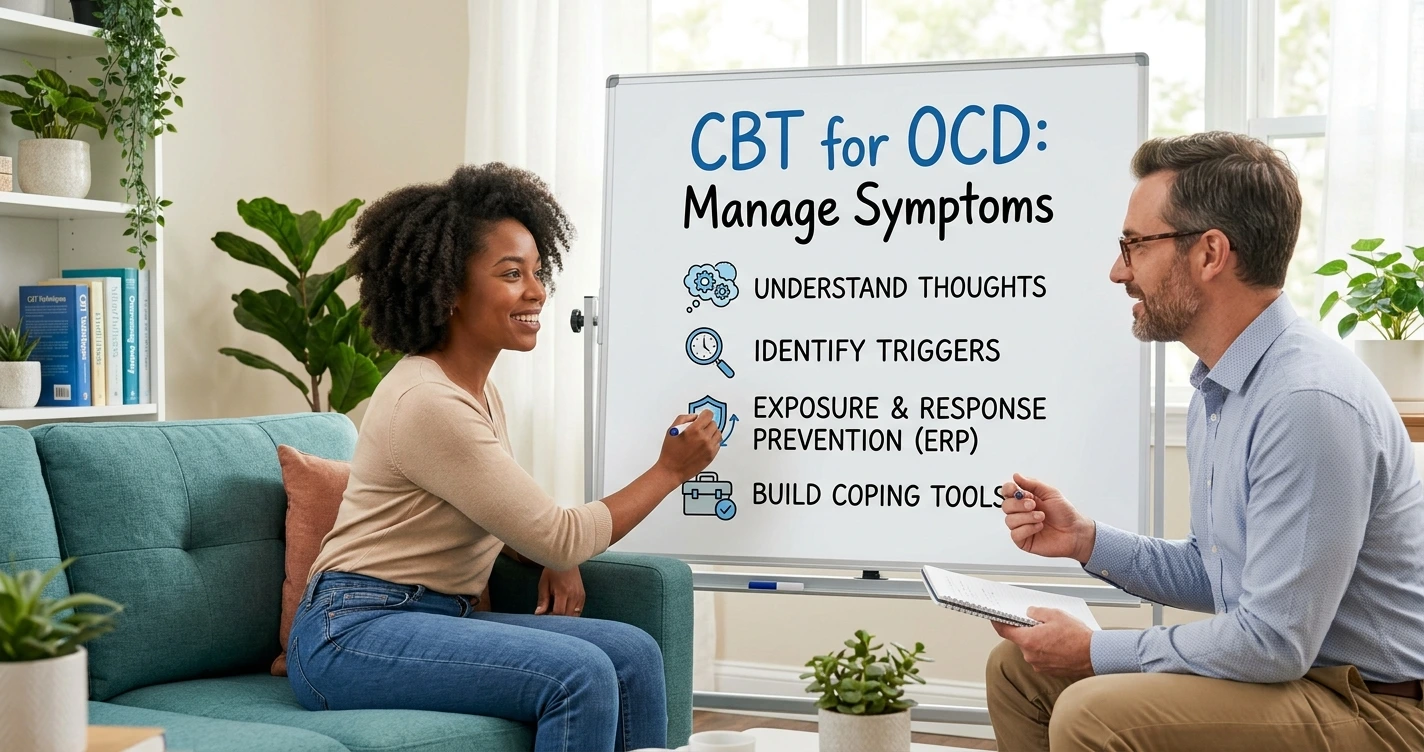
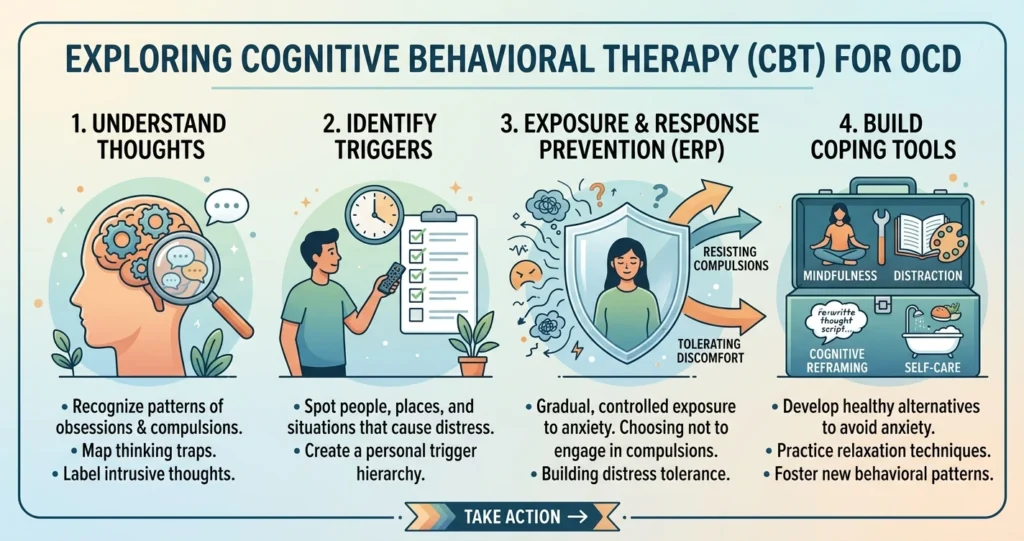
The best known CBT treatment method for OCD is Exposure and Response Prevention (ERP), which is a technique that involves systematically and purposefully exposing yourself to situations or thoughts that cause your OCD obsessions, but avoiding the urge to engage in the corresponding compulsions. This is done incrementally and systematically over time, so as to build up tolerance to the anxiety, instead of avoiding or neutralising it.
CBT for OCD usually includes some work with the thoughts and feelings that perpetuate the cycle, such as believing that if you have an intrusive thought, you’ll want or intend the thing you thought of, which is a common and distressing belief held by people with OCD.
What is usually included in the treatment?
Initial sessions typically involve learning more about the nature of the obsessions and compulsions within the person’s pattern, because treatment should target the person’s specific triggers rather than treating them in a generic way. Exposure exercises are then gradually introduced starting with situations that elicit manageable anxiety and progressing to more difficult situations, with the pace at which this happens being individual to the person.
This is intentional and purposeful learning, not something that one would normally try on one’s own without guidance or support because it can become overwhelming if it is not done properly.
The following are some indicators that OCD may be present.
Some specific patterns may point to OCD, more than just being a personality trait or being generally anxious:
- Intrusive thoughts that are both unpleasant and difficult to get rid of, but that are acknowledged as not necessarily rational
- Pattern of repetitive behaviors/mental rituals performed to alleviate anxiety or to prevent some feared event from occurring
- Obsessions/comulsions that consume a lot of time (an hour or more a day)
- Real disturbances of activities, relationships, or functioning that occur as a result
If the patterns fit, it is a good idea to seek a mental health evaluation, not a self-evaluation from a checklist.
What to Expect From Treatment?
CBT, especially ERP, is typically a step-by-step, gradual process. Improvement usually occurs over time, as the person becomes more tolerable to anxiety, or to decrease the need for compulsions over time, rather than if they completely stop intrusive thoughts. For some, a significant improvement can be seen in the months of dedicated effort—this varies depending on the pattern of OCD and the severity.
Frequently Asked Questions
No. This is a misconception many people have. OCD is a set of intrusive thoughts and compulsive actions that are focused on a particular theme and cause distress rather than a concern about cleanliness and/or order and can relate to many things other than cleanliness and/or order, including harm, doubt and relationships.
Exposure and Response Prevention (ERP) is a form of CBT that works for some individuals. Some, particularly those who have more serious OCD, may be advised to take drugs and/or therapy under the supervision of a psychiatrist. This is based upon a person’s individual assessment.
CBT for OCD is similar to CBT in general but also includes Exposure and Response Prevention, a technique that targets the compulsion cycle. This technique may not be part of general anxiety treatment because the mechanisms that maintain OCD are a little different from general anxiety.
During the initial exposures, it’s not unusual to experience heightened stress levels as this involves intentionally confronting situations that trigger the compulsion without engaging in the compulsion. This is done slowly and with professional guidance to make it a manageable process, and with repeated structured practice anxiety becomes less.
The difference is compulsions, which are repetitive behaviors or mental acts that are performed in a specific manner in an attempt to ward off distress from an obsession. If you have a recurring worry but don’t have the compulsive element, that could be due to an overall anxiety disorder instead of OCD. A professional evaluation will be able to help you understand which one does apply to you.
A Note on Next Steps
If these patterns sound familiar, speaking with a qualified mental health professional is the appropriate way to get an accurate assessment and understand which treatment approach fits your specific situation. The CBT service page explains more about how this approach is applied generally.