
Someone suggests you try CBT. Maybe it was a doctor, a friend who swears it changed how they handle stress, or an article you read late at night. You nod, but a quiet question stays with you: what is CBT, really, and what would you actually be doing if you started? This guide answers that question in plain language. You will learn how cognitive behavioral therapy works, what happens in sessions, which difficulties it is commonly used for, and how to judge whether it fits what you are going through.
No jargon walls, no promises of a quick fix. Just a clear picture, so the decision to begin (or not) is yours and well informed.
What Is CBT? The Short Answer
CBT, short for cognitive behavioral therapy, is a structured, goal-focused form of psychotherapy. It works on the idea that the way we interpret situations shapes how we feel and what we do, and that what we do, in turn, feeds back into how we think. When that cycle gets stuck in an unhelpful loop, distress builds. CBT helps you notice the loop, question it, and practise new responses until they start to feel natural.
So if you want a one-sentence answer to what is CBT: it is a collaborative, practical therapy that helps you understand and change the thought and behavior patterns keeping a problem going.
The Core Idea: Thoughts, Feelings and Behaviors Are Connected
Imagine two people who send a message to a friend and get no reply for hours. The first thinks, “She’s busy, she’ll answer later,” and carries on with the day. The second thinks, “I must have said something wrong,” feels a knot of worry, re-reads the message ten times and avoids contacting anyone else. Same event, very different emotional experiences. The difference sits in the interpretation.
Cognitive behavioral therapy does not claim that thoughts cause every problem, or that feelings are wrong. Emotions carry useful information. What CBT targets are the habitual, often automatic interpretations that make situations feel more threatening, hopeless or overwhelming than the evidence supports, and the behaviors (avoiding, checking, withdrawing, overworking) that keep those interpretations alive.
Where CBT Comes From
Modern CBT grew mainly out of the work of psychiatrist Aaron T. Beck in the 1960s, who noticed that people with depression tended to experience recurring, negative automatic thoughts about themselves, the world and the future. Around the same period, psychologist Albert Ellis developed a related approach focused on irrational beliefs. These cognitive ideas merged with behavioral therapy, which had already shown that changing actions could change emotional responses. The result is a family of therapies that has become one of the most widely researched forms of psychotherapy in the world.
How CBT Works in Practice?
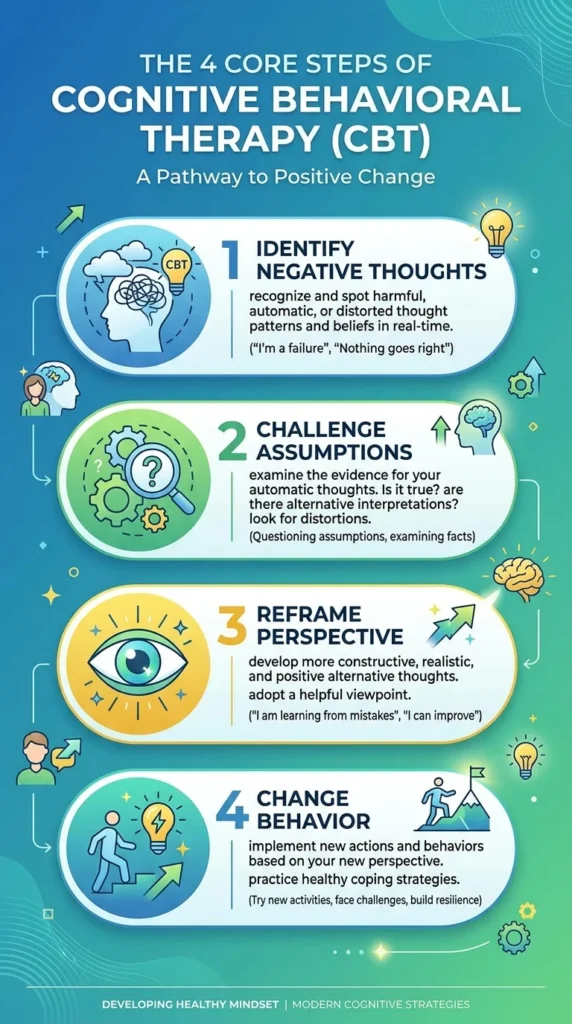
Understanding the theory is one thing. Knowing how CBT works session by session is what most people actually want. In practice, the work tends to move through three overlapping strands.
Spotting the Thought Behind the Feeling
Many of our reactions happen fast. A wave of anxiety arrives before we have consciously “thought” anything. Early in CBT therapy, you learn to slow these moments down and catch the automatic thought underneath. Over time, people often notice familiar patterns, sometimes called thinking traps or cognitive distortions. A few common ones:
- Catastrophizing: jumping to the worst possible outcome.
- Mind reading: assuming you know what others think of you.
- All-or-nothing thinking: seeing things as total success or complete failure.
- Overgeneralizing: treating one setback as proof that things always go wrong.
Naming a pattern does not make it disappear, but it creates a little distance. “I’m a failure” becomes “I notice I’m thinking I’m a failure,” and that small shift opens room to respond differently.
Testing Thoughts Instead of Simply Believing Them
CBT is not about replacing negative thoughts with forced positive ones. Telling yourself “Everything is fine!” when it clearly is not rarely helps. Instead, the therapist and client work together almost like investigators. What is the evidence for this thought? What is the evidence against it? What would I say to a friend in the same situation? Is there a more balanced way of seeing this?
This process, often called cognitive restructuring, aims for thoughts that are accurate and useful rather than artificially cheerful. A balanced thought might be: “My presentation had weak moments, and parts of it went well. One presentation does not define my career.”
Changing What You Do: Behavioral Experiments and Gradual Exposure
Thoughts are only half of the picture. The “behavioral” part of cognitive behavioral therapy recognises that action is often the fastest route to new beliefs. If you believe something terrible will happen when you speak up in meetings, avoiding meetings keeps that belief untested. In CBT, you might design a small, manageable experiment: share one comment, then notice what actually happens.
For anxiety in particular, therapists may use gradual exposure, approaching feared situations step by step, at a pace agreed together, so that the nervous system learns those situations are more tolerable than expected. For low mood, behavioral activation is common: gently rebuilding activities that bring a sense of pleasure or achievement, because withdrawal tends to deepen depression.
What Happens in CBT Sessions?
People are often surprised by how organised CBT therapy feels compared with what they imagine from films. It is less about lying on a couch and talking freely for an hour, and more about working actively on agreed goals.
Structure, Goals and Between-Session Practice
The first sessions usually focus on understanding what brings you to therapy, how the difficulty shows up in your daily life, and what you would like to be different. Together, you and your therapist build a shared map (sometimes called a formulation) of how your thoughts, emotions, physical sensations and behaviors interact around the problem.
Later sessions often follow a recognisable rhythm: a short check-in, a review of anything practised since the last session, focused work on one issue, and agreement on something to try before next time. That between-session practice, sometimes called homework, is one of the distinctive features of CBT. It might be keeping a short thought record, trying a behavioral experiment, or practising a breathing or grounding skill. The point is that change happens in real life, not only in the therapy room.
If you would like a closer look at specific tools used for worry and nervousness, our guide to CBT techniques for managing anxiety walks through several of them in detail.
How Many Sessions Does CBT Usually Take?
CBT is generally considered a shorter-term therapy than many other approaches. The UK’s National Health Service, for example, describes a typical course as roughly 5 to 20 weekly sessions of around 30 to 60 minutes. In private practice the length varies with the person: a focused concern such as a specific fear may need fewer sessions, while long-standing patterns, several overlapping difficulties or a history of trauma usually call for more time. Progress is reviewed regularly, so you are never committing blindly to an open-ended process.
What Can CBT Help With?
One reason CBT is so widely recommended is the volume of research behind it. Clinical guidelines from the UK’s National Institute for Health and Care Excellence (NICE) recommend CBT-based approaches for depression and for a range of anxiety disorders, and a large 2012 review of meta-analyses by Hofmann and colleagues, published in Cognitive Therapy and Research, found particularly strong support for its use with anxiety-related problems. That said, research describes averages across many people. How well any therapy works for you depends on your situation, your goals and the therapeutic relationship.
Anxiety, Panic and Persistent Worry
Anxiety is where cognitive behavioral therapy is best known. It is commonly used for generalized worry, panic attacks, social anxiety, health anxiety and specific fears. The work often combines understanding the physical side of anxiety, challenging the predictions that fuel it, and reducing avoidance. If panic is your main concern, you may find our guide to managing panic attacks a useful companion read.
Low Mood and Depression
For depression, CBT typically focuses on the harsh, self-critical thinking that often accompanies low mood, and on rebuilding routine and meaningful activity step by step. It does not ask anyone to “just think positively.” Where depression is severe, CBT is often one part of a wider plan that may include medical support, which is why coordination with psychiatry can matter.
Stress, Burnout and Everyday Struggles
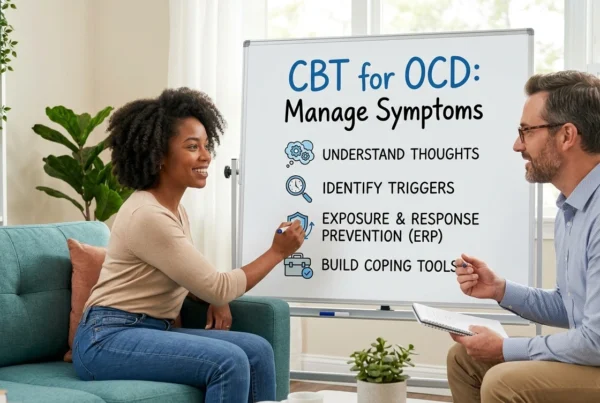
CBT is not only for diagnosed conditions. Many people use it for chronic stress, perfectionism, low self-esteem, sleep worries linked to anxiety, or burnout. It is also one of the main approaches used for obsessive-compulsive patterns, which we explain in our article on CBT for OCD, and for recovery after exhaustion, covered in CBT for burnout.
An Illustrative Example: CBT and Exam Anxiety
To make how CBT works more concrete, here is a composite example drawn from common patterns, not a real client. Picture a university student in Beirut, two weeks before finals. Every time she opens her notes, her chest tightens and a thought fires: “If I fail this exam, my whole future is ruined.” She closes the laptop, scrolls on her phone, then feels guilty, which makes the next study attempt even harder.
In CBT, the first step would be mapping that cycle: trigger (opening notes), thought (catastrophic prediction), emotion (panic, guilt), body (tight chest), behavior (avoidance), consequence (less preparation, more fear). Next, she would examine the thought. Has one exam ever decided everything? What options exist if a result disappoints? A more balanced version might be, “This exam matters, and I can prepare in manageable blocks. One grade is not my whole future.”
Then comes action. She might agree to study in 25-minute blocks with short breaks, and to notice what actually happens to her anxiety once she starts rather than when she imagines starting. Most people find anxiety peaks before the task and eases once they are engaged. That lived experience teaches more than any argument could. Exam pressure, performance blocks and learning-related stress are concerns Yusra regularly supports students with through her work in university student welfare.
What CBT Is Not: Common Misunderstandings
Because CBT is popular, it also attracts myths. A few worth clearing up.
It is not positive thinking. The aim is realistic, balanced thinking. Sometimes the honest conclusion is that a situation really is hard, and the work becomes about coping with it well.
It does not ignore your past. CBT focuses mostly on the present, but understanding how earlier experiences shaped your core beliefs is often part of the work, especially for long-standing patterns.
It is not a script you follow alone. Worksheets and apps can be helpful, yet the relationship with a trained therapist, who adapts the approach to you, is a large part of what makes therapy effective.
It is not cold or mechanical. Good cognitive behavioral therapy is warm, collaborative and paced to what you can manage. Structure exists to support you, not to rush you.
Is CBT Right for You?
Knowing what is CBT in theory helps, but the real question is whether it suits your needs. There is no universal answer, though some signs point in a helpful direction.
When CBT Tends to Be a Good Fit
CBT often works well for people who want practical tools, clear goals and a sense of measurable progress. If you can identify specific situations where you get stuck, such as panic in crowded places, endless worry at night, or procrastination driven by fear of failure, CBT gives you a structured way to work on them. A willingness to try things between sessions also helps, even if those steps are small at first.
When a Different or Combined Approach May Help
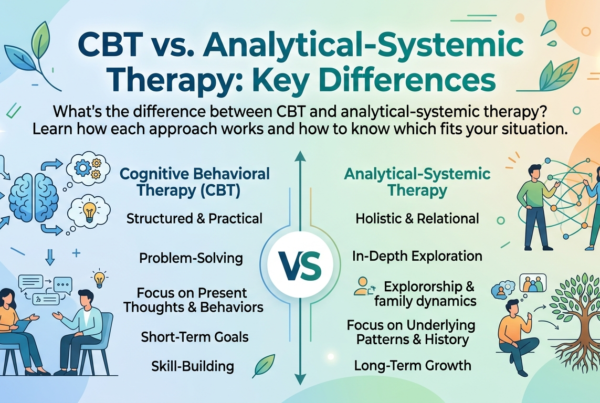
Some difficulties are rooted more deeply in relationship patterns, family history or repeated cycles that keep returning despite insight. In those cases, a purely skills-based approach may feel incomplete. Yusra’s practice integrates CBT with the analytical-systemic approach, which explores how family and relational patterns shape the present. If you are curious how the two compare, our article on CBT vs. analytical-systemic therapy explains the differences and when combining them makes sense.
CBT is also not a substitute for urgent care. If you are in crisis or worried about your immediate safety, please contact local emergency services or go to the nearest hospital straight away.
Finding CBT Therapy in Lebanon: What to Look For
If you are considering CBT therapy in Lebanon, a few practical checks make a real difference. First, look for formal training in cognitive behavioral therapy, not just general familiarity with its ideas. In Lebanon, the Lebanese Association for Cognitive and Behavioral Therapies (ALTCC) is one recognised source of CBT certification; Yusra holds her CBT certification from ALTCC. Second, ask how the therapist structures sessions, sets goals and reviews progress. A good CBT practitioner should be able to explain this clearly. Third, pay attention to how you feel in the first session. Feeling heard and respected matters as much as technique.
You can learn more about how Yusra uses cognitive behavioral therapy in Lebanon, including the concerns it is used for and what working together involves.
Frequently Asked Questions About CBT
CBT is most commonly used for anxiety-related problems, including generalized worry, panic attacks and social anxiety, as well as for depression and low mood. It is also widely used for stress, burnout, obsessive-compulsive patterns, perfectionism and self-esteem difficulties. A first consultation helps clarify whether it suits your particular concern.
CBT is a form of talk therapy, but a more structured one. Sessions usually have an agenda, work toward specific goals and include practice between sessions. Many other talking therapies are more open-ended and exploratory. Neither is “better” in general; the right choice depends on your needs and preferences.
Self-help resources based on CBT can be genuinely useful for mild difficulties or as a support alongside therapy. For persistent, intense or complex problems, working with a trained therapist is usually more effective, because they can tailor the approach, notice patterns you might miss and adjust the pace when things feel hard.
It varies from person to person. Some people notice small shifts, such as catching a thinking trap or feeling slightly less avoidant, within the first several sessions. Deeper, lasting change usually takes longer and depends on the difficulty, how long it has been present and the practice done between sessions. Your therapist should review progress with you regularly.
CBT principles can be applied to relationship difficulties, for example by looking at how partners interpret each other’s behavior. In Yusra’s practice, couples and family work draws on an integrative approach that combines practical tools with a systemic view of relationships. You can read more on the couples therapy and family therapy pages.
Taking the First Step With CBT
At its heart, the answer to what is CBT is surprisingly simple: a practical, evidence-based way to understand the patterns keeping you stuck and to build new responses, one manageable step at a time. It will not erase every difficult feeling, and it is not meant to. What it can offer is a clearer view of what is happening inside you and a set of skills you keep using long after therapy ends.
If you are wondering whether cognitive behavioral therapy could help with what you are facing, a first conversation is the easiest place to start. You can book a confidential consultation or reach out on WhatsApp to ask any questions before deciding.
About this article: This content is for general education and does not replace individual assessment or treatment. It was reviewed by Yusra Imad, Licensed Clinical Psychologist and CBT Psychotherapist, holding CBT certification from ALTCC. If you are in immediate danger or thinking of harming yourself, contact local emergency services or go to the nearest hospital.
Reviewed by Yusra Imad, Licensed Clinical Psychologist and CBT Psychotherapist