If an HR lead or business owner has decided to explore the possibility of taking their company to a corporate mental health workshop, they typically do so because of practical concerns rather than clinical ones. What will the employees be expected to do? Will anyone be called upon to give their responses? Is it a lecture, a group therapy session? There’s some degree of uncertainty that is reasonable as the term encompasses many different formats and a poorly orchestrated session can leave a team even more wary than when they began.
You will learn about workshops, the activities involved in a workshop, and how to determine if it is suitable for your organization.
The Corporate Mental Health Workshop is comprising thoughts and ideas.
The meeting is what we call a workshop, which involves a group meeting that is planned for by a mental health professional. It’s teaching and practical. It provides staff with the same background information on a subject like stress, burn-out, communication or emotional wellbeing and some tools to review later.
It is not therapy. It is not expected that anyone will share personal issues and no one will be diagnosed or treated in the room. It’s important to clearly communicate to staff that it’s not about “mental health” meaning that they will be asked to share personal information.
What is the difference between continuous support and this?
A workshop happens at a set time, for a set group, around a set topic. Ongoing confidential support for individual employees is a different service with a different purpose. Some organizations use both, and if that’s what your team needs, you can read about Caring For Your Whole Team.
What does a Session look like?
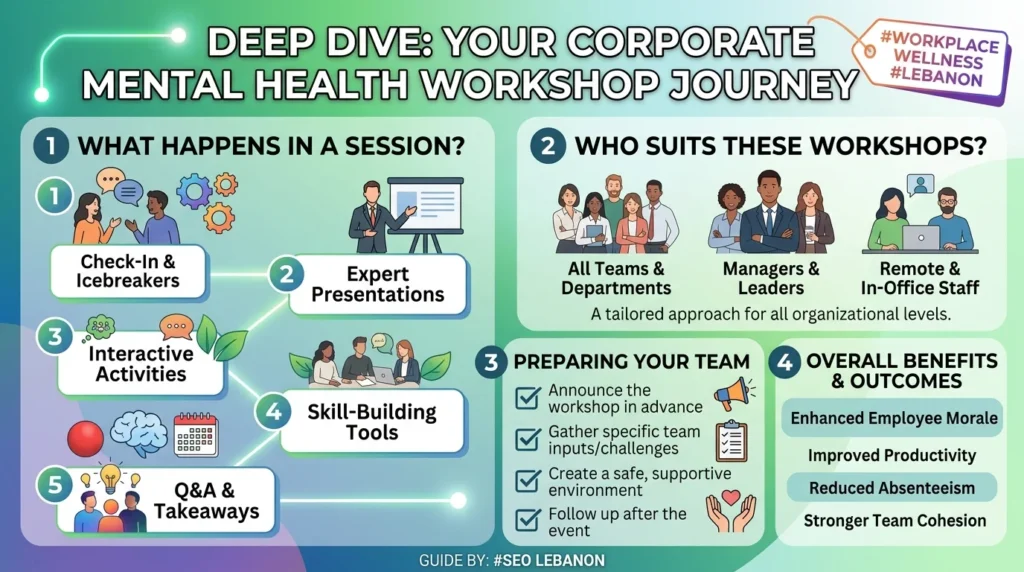
The format is varied, but is typically similar. They have a brief introductory line of the subject matter in simple words to make one common understanding for all to begin. A good facilitator takes the time to discuss what the idea means in day-to-day life, e.g., the ways in which stress accumulates during a busy quarter or a difficult working relationship with a fellow worker develops, before getting caught up in abstract definitions.
The second half (middle) of the session is usually more interactive. This could involve a guided discussion, short exercises, examples to consider, and room for questions. Participants interact usually in a voluntary and non-threatening manner; if people are not forced to participate they can do so in a more voluntary way.
Towards the end, emphasis shifts towards what people can learn: concrete practices, how to pick up on the early signs of one’s own and others’ behaviour, and what to do when others would help them on issues that cannot be covered by a workshop.
Why the Atmosphere Matters?
The tone a facilitator sets is a key factor as to whether a workshop is useful or not. If your employee feels that his manager is judging him or watching him, he will say little. When sessions are conducted in a safe space, when participants are invited to participate, when the subject matter is respected, and participants bring different levels of comfort, the best results are achieved.
Topics Workshops Commonly Cover: The topics covered in Workshops are listed below.
The topic is typically based on the organization’s current situation. Typical areas include:
- Recognising what causes stress and how it accumulates in the workplace.
- Identifying signs and symptoms of burnout
- Being able to communicate during pressure and deal with conflict situations.
- Creating more healthy separation of work and home life.
- Assisting colleagues who could be experiencing problems
The choice of topic will depend on your team. A burn-out workshop will have a different impact on a team that has just endured a stressful year, as opposed to an established but unconnected team. Before deciding on a topic, discuss with the provider what is going on in your organization and what you would like the session to focus on.
Who Benefits Most?
Workshops are likely to be effective where you wish to raise greater general awareness in a group, where you want to open up a dialogue around wellbeing, where you want managers to gain a deeper understanding of what their teams are experiencing or where your organisation is experiencing a particular strain, for example after restructures, an important season or a period of unusual difficulty.
They are not as well equipped to address the needs of specific people for personal assistance. A group session is not a substitute for confidential one-to-one assistance and those organisations that regard a group session as such are often disappointed.
What a Workshop Can & Can’t Do?
A well managed session may help to: improve understanding, lower stigma around talking with someone about their mental health, and provide language and actionable skills. It may also help managers to be more mindful about their response to an individual struggling.
It can’t alter stress-inducing conditions. If workloads are too heavy or they’ve got their issues from poor leadership, a workshop will not solve it by itself. The most successful outcomes are experienced by combining training with frank consideration of the organisation of work.
Preparing Your Team
There are certain steps which make a difference. Explain in straightforward, understandable language what the session will be about and what it will not be about in order to reduce anxiety on the part of employees about the sharing process. Encourage attendance as a voluntary option in the organisation – if possible, or at least encourage it as an option. Select an “okay” timeframe that is not conflicting with a due date. Invite leadership to participate and engage, as people mimic actions of the leader.
To see how these sessions are structured for organizations, visit the Corporate Workshops page.
Frequently Asked Questions
This varies with the subject and the medium. Some sessions are brief and concentrated, others may be longer, or may be delivered at different sessions. The length of the right is determined with the provider according to the size of the team and objectives of the team.
No. The workshop is educational and participation in the discussion is optional. The staff members are able to hear, reflect on what they hear privately and take from it what they can without revealing themselves.
Most will tailor content to the audience – it is worth enquiring how this is done. A session that is based on real-life pressure on your team is likely to be more beneficial than one based on pressure in general.
A single session may help to raise awareness and provide the person with useful tools but change is likely to be more successful if reinforced. Others plan to follow up or run workshops in conjunction with other types of support.
This sometimes happens, and a good session prepares for it by explaining where to turn for support. Having a clear route to confidential professional help, such as an ongoing support service or an individual referral, makes the workshop far more effective.
Take the Next Step
If you’re thinking about bringing mental health training to your workplace, a short conversation about your team’s needs is the best place to start.
Book a Consultation to discuss corporate mental health workshops with Yusra Imad, or read more on the Corporate Workshops page.