


When ADHD is diagnosed in grown-ups, it frequently shows up in a very different way than it does in children — the ADHD stereotype being a hyperactive kid bouncing off the walls. As an adult, it can manifest as an inability to complete tasks, poor organizational skills, lack of concentration on tasks not of particular interest, or an inability to follow through. It’s easy to see how many adults with ADHD spent years thinking that this was laziness, lack of discipline, or that they were just bad at being an adult.
This article looks at the common signs that prompt adults to seek an ADHD assessment, what the evaluation process actually involves, and what tends to happen once it’s complete.
Why Adult ADHD may be overlooked?
People are often diagnosed with ADHD in childhood, and many others may not be diagnosed until they are adults, perhaps because their symptoms did not pose a significant problem in the school environment, or perhaps because they learned to cope with them in childhood but not as an adult, such as having to deal with deadlines at work, household responsibilities, and several competing demands at once.
This delay allows many adults to tinker with patterns they don’t completely understand for many years, while thinking that the patterns are a personal or moral deficiency, when in fact they are an obvious and measurable pattern.
It’s Not Just About Attention
One thing that many people believe is that being inattentive is the only issue with ADHD. In reality, sometimes it takes the form of challenges with attention in both directions, that is, focusing on the task that demands sustained attention, but also sometimes hyperfocusing on personally interesting things. Executive functioning, in general (planning, organizing, time management, emotional regulation) is also often impaired, which is why ADHD in adults can be very different from one adult to another.
Common Signs in Adults
There are some patterns that are found often with adults who are thinking about an evaluation:
- Persistent trouble organizing tasks, time or possessions, while trying to do so.
- A tendency to begin tasks with excitement but end up not completing them.
- Often forgets meetings, deadlines, or obligations
- Trouble staying focused on tasks that are not interesting to them
- Restlessness and/or inability to relax even in the down time.
If they are more widespread and have been a pattern over time, rather than having developed in one context or the other, they are more likely to be related to ADHD rather than simply a period of disorganization or stress.
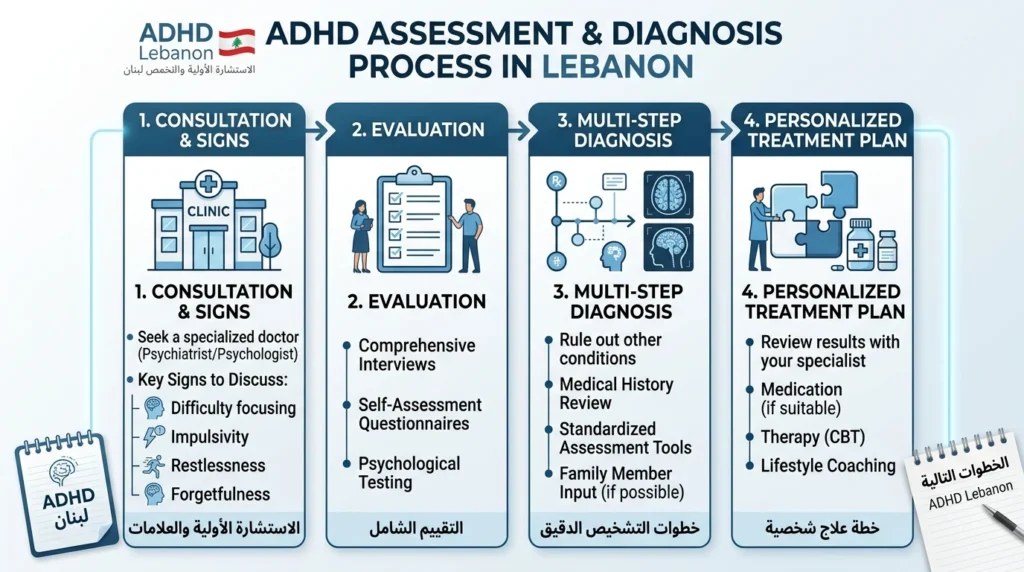
What is the Assessment Process?
An adult ADHD assessment usually starts with a detailed clinical interview which assesses present symptoms and development and documents how these manifest themselves in various contexts and periods of life — ADHD, by definition, occurs since childhood, even if not recognized at the time.
This typically is aided by a set of standardized rating scales and, if applicable, tasks that include structured items to evaluate attention and executive functioning more objectively than self-reported. Since the symptoms may overlap with other disorders, such as anxiety and depression, the assessment must also rule out these alternative and/or co-occurring causes and not conclude ADHD without first considering them.
What Happens After the Assessment?
After testing, the psychologist uses the information to determine if the identified challenges are most likely due to the ADHD or if there is another explanation for them, or if there is a combination of factors. This is discussed in a feedback session, which is usually followed by a written feedback report.
These recommendations for the next steps in the process are usually included in the report/discussion, and may include specific therapies, accommodations, and/or, if appropriate, working with a psychiatrist about medication as part of a broader strategy – a choice that is not automatic.
Why the proper assessment is important?
There has been a rise in the number of people who use social media to fill in checklists or do informal quizzes and diagnose themselves with ADHD, but this is not a replacement for the appropriate evaluation. Many of the characteristics of ADHD are the same characteristics of anxiety/depression and just extended stress — disorganization, procrastination, restlessness — and treating the wrong condition doesn’t usually help. There is an assessment process that is structured to clearly differentiate between these possibilities that is more confident than self-assessment.
If several of the patterns described here sound familiar, the Psychological Assessment & Diagnosis service outlines how this evaluation process works.
Frequently Asked Questions
Yes. Many adults are diagnosed and assessed for the first time when they are older and maybe their symptoms worsened in adulthood or they hadn’t been recognized or assessed when they were younger.
The pattern established from childhood, much of the assessment, is more likely to be based on self-report and retrospective history in adult assessments, whereas for children, current assessments by the teacher and parent are more likely to be used.
Not necessarily. There are many people who may get disorganized, forgetful, or restless occasionally, but not to the extent that they have a persistent, pervasive pattern that impairs functioning, as would be diagnosed with ADHD. Only a proper assessment can be used to differentiate the two (a proper assessment is the only reliable way).
Not automatically. Other individuals are able to control ADHD symptoms with therapy and accommodations without medications, and others may use medication as a comprehensive treatment strategy in combination with therapy and accommodations, which are always provided by a psychiatrist. It is a judgment based upon personal factors and is not an automatic result of the assessment.
This depends on the complexity of the presentation, the number of areas that are assessed, as well as the time frame required for scheduling and interpreting results, but this entire process (from the initial interview to the testing and feedback) can take weeks.
Take the Next Step
If these patterns have followed you for years without a clear explanation, an assessment can offer real clarity about what’s actually going on.
Book a Consultation to discuss an adult ADHD assessment with Yusra Imad, or learn more on the Psychological Assessment & Diagnosis page.