


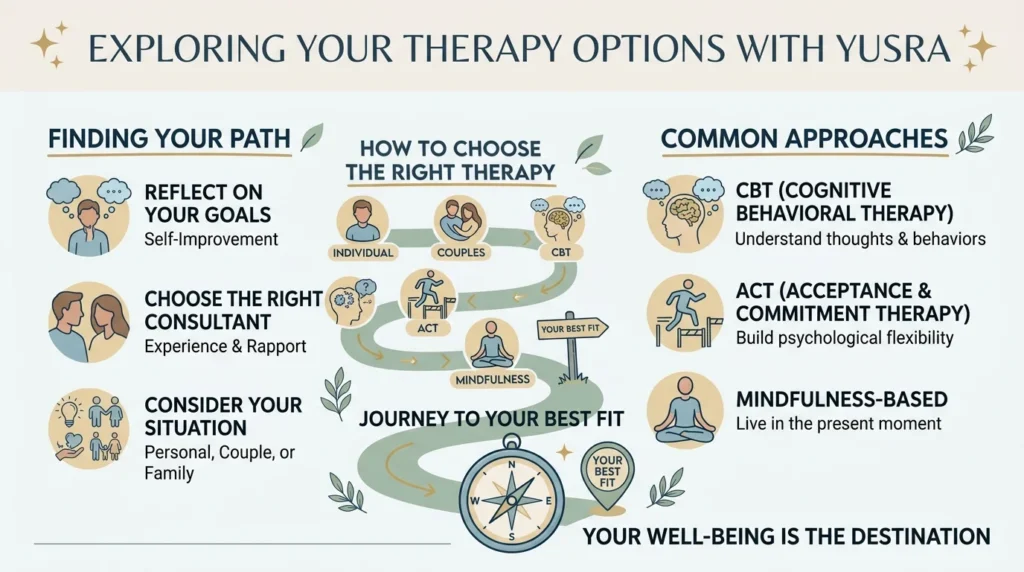
Therapy isn’t simply one thing. Once you step through the different methods available it can begin to seem like deciding between options with no method of contrasting. CBT, family therapy, couples work, evaluating, and an integrative approach. The majority of individuals don’t know in the first spot which of them is pertinent to them, and that’s not your problem. It’s just not facts that many people could have learnt earlier in their lives.
This guide explains the different kinds of supportive treatment and the kinds to which each might be better suited, and what to consider if you’re uncertain where to begin.
It says ‘Begin with the question, not the method’.
Rather than “which therapy type” it is important to start with “what is actually going on.” Worries or sadness that keeps you from getting along in life? A marriage or family interactions that continually experience the same conflicts? Someone who’s looking for attention, focus or emotion, but it’s never been addressed properly? Often what the concern indicates is the correct type of support rather than researching therapy modalities in general.
It’s Fine Not to Know Yet
Many rationalize into therapy without an overt diagnosis and with no particular label to go with the need. It’s a valid one to begin with. Part of an initial consultation is to assist you in differentiating and understanding what is going on and which way works — you don’t have to come prepared with a diagnosis!
Individual Psychotherapy
Individual psychotherapy is generally the right fit when the concern is primarily personal — anxiety, low mood, stress, self-esteem, difficulty processing a life transition, or patterns you want to understand and change on your own terms. This is usually where people start when the difficulty doesn’t center on a specific relationship or require formal testing.
Cognitive Behavioral Therapy (CBT)
CBT is a structured, evidence-based approach particularly suited to anxiety, panic, and specific patterns of unhelpful thinking that keep a difficulty in place. It tends to work well for people who want a fairly direct, skills-based approach to managing symptoms alongside understanding them.
Couples Therapy
Couples therapy is the right direction when the difficulty centers on the relationship itself — communication breakdowns, recurring conflict, emotional distance, or trust that’s been damaged. This is distinct from individual therapy in that both partners are typically involved in the work together.
Family Therapy
Family therapy applies when the concern involves the broader family system — conflict between family members, communication difficulties, or challenges related to a specific transition affecting the whole household, such as separation or a teenager’s changing needs.
Psychological Assessment
A psychological assessment is appropriate when the goal is clarity rather than ongoing therapy in itself — for example, understanding whether attention difficulties reflect ADHD, or getting a clearer picture of cognitive or emotional functioning before deciding on next steps.
The Analytical-Systemic Approach
For people who find that recurring patterns — in relationships, self-worth, or emotional responses — trace back further than a single current stressor, the analytical-systemic approach offers a way of working through those deeper, longer-standing patterns rather than addressing symptoms in isolation.
Addiction-Focused Therapy
Where substance use or behavioral patterns are part of the picture, integrated therapy for addiction addresses these concerns directly, often alongside the individual and family dynamics that connect to them.
You Can Compare Two Approaches Directly
Those comparisons are addressed in greater detail separately, but those are considerations for two couples interested in exploring the possibility of CBT compared to the analytical-systemic approach; or one or a couple interested in the possibility of couples therapy and exploring individual therapy first, rather than a quick overview of the choice.
If You’re Still Unsure
The best way to determine an appropriate “base” is a discussion with the psychologist personally. A consultation is where you should start, and the point of an initial consultation is to explain what you’re seeing, and get professional guidance on where to start.
Frequently Asked Questions
This is very normal, and not a concern. Many concerns are intertwined—anxiety and strained relationships, for instance—and a psychologist might be able to find out what to start with, as well as consider whether a combination is more appropriate as it goes.
Yes. You don’t have to commit to a single approach and abandon others. If it becomes apparent that a different support type is more appropriate that is only natural, if it did not go well by all means.
In most cases, no, although it is generally a good option to follow up one-on-one therapy, couples therapy, family therapy or a preliminary assessment with an option to begin therapy without being referred by a healthcare provider.
After a few sessions most people have a fairly good idea after the therapist starts getting a better idea of what your situation is; the therapist will either say it’s the right route to take or if not he or she will suggest making changes.
Very much so. Very few people have had prior experience with therapy to go by, and it is this uncertainty that helps make a first conversation worthwhile: not something that you do solo but one that you do together.
Take the Next Step
If you’re still weighing your options, that’s exactly what an initial conversation is for.
Book a Consultation to talk with Yusra Imad about which approach fits your situation, or explore the full range of services to learn more about each one.