
When a person begins to consider what treatment is available for burnout, typically they have not had enough rest. It helped for a few days when she went on a vacation. There was a brief respite from the exhaustion this week as the lighter week began, but it then returned. Cognitive behavioral therapy is often going to be the next step — not a substitute for sleep, but a tool to work through the patterns that led to the burnout in the first place.
This article examines the following aspects of CBT approaches to burnout: What does this work entail and what can it practically provide?
Why is CBT relevant to burnout?
Burnout isn’t all about workload. It’s also influenced by an individual’s mindset regarding their responsibilities, their limits, and their own value when compared with output, such as the idea that they must take it for granted to rest, that to refuse to say no is a sign of lack of self-esteem, or that slowing down is a sign of falling further behind forever. Thought patterns can keep people going beyond the point where their body and mind are saying, “stop!”.
CBT helps by identifying these patterns directly, and looking at the accuracy or if it is just a habit. It’s not rejecting the reality of the external stressors to burnout – demanding work and environment, real overload – but it does acknowledge the internal patterns that make that more difficult to handle or get away from.
CBT doesn’t overlook the outside factors
Many people think that CBT is simply about mental attitudes and that if you change your thinking you will have improved. That’s not accurate. Effective CBT treatment for burnout acknowledges and helps a person understand the circumstances outside of their control (e.g., too many hours to work, unclear expectations, lack of support) as well as the internal patterns that may be contributing to the stress (e.g., having a more negative or positive outlook, taking on more or less responsibility).
The typical CBT for Burnout treatment steps.
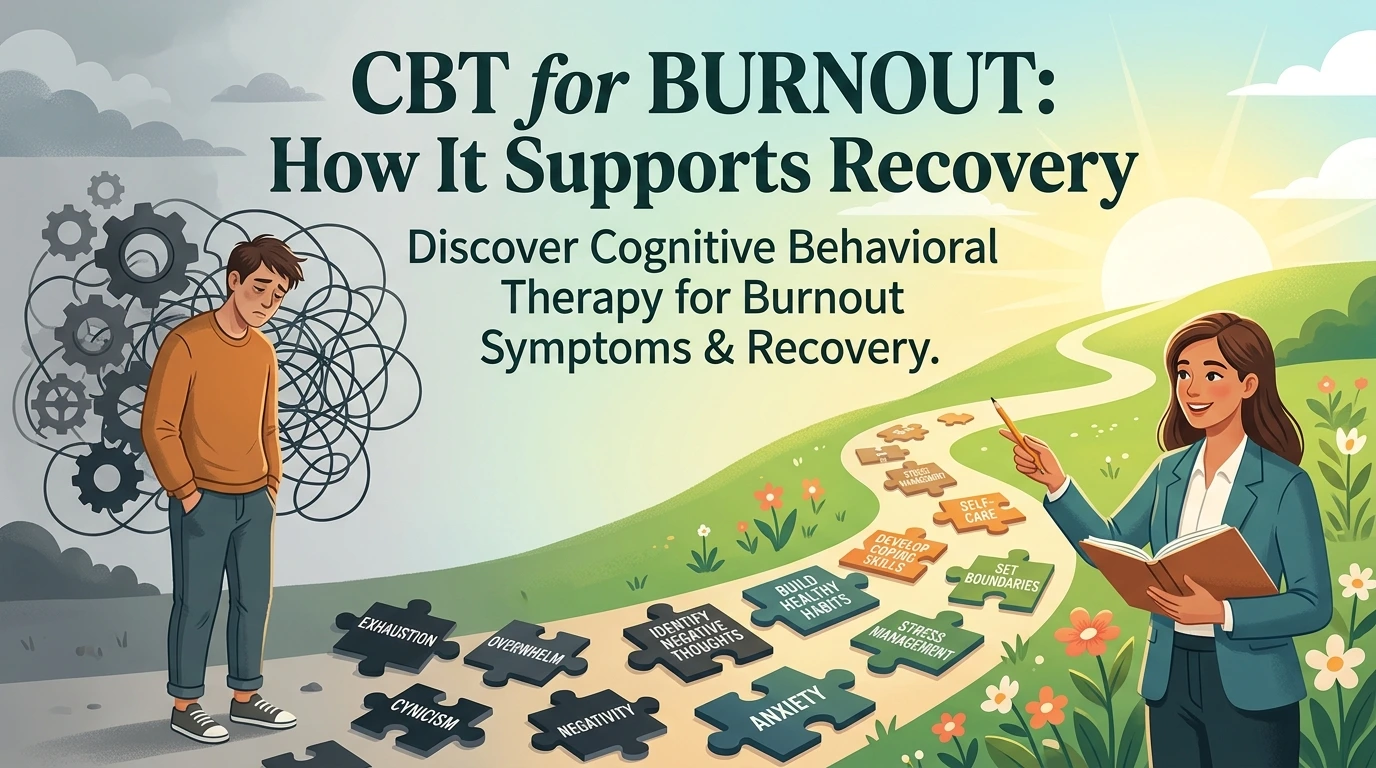
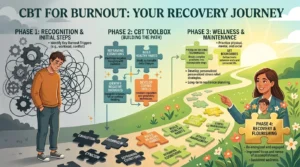
Sessions typically begin by outlining the unique stressors that are causing a person’s burnout and examining the thoughts and behaviors that have formed around those stressors. This then involves exploring beliefs around rest, boundaries, and productivity that may be contributing to unsustainable behaviours, cultivating more realistic and flexible thinking about workload and limits, and establishing practical strategies for setting boundaries without the guilt or anxiety that often comes with it for people who tend to burn out.
It typically includes behavioral components as well: changes in routine, recovery and daily work/rest balance, and not what is left over once everything has been done.
What Recovery Through CBT Can Be Like?
Burnout CBT tends to be a gradual process, so it is important to understand that it will take time. Early sessions may be more about stabilisation – getting some sort of baseline recovery back before addressing deeper patterns. From there, the focus starts to turn to problem solving the beliefs and habits that led to the burnout in the first place (and now, it is less likely that the same process will automatically be reconstructed as things get busy again).
This is one of the difference between CBT for burn-out and simply taking time off – It isn’t just about feeling better in the short term but about changing the pattern that caused the depletion.
Is the CBT a suitable method for your burnout?
CBT is especially effective when these thoughts are directly linked to burnout, such as perfectionism, setting boundaries, not resting without guilt, or chronic over commitment. If the burnout is more related to a short-term situation that is not sustainable, it is typically necessary to treat the situation along with the therapy.
The combination that works for you may be different from one person to another, and a psychologist can help you determine which one is applicable in your situation through a discussion.
If workplace burnout is affecting your team more broadly rather than being an individual concern, corporate mental health workshops can address these patterns at an organizational level.
For individual support, the CBT service page outlines how this approach is applied more broadly across different concerns, including burnout.
CBT for Burnout: How It Supports Recovery
Frequently Asked Questions
On average, how many CBT sessions is it expected to take to treat burnout?
There is no set number — it depends on the duration of the burnout, and on how ingrained are the underlying patterns. For some, it can take a few sessions for them to make meaningful changes, and deeper patterns can take longer. After an initial assessment, a therapist can provide a more accurate estimate.
If my job hasn’t changed is CBT a viable option for burnout?
Yes, but it helps best if there is some reality to the situation in the outside world, if at all possible. CBT can also enable you to deal with the internal patterns of guilt around rest, difficulty setting limits etc. that make an unsustainable workload more difficult to cope with, even if the workload itself takes time to work on separately.
What is the difference between CBT for anxiety or depression and CBT for burnout?
The techniques used are similar but the emphasis is diverse because CBT is a flexible therapy. When it comes to burnout, the focus tends to be on beliefs around productivity, rest, and boundaries, and establishing sustainable habits. For anxiety or depression, the focus changes to other thought patterns, and there are other triggers that occur in anxiety and depression.
Does CBT for burnout involve just relaxation techniques?
No. While relaxation techniques may be a part of the management plan, the main focus of CBT for burnout is to address the thought patterns and habits that led to the depletion in the first place.
How can I tell if I need CBT, or if I just need some time off?
If you’ve only taken a break, or vacation, and then the burnout sets in again, it’s a good indication that you need more direct attention to the patterns than vacation and rest can offer. Talking to a psychologist will assist you determine which is best for you – CBT or otherwise.
Take the Next Step
A recurring burnout situation is often more than just a matter of a vacation. If you are able to directly tackle the patterns, recovery is more likely to be lasting.
Book a Consultation or reach out on WhatsApp to talk with Yusra Imad about CBT for burnout, or explore the CBT service page to learn more about the approach.