
Two people say “I struggle with anxiety.” One lies awake running through a dozen possible disasters: money, health, family, work. The other feels fine at home but dreads every meeting, phone call and dinner invitation, sure that others will judge them. Both are describing anxiety, yet their inner experiences are very different. Understanding generalized anxiety vs social anxiety helps you name what you are living with, explain it to the people around you, and find the kind of support that fits.
This guide walks through what each looks like, where they differ and overlap, and how therapy approaches them. It is meant to inform, not to diagnose; only a qualified professional can assess your situation properly.
Generalized Anxiety vs Social Anxiety: The Short Answer
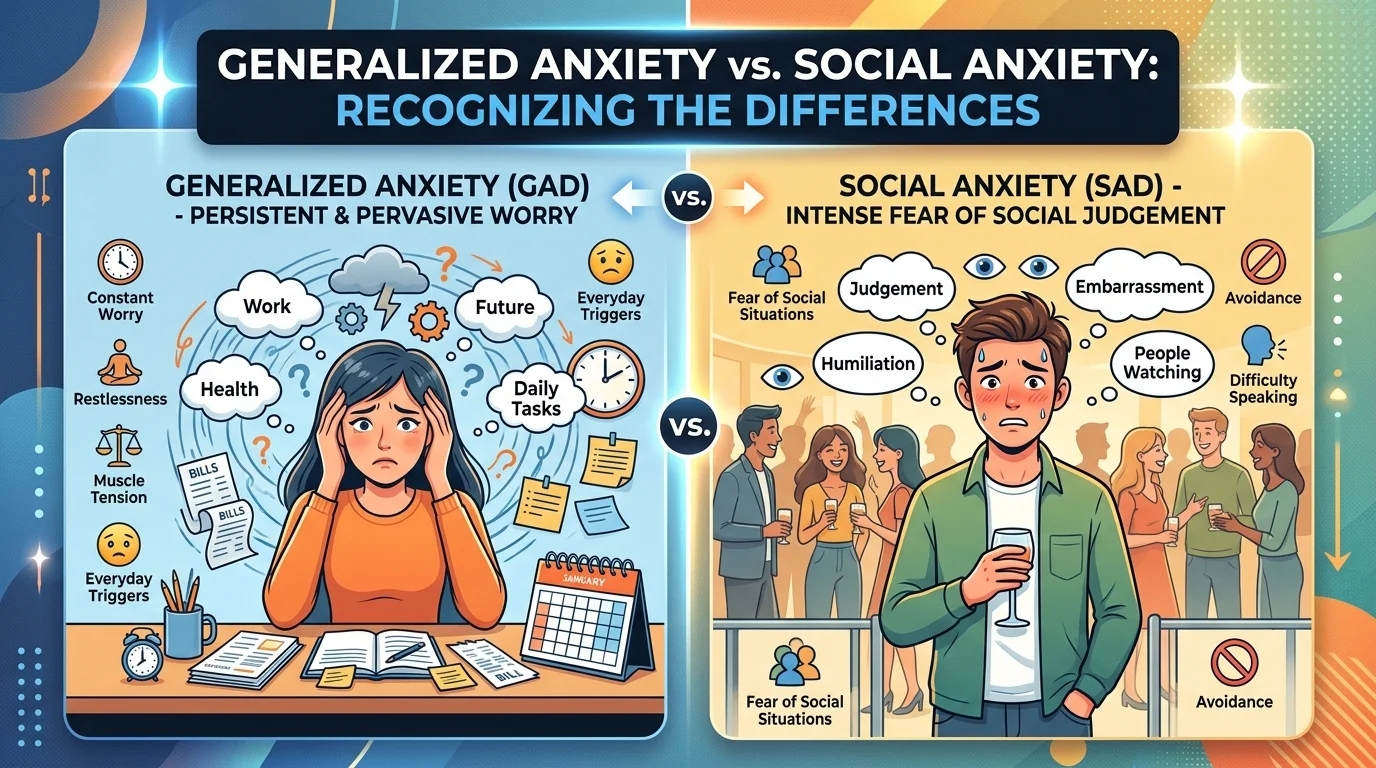
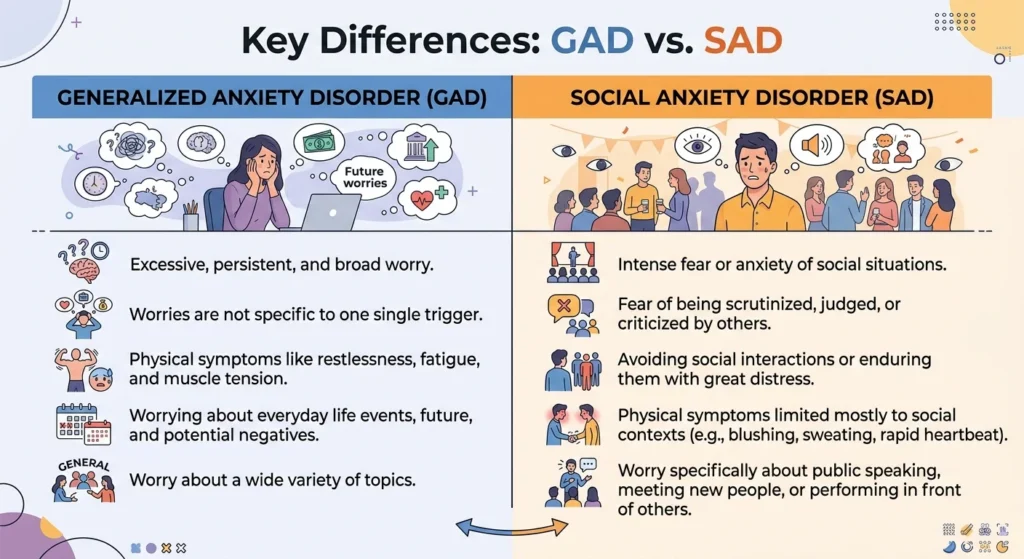
The clearest difference lies in what the fear is about. Generalized anxiety involves excessive, hard-to-control worry about many different areas of life, such as health, finances, family, work and the future. Social anxiety centres on one specific fear: being watched, judged, embarrassed or rejected by other people.
Put simply, generalized anxiety asks “What if something goes wrong?” about almost everything. Social anxiety asks “What will they think of me?” in situations involving other people. Both are recognised conditions in the Diagnostic and Statistical Manual of Mental Disorders (DSM-5): generalized anxiety disorder (GAD) and social anxiety disorder (sometimes called social phobia). Both are also among the most common types of anxiety that bring people to therapy.
What Is Generalized Anxiety?
Generalized anxiety is more than being a “natural worrier.” In generalized anxiety disorder, worry is excessive, persistent and difficult to switch off. According to the DSM-5, it occurs more days than not over at least six months and is accompanied by physical and mental symptoms that interfere with daily life. The worry often jumps from topic to topic: when one concern is resolved, another quickly takes its place.
Generalized Anxiety Symptoms
Common generalized anxiety symptoms include a near-constant sense of worry or dread, along with several physical and mental signs:
- Restlessness or feeling keyed up and on edge.
- Tiring easily and feeling mentally drained.
- Difficulty concentrating, or the mind going blank.
- Irritability, muscle tension and disturbed sleep.
What Worry Feels Like From the Inside?
People with generalized anxiety often say their mind feels like a browser with too many tabs open. They may know their worries are out of proportion, yet they cannot stop. Many also hold quiet beliefs about worry itself, for example that worrying helps them prepare, prevents bad outcomes or proves they care. Those beliefs make worry hard to let go of, because it feels useful even while it exhausts them.
What Is Social Anxiety?
Social anxiety is an intense, persistent fear of social or performance situations where you might be observed or evaluated. The core fear is acting in a way, or showing anxiety symptoms, that will lead to embarrassment, humiliation or rejection. As with generalized anxiety, the DSM-5 typically looks for a pattern lasting six months or more that causes real distress or gets in the way of work, study or relationships.
Social Anxiety Symptoms
Typical social anxiety symptoms include dreading social events days or weeks in advance, intense self-consciousness during interactions, and replaying conversations afterward looking for mistakes. Physical signs often include blushing, sweating, trembling, a shaky voice, a racing heart or feeling sick. People may avoid eye contact, speak very little, or skip situations entirely. Common triggers include meeting new people, speaking in meetings, presenting, eating in front of others, making phone calls and dating.
More Than Shyness
Shyness is a personality trait, and many shy people live comfortable, connected lives. Social anxiety is different in intensity and impact. It can lead someone to turn down promotions, drop out of classes, avoid friendships or feel painfully alone, even while wanting connection. Recognising this difference matters, because social anxiety is often dismissed as “just being shy” and left without support for years.
The Key Differences Between Generalized and Social Anxiety
When comparing generalized anxiety vs social anxiety, four questions usually clarify which pattern fits best.
What Is the Fear About?
Generalized anxiety spreads across many life areas. Social anxiety focuses on how you come across to others and the fear of negative judgment. Someone with generalized anxiety might worry about a meeting because the project could fail; someone with social anxiety worries about the meeting because they might say something foolish in front of colleagues.
When Does It Show Up?
Generalized anxiety is usually present much of the time, in the background of daily life, often worse at night or during quiet moments. Social anxiety tends to spike before, during and after social situations, and may ease considerably when someone is alone or with a few trusted people.
What Keeps It Going?
Research-based psychological models describe different maintaining factors. In generalized anxiety, difficulty tolerating uncertainty and the habit of using worry as a coping strategy play a major role. In social anxiety, an influential cognitive model developed by psychologists David Clark and Adrian Wells highlights two processes: intense self-focused attention during interactions (monitoring how you look and sound) and “safety behaviors,” such as rehearsing sentences, avoiding eye contact or holding a drink to hide shaking hands. These behaviors feel protective but prevent you from discovering that the feared judgment rarely happens.
What Does Avoidance Look Like?
Both forms of anxiety involve avoidance, but it looks different. With generalized anxiety, avoidance may mean procrastinating on decisions, seeking constant reassurance or over-preparing. With social anxiety, it usually means avoiding people, events and situations where you might be evaluated, or attending but staying invisible.
Where Generalized and Social Anxiety Overlap
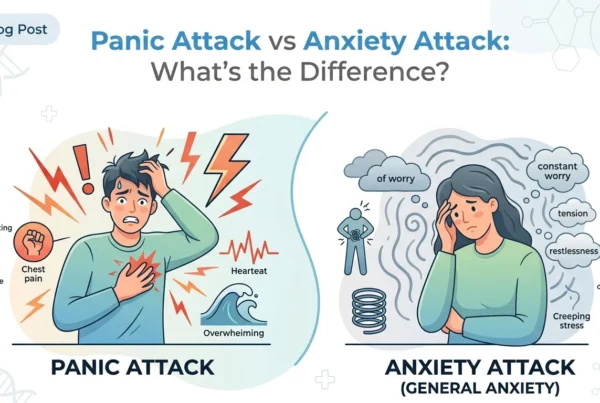
The two are not mutually exclusive. Many people experience features of both, and anxiety conditions frequently occur alongside each other and alongside low mood. Both can also include panic attacks, for example a sudden surge of fear during a presentation or in the middle of a sleepless night of worry. If sudden waves of fear are part of your experience, our article on panic attack vs anxiety attack explains how to tell those episodes apart.
Because of this overlap, self-labelling has limits. A careful assessment looks at your whole pattern rather than forcing it into one box, and the treatment plan follows that understanding.
Two Illustrative Scenarios
The examples below are composites based on common patterns, not real clients.
Nadine, 41, works in finance and has two children. She describes herself as “always switched on.” Before bed, her mind runs through her father’s health, school fees, a comment from her manager, the car’s strange noise and whether she locked the door. She checks news and messages repeatedly, feels tense in her shoulders most days and struggles to fall asleep. Social situations are not the problem; in fact, she enjoys seeing friends. Her pattern fits generalized anxiety.
Karim, 20, is a university student who performs well in written exams but has not spoken once in class this semester. Before seminars, he rehearses what he might say, then stays silent anyway. He eats lunch alone to avoid awkward conversation and turned down a part-time job that involved customer contact. At home with family, he feels relaxed. His pattern fits social anxiety. Students in situations like Karim’s are something Yusra regularly encounters through her work in university student welfare.
How Other Types of Anxiety Fit In
Generalized and social anxiety are two of several recognised types of anxiety. Others include panic disorder, specific phobias (intense fear of particular things such as flying or heights), agoraphobia, and health anxiety. Obsessive-compulsive patterns, once grouped with anxiety disorders, are now classified separately in the DSM-5, though anxiety is often central to them; our article on CBT for OCD explains that pattern. Each type has its own focus, which is why the same general advice does not suit everyone with anxiety.
How Therapy Helps Each Type of Anxiety
Cognitive behavioral therapy is one of the most widely recommended treatments for both conditions. Clinical guidelines from the UK’s National Institute for Health and Care Excellence (NICE) recommend CBT for generalized anxiety disorder and specifically recommend individual CBT for social anxiety disorder. The broad approach is similar, but the focus changes.
For generalized anxiety, therapy often explores your beliefs about worry, builds tolerance for uncertainty, and practises strategies such as setting aside a specific “worry time” so that worry stops filling the whole day. It also works on problem-solving for real concerns and letting go of hypothetical ones.
For social anxiety, therapy commonly involves shifting attention outward rather than monitoring yourself, gradually dropping safety behaviors, and testing feared predictions through planned experiments, such as asking one question in a meeting and noticing what actually happens. Some therapists use role-play or video feedback, because people with social anxiety often discover they look far calmer than they feel.
You can learn more about this approach on our page on CBT therapy in Lebanon. When anxiety is tied to relationship patterns, family dynamics or long-standing beliefs about yourself, broader individual psychotherapy that combines CBT with an analytical-systemic lens can address those deeper layers too.
When Worry Meets Real Uncertainty?
Living in Lebanon involves real uncertainty for many people, whether economic, practical or about the future. It is worth separating realistic concern from excessive worry. Concern about real problems is a natural response and can lead to useful action. Generalized anxiety becomes a concern when worry is constant, spreads to areas with little actual risk, and keeps going long after any helpful planning is done. Therapy does not ask you to pretend difficult circumstances are fine; it helps you respond to them without being consumed by them.
When to Seek Support?
Consider speaking to a psychologist if anxiety has lasted for months, if it is hard to control, or if it is affecting your sleep, work, studies, relationships or ability to enjoy life. The same applies if you are avoiding situations you would genuinely like to take part in. You do not need to know which type of anxiety you have before reaching out. Clarifying that is part of what a first consultation is for.
Frequently Asked Questions
Yes. It is common for anxiety conditions to occur together. A psychologist will look at your full pattern, rather than a single label, to understand what drives your anxiety and plan treatment accordingly.
No. Introversion is a personality preference for quieter settings and time alone to recharge. Social anxiety involves fear and distress about being judged. An introvert can feel comfortable socially when they choose to engage, while someone with social anxiety may want connection but feel blocked by fear.
Early signs often include worry that feels harder to switch off, trouble falling asleep because of racing thoughts, feeling tense or restless, irritability and difficulty concentrating. Many people notice they worry about several unrelated things in quick succession.
For some people symptoms ease over time, but social anxiety often persists for years when left unaddressed, partly because avoidance prevents people from learning that their fears are exaggerated. Structured therapy can shorten that process considerably.
Both respond well to evidence-based therapy such as CBT, and progress depends more on the individual, the severity and how long the pattern has been present than on the label itself. A tailored plan matters more than the category.
Finding the Right Support for Your Anxiety
The difference between generalized anxiety vs social anxiety comes down to what your mind is guarding against: an endless list of possible problems, or the judgment of other people. Understanding your pattern takes away some of its power and points toward support that fits, rather than generic advice that misses the mark.
If anxiety is shaping your days, a conversation with a psychologist can help you make sense of it and plan next steps. Explore cognitive behavioral therapy in Lebanon, book a confidential consultation, or send a message on WhatsApp with any questions.
About this article: This content is for general education and does not diagnose or replace individual assessment or treatment. It was reviewed by Yusra Imad, Licensed Clinical Psychologist and CBT Psychotherapist, holding CBT certification from ALTCC. If you are in immediate danger or thinking of harming yourself, contact local emergency services or go to the nearest hospital.
Reviewed by Yusra Imad, Licensed Clinical Psychologist and CBT Psychotherapist