

Most people don’t wake up one morning and decide to see a psychologist in Lebanon. It happens slowly. A few months of sleeping badly. A short temper that surprises you. A heaviness that doesn’t lift after the weekend, the holiday, or the vacation you were sure would fix everything. Then one evening you type the words into a search bar and realize you have no idea where to begin.
This guide is for that moment. Whether you’re searching for yourself, a partner, a parent, or a teenager, you’ll find a clear picture of what a psychologist in Lebanon actually does, how therapy differs from psychiatry, what a first session feels like, and how to choose someone you can genuinely talk to. No jargon, no pressure, just the practical information I wish more people had before booking that first appointment.
Why So Many People in Lebanon Are Looking for a Psychologist?
Lebanon has asked a great deal of its people over the past several years: an economic collapse, the Beirut port explosion in 2020, repeated political shocks, and the strain of war and displacement. Add the ordinary pressures of work, family, and migration (nearly every Lebanese family has someone living abroad), and it makes sense that mental health support in Lebanon has moved from a whispered topic to a daily conversation.
The numbers back this up. The World Health Organization estimates that roughly one in eight people worldwide lives with a mental health condition, and Lebanese national research led by Dr. Elie Karam and colleagues has found that around one in four adults in the country experiences a mental disorder at some point in life. Those figures are only part of the story, though. Many more people live with stress, grief, or exhaustion that doesn’t meet a diagnostic threshold but still deserves care.
The stigma hasn’t vanished, but it has softened. Younger adults in Beirut, Jounieh, Tripoli, and Saida increasingly treat seeing a psychologist in Lebanon the way they’d treat seeing a physiotherapist after an injury: a sensible step, not an admission of weakness. Families are slower to come around in some cases, and that’s something a good therapist will help you navigate too.
What Does a Psychologist in Lebanon Actually Do?
A psychologist is a trained professional who uses evidence-based talk therapy and psychological assessment to help people understand and change patterns in how they think, feel, and behave. Sessions are structured conversations, usually 45 to 60 minutes, in which you set the pace. A psychologist doesn’t hand out advice like a relative at a Sunday lunch. Instead, they help you see your situation more clearly and build skills you can use when the session is over.
The work varies widely. With one client it might be unpicking the anxious loop that starts at 2 a.m. With another, it’s processing a loss, repairing a relationship, or recovering from a traumatic event. A clinical psychologist in Lebanon may also conduct formal assessments, for example for attention difficulties, learning differences, or developmental concerns in children.
Psychologist vs. Psychotherapist vs. Psychiatrist
These titles get mixed up constantly, and the confusion stops people from reaching out. In broad terms, a psychologist focuses on assessment and therapy. A psychotherapist is someone trained specifically in therapeutic methods, and in practice the work overlaps heavily with that of a therapy-focused psychologist. A psychiatrist is a medical doctor who can diagnose conditions and prescribe medication, and who often works alongside a therapist when medication is part of the plan.
You don’t need a referral from any of them to start. Many people begin with talk therapy and only add a psychiatrist later if their symptoms call for it. A good psychologist in Lebanon will tell you honestly when a medical opinion would help and will coordinate with the doctor if you wish.
Signs It May Be Time to See a Psychologist
There’s no minimum level of suffering you have to reach before therapy is “allowed.” Still, certain patterns suggest that professional support would make a real difference:
- Persistent sadness, worry, or numbness lasting more than a couple of weeks
- Sleep, appetite, or concentration changes that interfere with work or study
- Panic attacks, constant dread, or avoiding places and situations you used to manage
- Grief, trauma, or a major life change that you can’t seem to move through
- Relationship conflict that keeps repeating, whoever the other person is
There’s a quieter category too. Some people function perfectly well on paper (good job, stable family, busy social calendar) and still feel hollow or permanently on edge. Being high-functioning doesn’t mean being fine. A psychologist in Lebanon sees this often, especially among professionals who have spent years in survival mode and never had a chance to put anything down.
If you’re ever having thoughts of harming yourself, don’t wait for an appointment. In Lebanon you can call the Embrace Lifeline at 1564, a free, confidential emotional support line, or go to the nearest emergency room.
How to Choose the Right Psychologist in Lebanon?
This is where most people get stuck, so let’s slow down. Research on therapy consistently shows that the relationship between you and the therapist, often called the therapeutic alliance, predicts outcomes better than almost any specific technique. In plain terms: the right person matters more than the right brand of therapy.
Check Qualifications and Training
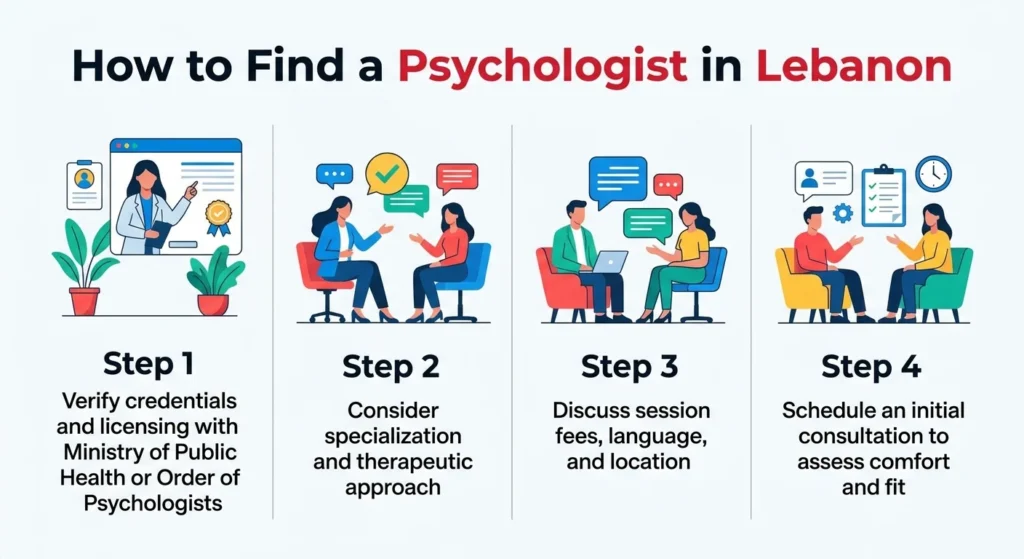
Start with credentials. A qualified psychologist in Lebanon should be able to tell you plainly where they trained, what degree they hold, what their area of focus is, and what professional body or registration they belong to. Ask directly. A confident professional won’t be offended; they’ll appreciate that you asked. Be cautious about anyone who uses the title loosely, offers guaranteed results, or promises to “cure” a condition in a set number of sessions.
Look for Experience That Matches Your Situation
Psychology is a broad field. Someone who excels with adolescents may not be the best fit for couples work, and a therapist experienced in trauma recovery has a different toolkit from one who specializes in workplace burnout. When you reach out, describe your concern in a sentence or two and ask whether it’s something they regularly work with. Their answer, and the way they give it, will tell you a lot.
Consider Language and Cultural Fit
This point gets underestimated. Lebanese clients often switch between Arabic, English, and French in a single sentence, and emotions don’t always translate neatly. Being able to say “I feel like I’m carrying everyone” in the language where it actually lands matters. A psychologist in Lebanon who understands the cultural context (family expectations, sectarian tensions, the weight of “what will people say,” the pressure on the one who stayed versus the one who left) can work with your reality instead of explaining it back to you from a textbook.
Decide Between In-Person and Online Sessions
Online therapy has become a mainstream option, and for many people it removes real obstacles: traffic in Beirut, power cuts, long distances from the capital, or the discomfort of being seen walking into a clinic. Others prefer the focus of a physical room. Neither is better; it depends on your privacy at home, your internet reliability, and your own comfort. Many therapists offer both, and some psychologists in Lebanon also see clients who live abroad.
What to Expect From Your First Session With a Psychologist
The first appointment is mostly about getting acquainted, and it’s usually calmer than people fear. Your therapist will ask what brought you in, what’s been happening lately, and a bit about your background: family, work, health, past experiences with therapy. You won’t be asked to relive your worst memories on day one, and you can decline any question.
They’ll also explain confidentiality, which is the foundation of the whole process. What you share stays in the room, with a few limited exceptions related to serious risk of harm, and a good psychologist in Lebanon will go through those exceptions openly so there are no surprises. You’ll typically discuss practical matters as well: session length, frequency, fees, and cancellation policy.
Here’s a small illustration, a composite based on situations that are very common rather than a single real client. A woman in her early thirties, working in Beirut and supporting her parents financially, books a session because she can’t switch off. She expects to be told to “relax more.” Instead, over a few weeks, she and her therapist trace how responsibility for everyone’s stability landed on her years ago, and she practices saying no without guilt. Nothing dramatic happens in any single session. Six months later, her sleep has improved, and so has her relationship with her mother. That quiet kind of progress is what therapy usually looks like.
At the end of the first meeting, ask yourself one thing: did I feel heard? You don’t need to feel fixed or even fully comfortable. But if something felt off, it’s perfectly reasonable to try a second psychologist in Lebanon before committing.
Common Types of Therapy You’ll Encounter
You don’t need to memorize methods, but knowing the vocabulary helps you ask better questions. Cognitive behavioral therapy (CBT) is among the most researched approaches and focuses on the links between thoughts, emotions, and actions; it’s widely used for anxiety, depression, and panic. Trauma-focused therapies, including EMDR, help people process distressing memories so they stop intruding on daily life. Psychodynamic therapy explores deeper patterns, often rooted in early relationships. Couples and family therapy treats the relationship itself as the client. Many practitioners blend approaches, adjusting to the person in front of them rather than following a script.
Ask your prospective therapist how they work and why they’d suggest that approach for you. You’re entitled to understand the plan.
How Much Does a Psychologist in Lebanon Cost?
Fees vary considerably by city, experience, specialty, and whether sessions are online or in person, and the economic situation has made pricing less predictable than it used to be. Rather than quote figures that may be outdated by the time you read this, here’s what I’d suggest: ask about the rate and payment currency upfront, ask whether there’s a sliding scale or a reduced rate for students and people in financial hardship, and check whether your insurance covers any part of it.
If cost is the barrier, you have options. Some NGOs and university-affiliated clinics offer low-cost or free counseling, and Embrace and similar organizations can point you toward services. Consistency often matters more than frequency, so a plan you can sustain, even every two weeks, usually serves you better than an ambitious one you abandon after a month.
Making Therapy Work: Practical Tips From Experience
A few habits make a real difference. Show up even when you feel fine, because that’s often when the useful work happens. Say so when something isn’t working, since a good therapist wants that feedback. Give it time; most people need several sessions before they can judge fit, and meaningful change tends to take months, not days. And treat the space between sessions as part of the process: notice patterns, jot down what stood out, and bring it back.
Finally, be patient with yourself. Choosing to see a psychologist in Lebanon is already a significant act. It means you decided your inner life deserves the same attention you’d give a physical problem.
Frequently Asked Questions About Seeing a Psychologist in Lebanon
No. You can come with a specific problem, a vague sense that something is off, or simply a wish to understand yourself better. A diagnosis, if relevant, usually emerges during the process rather than being required beforehand.
Professional ethics require your therapist to keep what you share private. The exceptions are narrow, typically involving serious risk to you or someone else, and a responsible psychologist in Lebanon will explain them in your first session.
It depends on your goals. Focused concerns such as a specific phobia or a short-term stressor may improve within a few months, while longer-standing patterns or trauma often take more time. Your therapist should review progress with you regularly rather than leave it open-ended.
Often, yes, as long as the therapist offers online sessions and the arrangement fits any professional rules that apply. Many Lebanese living abroad choose a psychologist in Lebanon who shares their language and cultural background, even from a different time zone.
Take the First Step Toward Support
Finding the right psychologist in Lebanon isn’t about discovering the perfect expert on the first attempt. It’s about finding someone qualified, someone who understands your context, and someone you can be honest with. Start with a conversation, trust your read of the room, and adjust if you need to.
If you’re ready, I’d be glad to hear from you. You can book an introductory session and send a message with your questions first. And if this guide helped, share it with someone who might need it. Sometimes the most useful thing a person can receive is the knowledge that asking for help is allowed.