


Most families do not have problems with communicating with one another because they do not care about one another. They do not function well because their process of interaction has become formulaic with decades of effects on the cycle of communication: who speaks and who doesn’t, what is expressed and what is left unexpressed, how conflict is resolved, etc. have all grown into habits that hinder their ability. By the time a family reaches out for therapy, things at this stage are sounding much like the same old tune—misunderstandings, reactions, and feeling “unheard” again.
This article examines the ways in which people face difficulties in communication in their families, what family therapy is about and what it typically helps with.
Why Communication Breaks Down in Families?
Family communication problems are seldom caused by one event. They tend to develop slowly and are frequently unique to each family member, based on a particular communication style, early roles acquired (the peacekeeper, the avoider of conflict, the one who speaks for the others), and implicit notions of family resolution practices.
Family Therapists view such patterns as a system, rather than man or woman. All too often, although one family member may appear to be the main figure of conflict, the interplay of the family members and the dynamics of the surrounding environment are responsible for perpetuating the pattern.
The reality of “There’s Rarely One “Difficult” Family Member”
One thing that is often assumed is that, at least one person in the family has to do something different, and the rest of them need to “cope with it. Communication is seen as a form of activity that reaches everyone, even if not equal participation. For instance, when children fail to respond to dialogue with a teenager who has shut down, this is more of a pattern that has emerged that cannot solely be blamed on the conversation.
Frequent indicators of communication problems.
There are some recurring patterns that appear when it comes to strained communication within a family:
- Discussions of sensitive subjects are never brought up or discussed
- Members of the family don’t pay attention to one another, they just talk over each other.
- Some issues tend to literally become “thorny” no matter who brings them up.
- Over time, one or more members of the family feel that they have not been listened to or understood.
- Important thoughts or emotions are missing from sharing due to threat or futility
These patterns can emerge within parents-children relationships, between siblings or within the entire family and feel distinct according to which kinds of the relationships are damaged.
What is Family Therapy?
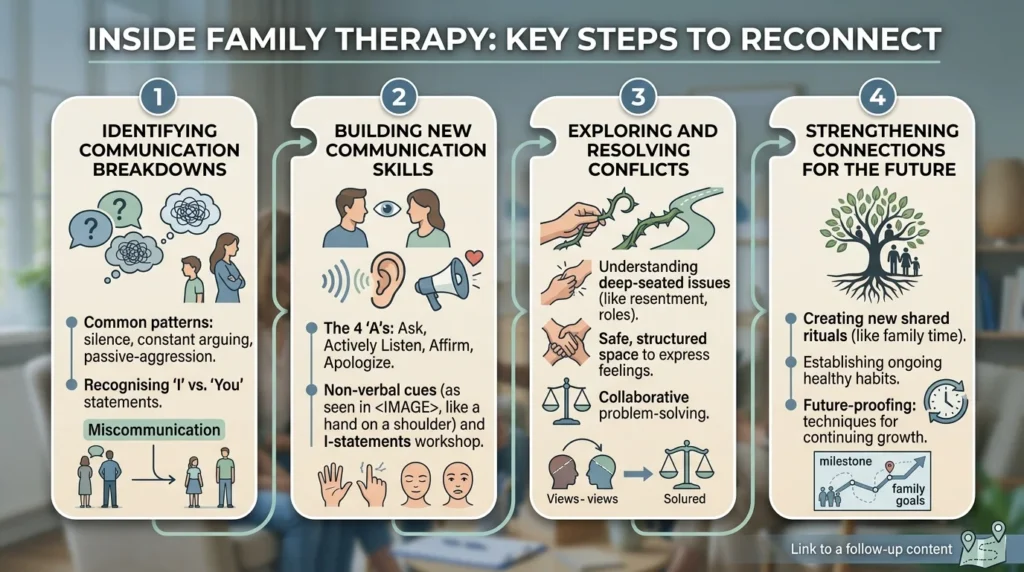
The initial phase of family therapy generally involves identifying the pattern(s) involved and listening to each family member’s unique perspective on the communication issues, rather than simply taking a family’s description of the pattern on faith. This is on its own informative, because family members may have really opposing interpretations of the same family dynamic.
From there it progresses to ways in which each one is allowed to express him or herself that will be heard—then into ways in which other family members do listen without acting immediately defensive. This often means slower conversations than is normal when they are on the verge of conflict, and making room for what’s going on at a deeper level than the discussion is likely to reveal, because this is where the core of the conflict is.
In general, how are sessions structured?
Sessions can be family-entire or with combination families or sometimes, individual sessions as part of a family group or process. The structure tends generally to follow the approach best suited to dealing with the problem pattern and is not fruitfully pegged to any particular pattern for all families.
What to Expect?
Family communication doesn’t change all at once, and you must keep in mind that you should have realistic expectations at the onset. Small changes early on may resemble a challenging situation where a difficult topic is first brought up but doesn’t spiral out of control, or keeping family members from being quite so uncomfortable with expressing themselves. These are little changes that can add up over time to make something that’s meaningfully different when it comes to their relationship.
It’s all part of the process, and setbacks are expected. A week of trouble experiencing doesn’t mean there’s no progress being made but is rather a reflection of old routines coming into play, which is also useful knowledge to the work.
When is Family Therapy an Option?
Signs that professional help might be needed include if you’ve been consistently at odds with your family, if some subjects feel too explosive, or if your family members feel more distant from each other even though they live together.
To learn more about how this approach is applied, see the family therapy page.
Frequently Asked Questions
Not necessarily. Sessions can be with the entire family, combinations of family members, or individual sessions but not both. The layout is generally adapted to suit the situation in use.
This is something that is often asked. Even with the participation of those willing to participate in family therapy, changes in the communication patterns with the therapist may have an impact on the entire family unit, even if not every member is able to attend session.
Individual therapy is focused on the experience and patterns within the individual. Family therapy considers the ways in which family relationships and communication patterns are directly involved in the problem, rather than focusing on the individual problem person by themselves.
Yes, one of the more typical causes of family therapy. Adolescence can often come with changing communication requirements for both parents and teens, and with family therapy, communication can become a way of relating that is respectful to the teen’s independence, while still being connected to the parents.
The length of time patterns are set in place, and the number of family relationships impacted will vary. Immediate results are seen within a few sessions one might witness in some families, while in others, shifts come about over a period of several sessions.
Take the Next Step
If communication within your family has become a consistent source of strain, that’s a reasonable reason to consider professional support.
Book a Consultation to talk with Yusra Imad about family therapy, or learn more on the family therapy page.