

Someone compliments your work and you immediately explain why it wasn’t that good. A friend cancels plans and you assume they finally realised you are not worth their time. You apologise for things that aren’t your fault, stay quiet in meetings, and keep a running list in your head of everything you do wrong. From the outside, you may seem fine. Inside, a quiet voice keeps repeating that you are not enough. That voice is at the heart of low self-esteem, and it shapes far more of life than most people realise.
This guide explains what low self-esteem is, the signs to recognise, where it comes from, how it keeps itself going, and how therapy helps people build a steadier, kinder sense of who they are. It is written for anyone who has ever wondered why feeling good about themselves seems so much harder for them than for others.
What Is Low Self-Esteem?
Self-esteem is the overall opinion you hold of yourself: how much you value, respect and accept who you are. Sociologist Morris Rosenberg, whose 1965 self-esteem scale is still among the most widely used measures in psychology, described it as a person’s overall positive or negative attitude toward the self.
Low self-esteem means that this overall view leans consistently negative. People with low self-esteem tend to see themselves as inadequate, unlikeable, incompetent or less worthy than others, often despite clear evidence to the contrary. It is not a diagnosis, but it is closely linked to anxiety, depression and relationship difficulties, and it can quietly shape decisions about work, love and friendship.
Healthy Self-Esteem Is Not Arrogance
Some people worry that building self-esteem means becoming boastful or self-centred. Healthy self-esteem is something different. It means having a realistic, balanced view of yourself, strengths and flaws included, and believing that you deserve respect even when you make mistakes. Interestingly, a major 2003 review led by psychologist Roy Baumeister found that simply boosting how good people feel about themselves did not reliably improve their performance or relationships. The goal of therapy is therefore not inflated self-esteem, but a stable, fair and compassionate relationship with yourself.
Signs of Low Self-Esteem
Low self-esteem can be obvious or very well hidden. Some common signs include:
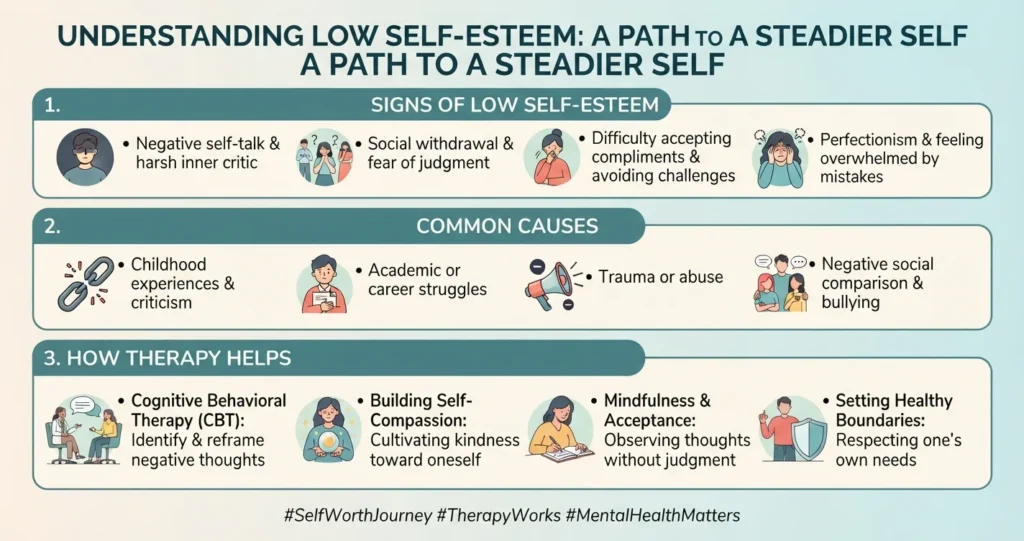
- A harsh inner critic that focuses on mistakes and dismisses successes.
- Difficulty accepting compliments or believing positive feedback.
- Constant comparison with others, usually unfavourably.
- Struggling to say no, set boundaries or ask for what you need.
- Avoiding challenges or opportunities for fear of failing or being judged.
People with low self-esteem may also apologise excessively, seek frequent reassurance, feel unusually hurt by criticism, or stay in relationships and jobs where they are treated poorly because they believe they do not deserve better.
When Low Self-Esteem Hides Behind Success
Not everyone with low self-esteem looks insecure. Some people compensate by working extremely hard, pleasing everyone or pursuing achievements that might finally prove their worth. Outwardly confident and successful, they may still feel like an impostor waiting to be exposed. If this sounds familiar, our articles on high-functioning anxiety and perfectionism and anxiety explore those patterns in depth.
How Low Self-Esteem Affects Your Life?
Because it shapes how we interpret almost everything, low self-esteem rarely stays in one area of life.
In relationships, it can lead to fear of rejection, jealousy, difficulty trusting a partner’s affection, or tolerating disrespect. Some people avoid closeness altogether; others cling tightly for fear of being left. At work or university, it can mean staying silent in meetings, avoiding promotions, procrastinating out of fear of judgment, or attributing every success to luck. In daily life, it can show up as social withdrawal, people-pleasing and exhaustion from constantly trying to be acceptable.
Emotionally, the effects can be significant. Longitudinal research by psychologist Ulrich Orth and colleagues suggests that low self-esteem is not only a consequence of depression but can also be a risk factor for later depression. Addressing self-esteem is therefore not a luxury; it can be an important part of protecting mental health. If low mood has become persistent, our article What Is Depression? explains the signs.
Where Low Self-Esteem Comes From?
Nobody is born believing they are worthless. Low self-esteem usually develops gradually through experience.
Early Experiences and Family Messages
Children build their sense of self from how the important people around them respond. Frequent criticism, harsh punishment, emotional neglect, comparison with siblings, or love that seemed to depend on good behavior or grades can leave a child concluding, “Something is wrong with me.” Even caring families can unintentionally send such messages, especially when parents are under stress themselves. Yusra’s analytical-systemic training is particularly relevant here, as it explores how family roles and patterns shape the way people see themselves as adults. Our article on attachment patterns in relationships explains how early bonds influence adult relationships too.
Later Life Experiences
Bullying, rejection, academic struggles, a difficult relationship, job loss or trauma can all damage self-esteem, even in people who felt secure before. Ongoing stress and repeated setbacks can slowly erode confidence over time.
Culture, Comparison and Social Media
Social media invites constant comparison with carefully curated lives. In Lebanon, many people also feel pressure linked to family expectations, academic and career achievement, appearance, or comparisons with relatives and friends who have built lives abroad. These pressures do not cause low self-esteem on their own, but they can feed an inner critic that is already harsh.
How Low Self-Esteem Keeps Itself Going?
One of the most helpful explanations comes from clinical psychologist Melanie Fennell, who developed an influential cognitive model of low self-esteem. She described how early experiences can lead to a core negative belief about the self, which she called the “bottom line,” such as “I’m not good enough” or “I’m unlovable.” To cope with this belief, people develop rules for living, for example, “I must never make mistakes” or “I must always put others first.”
When situations threaten to break those rules, such as a new challenge, criticism or conflict, the bottom line is activated. Anxious predictions and self-critical thoughts follow, and people respond with avoidance, over-preparation or people-pleasing. These strategies feel protective, but they prevent the person from discovering that the bottom line might be wrong. The belief survives, and the cycle continues. Understanding this loop is often the first step to breaking it.
Self-Esteem vs. Self-Compassion
Researchers have increasingly highlighted the difference between self-esteem and self-compassion. Psychologist Jennifer Crocker’s work on “contingent self-worth” shows that when people’s sense of value depends on specific outcomes, such as grades, appearance or approval, their self-esteem rises and falls with every success and failure, which can be exhausting. Psychologist Kristin Neff has argued that self-compassion, treating yourself with the kindness you would offer a friend, provides a steadier foundation because it does not depend on performance.
For people with low self-esteem, this matters. The aim is not to convince yourself that you are brilliant at everything, but to develop a sense of worth that survives mistakes, setbacks and ordinary human flaws.
An Illustrative Example
The following is a composite based on common patterns, not a real client. Nour, 27, works as a graphic designer in Beirut. Her colleagues praise her work, yet she is convinced she was hired by mistake. She rarely shares her ideas, agrees to every extra task, and replays every small comment from her manager for days. In her relationship, she often feels she must earn her partner’s affection and apologises constantly.
In therapy, Nour identifies her bottom line: “I’m only acceptable if I’m useful to others.” She traces it to a childhood in which she cared for younger siblings while her parents worked long hours, and praise came mainly when she helped. With her therapist, she begins testing her rules: sharing one idea per meeting, declining an extra task and noticing what happens, and keeping a daily record of things she did well. At first, it feels uncomfortable. Over several months, she notices that colleagues respect her more when she speaks up, and her partner is relieved when she expresses her own needs. Her inner critic does not disappear, but it no longer has the final word.
How to Build Self-Esteem: Practical Steps?
If you are wondering how to build self-esteem, the answer is usually not positive affirmations repeated in the mirror. Lasting change comes from gradually collecting new experiences and treating yourself differently. Some steps that often help:
- Notice your inner critic and ask whether you would speak to a friend that way.
- Keep a short daily record of things you did well or handled.
- Test one “rule for living” with a small, safe experiment.
- Practise saying no to one small request each week.
- Spend time on activities that reflect your values, not only others’ approval.
These steps take practice, and progress is rarely a straight line. Small, consistent changes tend to matter more than dramatic gestures.
How Self-Esteem Therapy Works?
Self-esteem therapy usually draws on cognitive behavioral therapy, including approaches based on Melanie Fennell’s model. In therapy, you identify your bottom line and rules for living, notice how they shape your reactions, and gradually test them through real experiences. You also learn to catch and respond to self-critical thoughts, recognise your strengths and build self-compassion. You can read more about the CBT approach in our introduction What Is CBT?
Because low self-esteem often has deep roots, therapy may also explore where your beliefs came from and how they continue to play out in your relationships. In Yusra’s practice, individual psychotherapy combines CBT with the analytical-systemic approach, so practical tools are paired with an understanding of family and relational patterns. Low self-esteem is one of the concerns listed on the site’s homepage, and improving it often supports progress with anxiety, low mood and relationship difficulties.
When to Seek Support?
Consider speaking with a psychologist if low self-esteem is affecting your relationships, work or studies, if you often feel worthless or not good enough, if you avoid opportunities because of fear of failure, or if your inner critic feels relentless. Support is especially important if low self-esteem comes with persistent low mood, anxiety or thoughts that life is not worth living. If you are having thoughts of harming yourself, contact local emergency services or go to the nearest hospital straight away.
Frequently Asked Questions
Low self-esteem usually develops from a mix of experiences, such as criticism in childhood, conditional approval, bullying, rejection, trauma or repeated setbacks. Ongoing stress, comparison and difficult relationships can also wear it down over time.
Yes. Therapy, particularly cognitive behavioral approaches, helps people identify the beliefs and rules that keep low self-esteem going, test them through real experiences and build a more balanced, compassionate view of themselves.
It varies. Some people notice changes within a few months of consistent work, while deeply rooted beliefs can take longer. Progress tends to build gradually as new experiences accumulate and self-critical habits loosen.
No. Low self-esteem describes a negative view of yourself, while depression is a mood condition with symptoms such as persistent low mood and loss of interest. They often occur together, and low self-esteem can increase the risk of depression.
Affirmations alone tend to have limited effect, especially if they feel untrue. Changing behavior, testing negative beliefs and practising self-compassion are usually more effective ways to build lasting self-esteem.
You Deserve a Kinder Relationship With Yourself
Low self-esteem can feel like an unchangeable part of who you are, but it is built from beliefs and habits, and beliefs and habits can change. With understanding, practice and the right support, it is possible to quiet the inner critic, take up more space in your own life and relate to yourself with fairness and kindness.
If a harsh inner voice is holding you back, therapy can help. Learn more about individual psychotherapy in Lebanon, book a confidential consultation, or send a message on WhatsApp with any questions first.
About this article: This content is for general education and does not diagnose or replace individual assessment or treatment. It was reviewed by Yusra Imad, Licensed Clinical Psychologist and CBT Psychotherapist. If you are in immediate danger or thinking of harming yourself, contact local emergency services or go to the nearest hospital.
Reviewed by Yusra Imad, Licensed Clinical Psychologist and CBT Psychotherapist in Lebanon.