
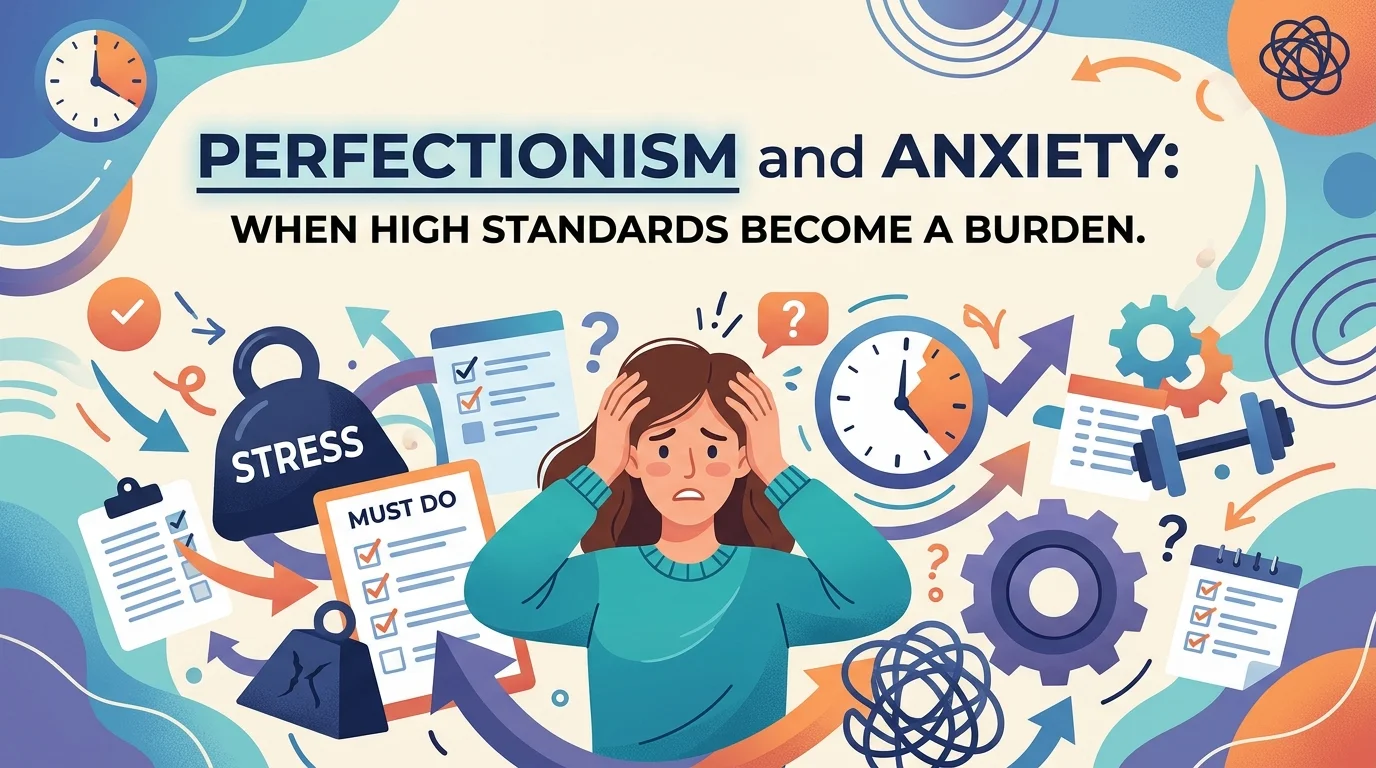
“I just like things done properly.” Many perfectionists say this, and it sounds harmless, even admirable. But behind it there is often a quieter story: hours lost to rewriting, sleepless nights over a small error, a dread of being seen as anything less than excellent. Perfectionism and anxiety frequently travel together, each one feeding the other until high standards stop being a source of pride and start feeling like a trap.
This guide explains what perfectionism really is, how it fuels anxiety, the behaviors that keep the cycle going, and how therapy helps people keep their care and ambition without the constant fear underneath.
What Is Perfectionism?
Perfectionism is more than wanting to do well. Psychologists generally describe it as setting extremely high standards and then judging your self-worth by whether you meet them, combined with harsh self-criticism when you fall short. The problem is not ambition. It is the belief that anything less than flawless means failure.
Healthy Striving vs. Perfectionism
Researchers often distinguish between two sides of high standards. Healthy striving means aiming high, working hard and feeling satisfied with good progress. Perfectionistic concerns, a term used in research by psychologists such as Joachim Stoeber, involve fear of mistakes, doubt about your performance and worry about others’ judgment. Studies consistently link those concerns, rather than high standards themselves, to anxiety, stress and low mood. In short: you can keep your standards. It is the fear attached to them that causes harm.
Three Directions of Perfectionism
Psychologists Paul Hewitt and Gordon Flett proposed an influential model describing three forms of perfectionism. Self-oriented perfectionism is demanding perfection from yourself. Other-oriented perfectionism is expecting perfection from other people, which often strains relationships. Socially prescribed perfectionism is believing that others expect you to be perfect and will reject you if you are not. This third form is particularly closely linked to anxiety, because it turns everyday life into a constant performance under imagined judgment.
How Perfectionism and Anxiety Feed Each Other
The link between perfectionism and anxiety works like a loop. Understanding the loop is the first step toward interrupting it.
Impossible Standards Create Constant Threat
When the bar is set at “perfect,” almost every task carries a risk of failure. A presentation, an email, a family dinner or an exam becomes a test you could fail. Living with that sense of threat day after day keeps the nervous system on high alert, which is exactly what anxiety is.
Fear of Failure Drives Over-Control
A powerful fear of failure sits at the centre of many perfectionists’ lives. To manage it, they over-prepare, check repeatedly, seek reassurance or avoid tasks altogether. These behaviors bring short-term relief, but they also prevent the person from ever learning that “good enough” is usually fine, so the fear stays intact.
The Inner Critic Keeps Score
Harsh self-criticism is one of the most damaging parts of perfectionism. When something goes well, the inner critic dismisses it (“anyone could have done that”). When something goes wrong, it attacks (“you’re useless”). Over time, this voice becomes so familiar that people mistake it for motivation. In reality, research on self-compassion, including work by psychologist Kristin Neff, suggests that treating yourself with understanding after setbacks is associated with greater resilience, not less effort.
Signs Perfectionism Is Fuelling Your Anxiety
Perfectionism can be hard to see from the inside, because it often feels like simply having standards. Some signs that it may be feeding anxiety:
- You feel intense distress over small mistakes, long after they happen.
- Praise barely registers, while criticism stays with you for days.
- You struggle to start or finish tasks because they might not be good enough.
- You find it hard to delegate, rest or say “this is done.”
- Your sense of worth rises and falls with your performance.
If several of these feel familiar, it may be worth looking more closely at how perfectionism is shaping your emotional life.
The Hidden Behaviors That Keep Perfectionism Going
Perfectionism does not always look like polished work. Sometimes it looks like the opposite. Procrastination is one of its most common faces: if a task must be perfect, starting it feels overwhelming, so it gets delayed until the last minute. The rushed result then seems to confirm the belief that “I can only do well under pressure” or “I’m not good enough.”
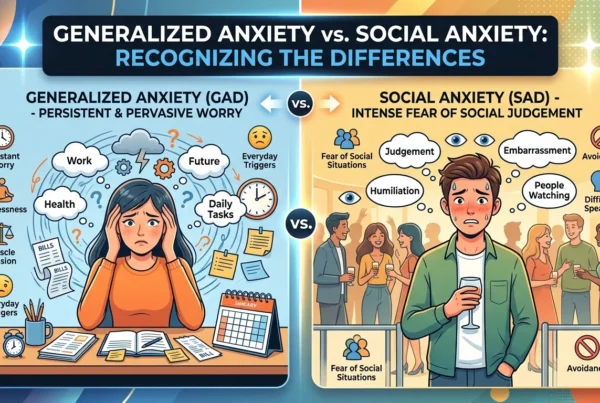
Other maintaining behaviors include excessive checking and rereading, spending far longer on tasks than they require, avoiding new challenges where you might not excel, seeking repeated reassurance from others, and comparing yourself constantly with people who seem more successful. Each of these feels protective, yet each keeps anxiety alive by preventing you from discovering that imperfection is survivable. When these patterns sit behind a capable outward image, they often take the form described in our article on high-functioning anxiety.
Where Perfectionism Comes From?
Perfectionism usually develops from a mix of temperament and experience. Some people are naturally more conscientious or sensitive to mistakes. Experiences then shape how that tendency grows. Growing up with high expectations, conditional praise, criticism for mistakes, or a family atmosphere where achievement was the main source of approval can teach a child that worth must be earned. Taking on adult responsibilities early, or watching a parent struggle with their own perfectionism, can have a similar effect.
Culture and environment play a role too. Competitive education systems, social media’s endless highlight reels and workplaces that reward constant availability all reinforce the message that ordinary is not enough. Yusra’s analytical-systemic training is relevant here: it explores how family roles, expectations and relational patterns shape the standards people carry into adulthood, which often helps explain why perfectionism feels so deeply rooted.
An Illustrative Example
The following is a composite based on common patterns, not a real client. Rana, 30, is an architect in Beirut. Her designs are excellent, but each project takes her far longer than planned because she redraws details repeatedly. She rarely shares work-in-progress for fear of criticism, and she misses deadlines more often than she would like, which then fuels more anxiety. At home, she feels irritated when her partner loads the dishwasher “wrong.” She describes herself as tired all the time.
In therapy, Rana identifies a core belief: “If my work isn’t perfect, people will see I’m not really talented.” Together with her therapist, she designs experiments: sharing a draft at 80 percent completion with a trusted colleague, setting a time limit for revisions, and allowing one small imperfection in a presentation. She records what she predicts will happen and what actually happens. The colleague gives helpful feedback; the presentation is well received. Over time, she begins to separate her standards from her worth. She still produces high-quality work, now with fewer late nights and noticeably less anxiety.
How Perfectionism Therapy Works
Perfectionism therapy usually draws heavily on cognitive behavioral therapy. Researchers Roz Shafran, Zafra Cooper and Christopher Fairburn described “clinical perfectionism” as the over-dependence of self-evaluation on achieving demanding standards, and CBT approaches built on this work have been studied in a range of settings with encouraging results.
In practice, CBT helps you identify the rules and beliefs driving perfectionism, such as “I must never make mistakes” or “If I’m not the best, I’m worthless,” and test them against real experience. Behavioral experiments are central: deliberately doing something “good enough” and observing the outcome. Therapy also works on broadening your sense of self-worth so that it rests on more than performance, including relationships, values, interests and character. Self-compassion skills help soften the inner critic. You can learn more about the approach on our page on CBT therapy in Lebanon.
Because perfectionism often has deep roots, therapy may also explore where these standards came from and what they once protected you from. Combining practical CBT with this deeper understanding tends to make change last.
Practical Steps to Loosen Perfectionism
Small, deliberate steps can begin to shift the pattern. Try setting a time limit for a task and stopping when it ends, even if the result feels imperfect. Notice your inner critic and ask what you would say to a friend in the same situation. Share a piece of work before it feels “ready” with someone you trust. Celebrate completion, not only excellence. And when you make a mistake, practise a short, kind response such as “That was a mistake, and I can handle it,” rather than a list of everything wrong with you.
These steps will probably feel uncomfortable at first. Discomfort is not a signal to stop; it is often a sign that you are loosening a long-held rule.
Perfectionism Among Students and Young Adults
Perfectionism appears to be a growing concern among younger generations. A widely cited 2019 meta-analysis by psychologists Thomas Curran and Andrew Hill, published in Psychological Bulletin, found that levels of perfectionism among young people in the US, UK and Canada had increased over recent decades, especially the socially prescribed form. Students in Lebanon face their own pressures too, from scholarships to family expectations and plans to study abroad. For many, perfectionism shows up most intensely around exams, which we cover in our guide to exam anxiety for university students in Lebanon.

When to Seek Support?
Consider speaking with a psychologist if perfectionism is causing significant anxiety, affecting your sleep or health, damaging relationships, leading you to miss deadlines or opportunities, or leaving you feeling never good enough regardless of what you achieve. Perfectionism can also be part of other difficulties, such as anxiety conditions, depression or obsessive-compulsive patterns, so a professional assessment can help clarify what is going on.
In Yusra’s practice, individual psychotherapy combines CBT with the analytical-systemic approach, addressing both day-to-day perfectionist habits and the patterns that shaped them.
Frequently Asked Questions
Perfectionism is not an anxiety disorder in itself, but it is closely linked to anxiety. It can fuel anxiety by making many situations feel like tests, and anxiety can drive perfectionist behaviors as a way to feel safe. The two often reinforce each other.
High standards and conscientiousness can be genuine strengths. Problems arise when self-worth depends on flawless performance and mistakes trigger intense fear or self-criticism. Therapy aims to keep the healthy striving while reducing the fear.
If perfectionism causes ongoing distress, interferes with work or study, affects relationships, or leaves you exhausted and dissatisfied no matter what you achieve, speaking with a psychologist can help. You do not need to be in crisis to benefit.
When a task must be perfect, starting it can feel overwhelming and risky. Delaying it temporarily avoids the fear of doing it badly. Unfortunately, procrastination usually increases stress and reinforces the belief that you are not good enough.
Cognitive behavioral therapy is one of the most studied approaches for perfectionism. It focuses on testing perfectionist beliefs, reducing avoidance and checking, and building a more balanced sense of self-worth. Results vary between individuals, so progress is reviewed regularly.
High Standards Without the Fear
Perfectionism and anxiety can make even successful lives feel heavy. The goal of change is not to stop caring or lower your standards, but to stop treating every task as a judgment of your worth. When fear of failure loosens and self-criticism softens, many people find they work better, rest more easily and finally enjoy what they achieve.
If perfectionism is costing you more than it gives, support can help. Explore cognitive behavioral therapy in Lebanon, book a confidential consultation, or send a message on WhatsApp with any questions first.
About this article: This content is for general education and does not diagnose or replace individual assessment or treatment. It was reviewed by Yusra Imad, Licensed Clinical Psychologist and CBT Psychotherapist, holding CBT certification from ALTCC. If you are in immediate danger or thinking of harming yourself, contact local emergency services or go to the nearest hospital.
Reviewed by Yusra Imad, Licensed Clinical Psychologist and CBT Psychotherapist