
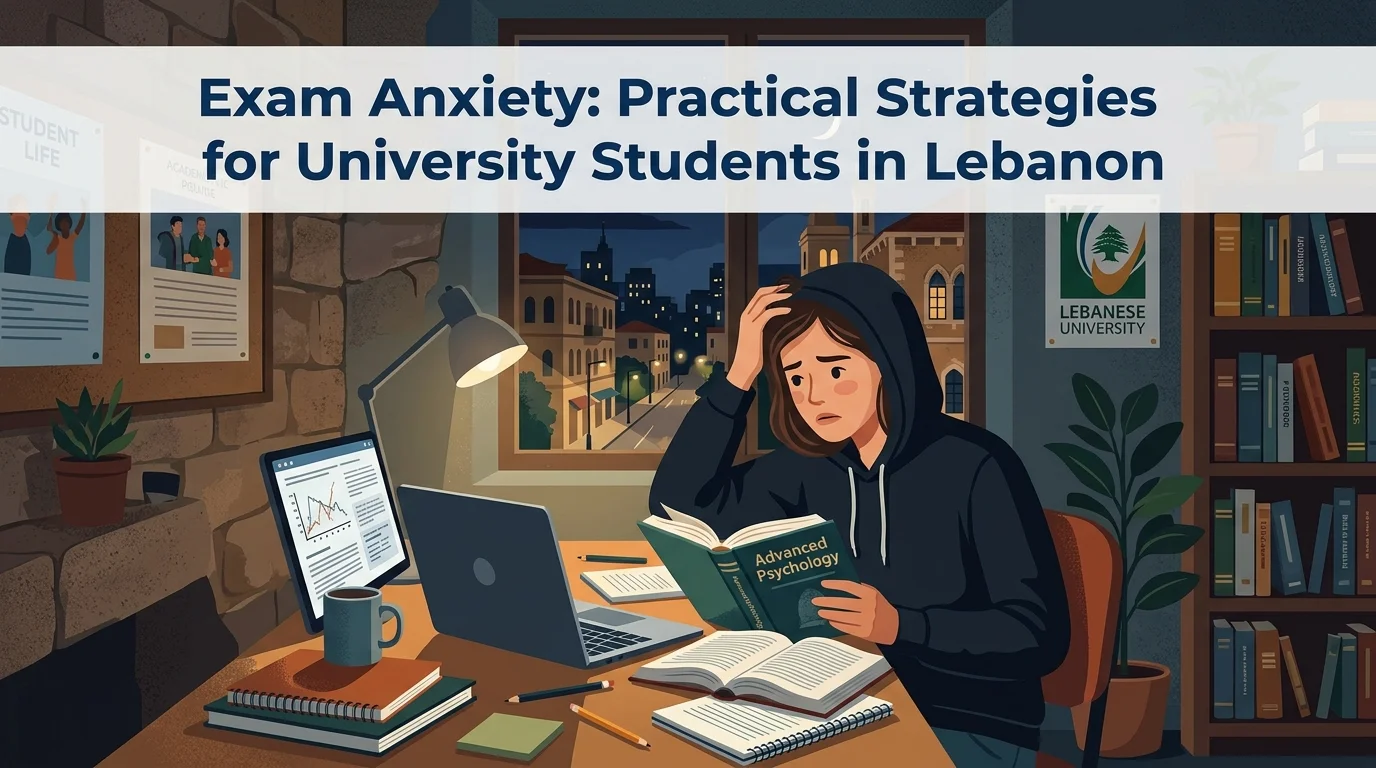
You studied. You know the material, or you did yesterday. Then you sit down, read the first question, and your mind goes completely white. Your heart pounds, your hands sweat, and every minute on the clock feels like a countdown to failure. If this sounds familiar, you are not lazy, unprepared or “bad at exams.” You are experiencing exam anxiety, one of the most common struggles among university students, and one of the most manageable once you understand it.
This guide is written for students in Lebanon facing midterms, finals, oral exams and high-stakes assessments. It explains what exam anxiety is, why it happens, and practical, evidence-informed strategies for the weeks before, the night before, the exam room and the hours after. It draws on cognitive behavioral therapy and on Yusra’s experience supporting university students through exam pressure and performance blocks.
What Is Exam Anxiety?
Exam anxiety, often called test anxiety, is an intense fear response to exams or evaluation that gets in the way of performing at your real level. It is not a formal diagnosis on its own, but it is a well-studied pattern, and for some students it overlaps with broader anxiety or perfectionism.
Normal Exam Nerves vs. Exam Anxiety
Some nervousness before an exam is normal and can even help. It sharpens attention and motivates preparation. Exam anxiety is different in intensity and impact. It starts earlier, feels harder to control, and interferes with studying, sleep, memory and performance. A useful question is: does the nervousness push me to prepare, or does it stop me from preparing and thinking clearly? If it is the second, you are likely dealing with exam anxiety rather than ordinary nerves.
The Two Sides of Exam Anxiety
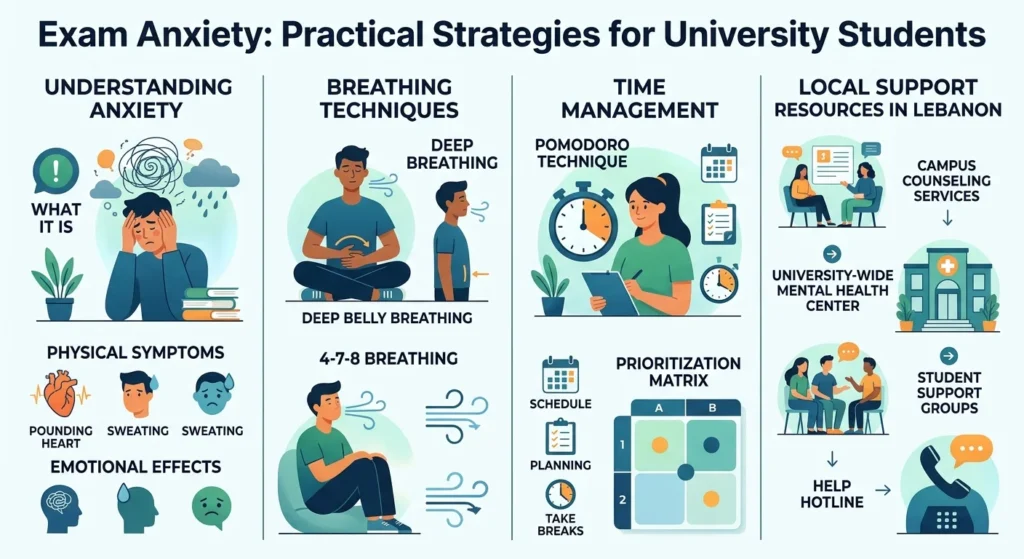
Researchers have long described exam anxiety as having two components, a distinction first proposed by psychologists Robert Liebert and Larry Morris in the 1960s. The first is worry: negative thoughts about failing, disappointing others and what a bad result might mean. The second is emotionality: the physical side, such as a racing heart, sweating, nausea and tension. Worry tends to be most closely linked to poor performance, because anxious thoughts compete for the same mental resources you need to recall information and reason through problems. That is why the mind can go “blank” even when you know the material.
Signs of Exam Anxiety
Exam anxiety shows up differently at different stages. Recognising your own pattern is the first step toward changing it.
In the Days and Weeks Before
Common early signs of exam anxiety include constant worry about upcoming exams, difficulty starting or sticking to study, sleeping poorly, irritability, loss of appetite or stress eating, and imagining worst-case outcomes. Some students over-study in a frantic way, while others avoid their books altogether because opening them triggers dread.
During the Exam
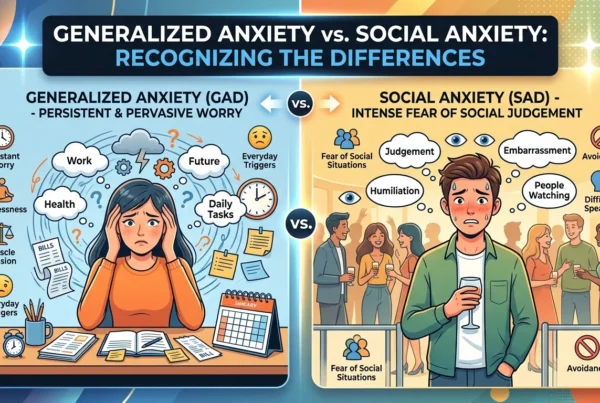
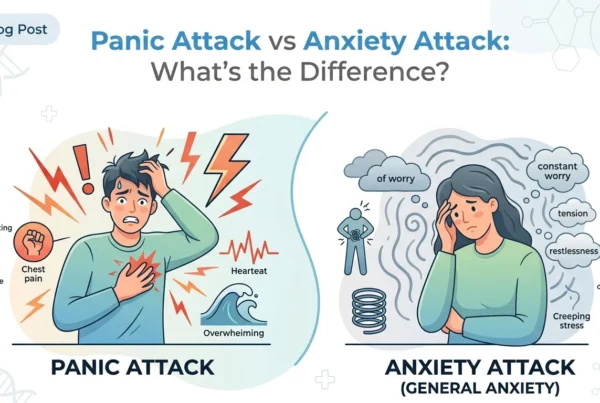
In the exam room, students describe going blank, rereading the same question without taking it in, racing thoughts, shaking hands, shortness of breath, feeling hot or dizzy, and watching the clock obsessively. Some experience a sudden wave of panic. If those waves feel overwhelming, our article on panic attack vs anxiety attack explains what may be happening in your body.
After the Exam
Afterward, many anxious students replay every answer, compare responses with classmates, and convince themselves they failed, often before results are out. This post-exam rumination keeps exam anxiety going into the next assessment.
Why Exam Anxiety Happens
Exam anxiety usually grows from a combination of factors rather than a single cause. Beliefs about exams play a large role: thoughts like “This exam decides my future,” “If I fail, I’m a failure,” or “Everyone will see I’m not smart enough” turn an assessment into a verdict on your worth. Perfectionism adds pressure by making anything short of excellent feel like a disaster.
Context matters too. Many students in Lebanon carry real pressure: scholarships that depend on grades, family sacrifices that make results feel like repayment, plans to study or work abroad, and wider economic uncertainty that raises the stakes of every semester. Family expectations, spoken or unspoken, can make exam stress feel heavier. These pressures are real, and dismissing them does not help. What therapy can do is help you hold them without letting them flood the exam room.
Past experiences also shape the pattern. A single difficult exam, an embarrassing oral, or a teacher’s harsh comment can teach the brain to treat future exams as threats. Some students also have undiagnosed attention or learning difficulties that make exams genuinely harder, which can feed anxiety over time.
Exam Anxiety Strategies for the Weeks Before
The most effective work on exam anxiety often happens well before exam day. How you study shapes how confident you feel.
First, study in ways that build real, retrievable knowledge. Research on learning, including well-known studies by Henry Roediger and Jeffrey Karpicke, shows that practising retrieval, by testing yourself rather than simply rereading notes, leads to stronger long-term memory. Spreading study over several shorter sessions rather than cramming also tends to improve retention. Self-testing has a second benefit: it lets you practise recalling information under mild pressure, which makes the real exam feel more familiar.
Second, make a realistic plan. Break each subject into specific, small tasks with set times, and include breaks. Vague goals like “study chemistry” invite avoidance; “do 10 practice questions on chapter 4 from 4 to 5 pm” is easier to start.
Third, protect your sleep. Sleep plays an important role in consolidating memory, so all-nighters often cost more than they gain. Regular meals, some movement and time with friends are not distractions from studying; they help your brain work better.
How to Calm Exam Nerves the Night Before and the Morning Of?
If you are wondering how to calm exam nerves as the exam approaches, focus on routine rather than last-minute cramming. The night before, do a light review of key points, prepare everything you need (ID, pens, calculator, water), and set a clear stopping time. Writing down your worries and one realistic, balanced response to each can help clear your head before bed.
In the morning, eat something even if your appetite is low, arrive with enough time but not too early, and avoid anxious last-minute conversations with classmates comparing what they studied. These conversations often spread panic rather than confidence. A few minutes of slow breathing, with a longer out-breath than in-breath, can help settle the body before you walk in.
Managing Exam Anxiety in the Exam Room
Even with good preparation, exam anxiety may still show up during the exam. The goal is not to make it disappear but to keep working alongside it.
When you sit down, take a moment to breathe slowly and ground yourself: feel your feet on the floor, notice the desk under your hands. Skim the paper and start with a question you feel more confident about; early success builds momentum. If your mind goes blank, do not keep staring at the same question. Mark it, move on, and come back later. Memory often returns once anxiety settles.
It can also help to reframe the physical signs. A racing heart is your body preparing to perform, not proof that something is wrong. Telling yourself “My body is getting ready for a challenge” rather than “I’m falling apart” can change how the sensations feel. And remember that one difficult question is not the whole exam.
After the Exam: Stop the Post-Mortem That Feeds Exam Anxiety
Once the exam is over, set a limit on post-exam review, because replaying answers feeds exam anxiety. A brief reflection on what went well and what to adjust next time is useful. Hours of replaying answers and comparing with classmates is not. Shift your attention to rest, a pleasant activity, or preparation for the next exam. Results will come when they come, and worrying about them in the meantime will not change them.
An Illustrative Example
The following is a composite based on common patterns, not a real student. Jad, 21, is an engineering student in Beirut. He understands the material in tutorials, but in exams his mind blanks within the first ten minutes. He has started to dread exam season weeks in advance and studies late into the night, rereading notes until he feels “ready,” which never happens. After each exam, he replays his answers for days.
In therapy, Jad maps his exam anxiety and identifies his core thought: “If I don’t get top grades, I’ll never find a good job and I’ll let my parents down.” Together with his therapist, he examines that belief, looking at people he knows whose careers did not depend on one grade. He switches from rereading to self-testing with timed practice questions, which shows him he knows more than he feels he does. He practises a short breathing and grounding routine and agrees to a plan for moving on from blank questions. He also sets a strict limit on post-exam reviewing. By the next exam period, the anxiety is still present, but it no longer takes over. He finishes the paper, and his results reflect what he actually knows.
How CBT Helps With Exam Anxiety?
Cognitive behavioral therapy is one of the most widely used approaches for exam anxiety, because it targets both the worry and the behaviors that keep anxiety going. In CBT, you learn to identify the thinking traps that turn exams into threats, such as catastrophising and all-or-nothing thinking, and replace them with balanced, realistic perspectives. You also work on behaviors like avoidance, over-preparing and reassurance-seeking.
Practical experiments are a key part of the process. Timed mock exams, for example, act as gradual exposure: you practise performing under exam-like conditions until the situation feels less threatening. You also build a personal toolkit for the exam room. If you would like to understand the approach more broadly, our article What Is CBT? is a good starting point, and you can read about CBT therapy in Lebanon on our service page.
For some students, exam anxiety is tied to deeper patterns, such as feeling that love or approval depends on achievement. Individual psychotherapy that combines CBT with an analytical-systemic lens can address those roots alongside practical strategies.
A Note for Parents
Parents in Lebanon often care deeply about their children’s education, and that care is a strength. Sometimes, though, well-meant pressure adds to exam anxiety. Asking “How are you feeling about your exams?” rather than “Did you get an A?”, praising effort as well as results, and making it clear that your love does not depend on grades can make a real difference. If your child’s anxiety seems intense or persistent, encouraging them to speak with a professional is a supportive step, not an admission of failure.
When to Seek Support?
Consider reaching out to a psychologist if exam anxiety is affecting your sleep, health or relationships, if you are avoiding studying or exams, if your grades consistently fall below what you know you are capable of, or if anxiety is spreading beyond exams into other parts of life. It is also worth seeking support if you suspect attention or learning difficulties are part of the picture; a psychological assessment can help clarify what is going on.
Yusra has extensive experience with student exam anxiety and performance blocks through her work in university student welfare, which you can read more about on the About page.
Frequently Asked Questions
Some exam nerves are completely normal and can even help performance. Exam anxiety becomes a concern when it is intense, starts long before exams, disrupts studying or sleep, or prevents you from showing what you know.
Anxious thoughts take up mental resources that you need for recall and reasoning. When anxiety spikes, retrieving information becomes harder, even if you know it well. Moving to another question, breathing slowly and returning later often helps memory come back.
In the moment, slow breathing with a longer exhale, grounding yourself through your senses, and starting with an easier question can help. Longer-term change comes from addressing the thoughts and habits behind the anxiety, which is where therapy is especially useful.
Yes, it can. High exam anxiety can interfere with concentration, memory and time management during exams. The good news is that it responds well to targeted strategies and support, which often leads to results that better reflect your abilities.
If test anxiety is regularly affecting your performance, wellbeing or daily life, speaking with a psychologist is a sensible step. Many universities also offer student support services, and private therapy can provide more tailored, ongoing help.
You Can Walk Into Your Next Exam Differently
Exam anxiety can make you doubt yourself, but it does not measure your intelligence or your future. With better study methods, a plan for the exam room and support for the thoughts behind the fear, most students find they can sit exams with far more steadiness, and perform closer to their real level.
If exams are taking a heavy toll, support is available. Explore cognitive behavioral therapy in Lebanon, book a confidential consultation, or send a message on WhatsApp before your next exam season begins.
About this article: This content is for general education and does not diagnose or replace individual assessment or treatment. It was reviewed by Yusra Imad, Licensed Clinical Psychologist and CBT Psychotherapist, holding CBT certification from ALTCC. If you are in immediate danger or thinking of harming yourself, contact local emergency services or go to the nearest hospital.
Reviewed by Yusra Imad, Licensed Clinical Psychologist and CBT Psychotherapist