A message from your partner lands the wrong way and, before you know it, you have written three furious replies. A colleague’s comment stays with you all evening. A small setback leaves you feeling flooded, as if the feeling has taken over the whole of you. Then, once it passes, comes the second wave: embarrassment, regret, and the question, “Why do I react like this?” If that pattern sounds familiar, the issue is rarely that you feel too much. More often, it is that no one ever taught you what to do with strong feelings once they arrive. That skill has a name: emotional regulation.
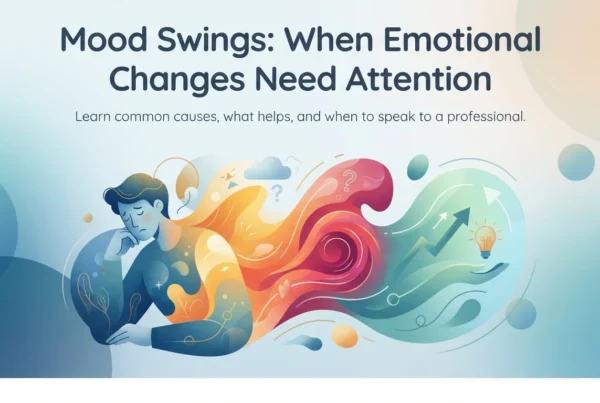
This guide explains what emotional regulation really means, why it comes more easily to some people than others, the strategies that tend to help and those that backfire, and how therapy builds these skills in a lasting way. If your main concern is that your moods shift quickly and you want to understand why, our article on mood swings and when to seek help looks at the causes in more detail.
What Is Emotional Regulation?
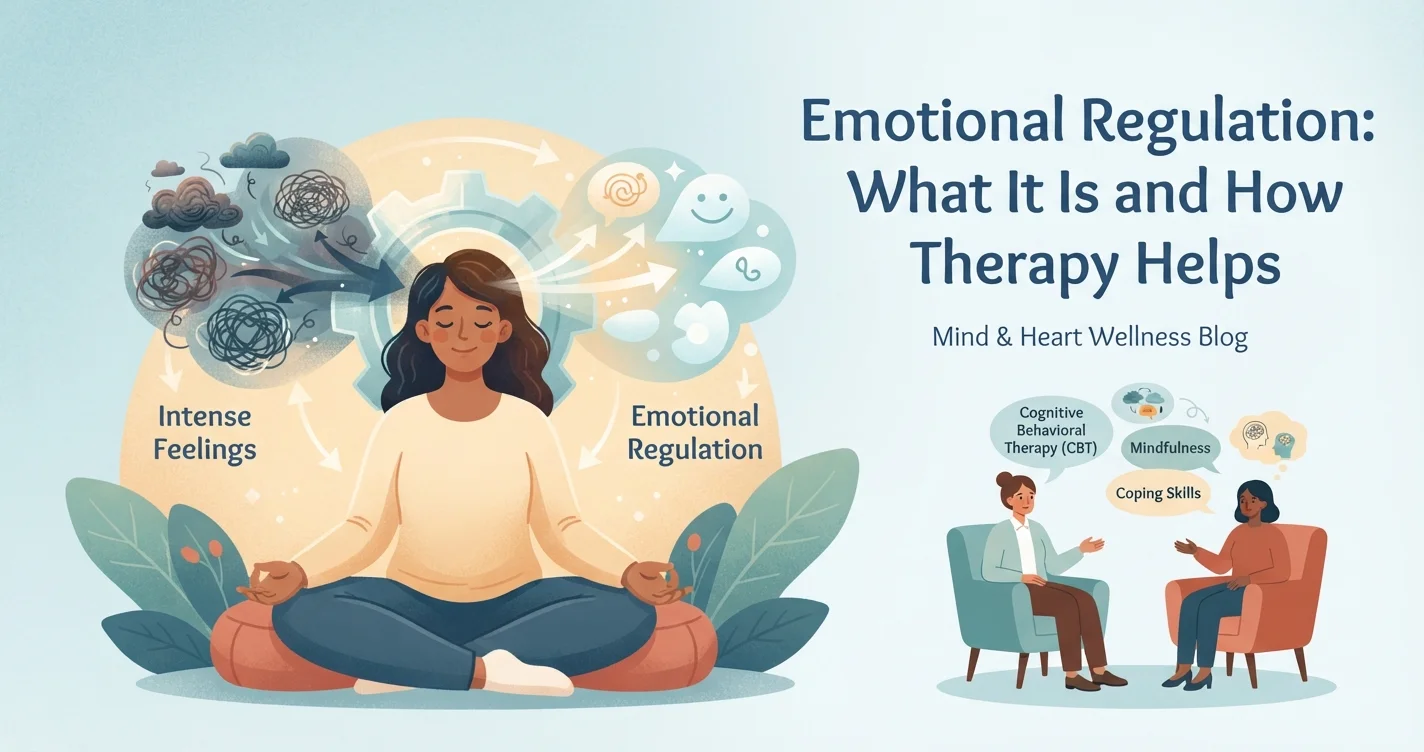
Emotional regulation is the ability to notice, understand and influence your emotions so that you can respond to situations in ways that fit your goals and values. Psychologist James Gross, one of the leading researchers in this field, describes it as the processes by which we influence which emotions we have, when we have them, and how we experience and express them.
That definition contains an important point. Emotional regulation is not about switching feelings off or never getting upset. Anger, sadness, fear and frustration are normal and often useful; they tell us when something matters or feels wrong. Healthy regulation means being able to feel an emotion fully without being controlled by it, and to bring yourself back to a steadier state afterward.
Emotional Regulation vs. Suppression
Many people confuse emotional regulation with hiding emotions. Pushing feelings down, putting on a brave face or telling yourself “Don’t be so sensitive” can look calm from the outside, but research suggests it often costs more than it saves. In a well-known 2003 study, James Gross and Oliver John found that people who habitually suppressed their emotional expression tended to report more negative emotion and poorer wellbeing, while those who habitually reappraised situations, looking at them from a different angle, tended to fare better. Suppression keeps the feeling inside; reappraisal changes how much of it you need to carry. In other words, healthy emotional regulation works with feelings rather than against them.
Signs of Emotional Dysregulation
When emotional regulation is difficult, clinicians sometimes use the term emotional dysregulation. It is not a diagnosis on its own, but a description of a pattern that can appear in many people and alongside many conditions. Common signs include:
- Emotions that feel overwhelming and seem to arrive out of nowhere.
- Reactions that feel out of proportion and are later regretted.
- Taking a long time to calm down after being upset.
- Using avoidance, food, alcohol or screens to escape feelings.
- Frequent conflict in close relationships.
Everyone experiences some of these occasionally. They become worth addressing when they are frequent, cause distress or start to damage relationships, work or self-esteem.
Why Emotional Regulation Is Harder for Some People
Difficulty with emotional regulation is not a character flaw. It usually grows from a combination of factors that make strong emotions more likely and harder to manage.
Temperament, Sensitivity and Emotional Regulation
Some people are naturally more emotionally sensitive. They feel things quickly, intensely and for longer. This sensitivity often comes with real strengths, such as empathy, creativity and deep loyalty, but it also means emotional regulation takes more practice.
What We Learned Growing Up
Emotional regulation skills are learned, and families are the first classroom. Psychologist Marsha Linehan, who developed dialectical behavior therapy (DBT), proposed that emotional difficulties often develop when a sensitive temperament meets an environment where feelings were dismissed, punished or ignored. A child told “Stop crying, it’s nothing” may learn that emotions are dangerous, but not how to soothe them. Others grow up in homes where anger was loud and frequent, and learn that explosion is how feelings are expressed. Yusra’s analytical-systemic training is especially relevant here, because it explores how these family patterns continue to shape the way adults experience and express emotions.
Stress, Sleep and Life Circumstances
Even people with good emotional regulation skills struggle when they are exhausted, unwell or under sustained pressure. Lack of sleep, chronic stress and difficult life circumstances all reduce the mental resources available to manage feelings. That is why the same comment can be shrugged off on a good day and feel unbearable on a bad one.
Trauma, ADHD and Other Factors
Experiences of trauma can leave the nervous system more reactive and quicker to sense threat. Emotional reactivity is also common in adults with ADHD, and it can be part of anxiety, depression and some personality patterns. If attention difficulties might be part of your picture, our article on ADHD vs anxiety in adults explains how they can overlap.
How Emotional Regulation Works: Five Points of Influence
James Gross’s process model of emotional regulation offers a helpful map. It suggests we can influence emotions at five points: by choosing which situations we enter, by changing a situation once we are in it, by shifting where we place our attention, by changing how we interpret what is happening, and by adjusting how we respond once the emotion is already present. The earlier in this chain we act, the less effort regulation usually takes.
In everyday terms, that might mean not checking work email just before bed (situation selection), asking to continue a heated discussion tomorrow (situation modification), focusing on your breathing rather than the insult replaying in your head (attention), reminding yourself that a friend’s short reply probably reflects a busy day rather than rejection (reappraisal), or taking a walk before responding (response). Seeing these options laid out often reassures people that emotional regulation offers more choices than they thought.
How to Regulate Emotions: Practical Skills?
If you are wondering how to regulate emotions in the moment, it helps to have a few reliable tools ready before you need them. Several of the most useful come from CBT and DBT.
Name It to Tame It
Simply putting a feeling into words can reduce its intensity. In a 2007 brain-imaging study, psychologist Matthew Lieberman and colleagues found that labelling emotions was associated with reduced activity in the amygdala, a brain region involved in threat responses. Saying to yourself, “I’m feeling hurt and angry right now,” creates a little distance between you and the emotion, and with distance comes choice.
Calm the Body First
When an emotion is very intense, thinking clearly is difficult. Bringing the body down a notch first often makes everything else easier. Slow breathing with a longer out-breath, splashing cool water on your face, stepping outside or moving your body can help settle the nervous system enough to think.
Pause Before You Act: A Core Emotional Regulation Skill
Strong emotions come with strong urges: to shout, send the message, leave, or shut down. Learning to notice the urge and wait, even for a few minutes, is one of the most valuable emotional regulation skills. Most urges peak and then fade if they are not acted on immediately. A simple rule such as “no important messages while I’m upset” can prevent a great deal of regret.
Check the Facts
Once the intensity has eased, it helps to ask what actually happened and how you interpreted it. Is there another explanation? Is the size of my reaction matching the size of the situation? This kind of reappraisal is central to CBT. You can read more about how CBT works with thoughts and feelings in our introduction What Is CBT?
Respond With Self-Compassion
Many people who struggle with managing strong emotions are also very hard on themselves afterward. Harsh self-criticism tends to add a second layer of distress to the first. Treating yourself with the kind of understanding you would offer a friend does not mean excusing hurtful behavior; it makes it easier to learn from it and repair.
Emotional Regulation in Relationships
Emotions rarely happen in isolation. They rise and fall in our interactions with partners, children, parents and colleagues. When one person becomes flooded, the other often reacts in turn, and a small disagreement can escalate quickly. People also help regulate each other: a calm voice, a hug or a reassuring word can settle strong feelings, a process sometimes called co-regulation.
This is why emotional regulation is often worked on not only individually but also within couples and family therapy. Learning to recognise escalation, take breaks before arguments spiral and return to the conversation calmly can transform relationships. Our article on attachment patterns in relationships explores how early bonds shape the way we react in close relationships.
An Illustrative Example
The following is a composite based on common patterns, not a real client. Karim, 34, works in sales in Beirut and has recently become a father. He describes himself as “calm, until I’m not.” At work, a curt email from his manager can ruin his whole day. At home, when the baby cries at night and his wife asks for help, he sometimes snaps, then withdraws for hours, ashamed.
In therapy, Karim first maps his pattern of emotional regulation. He notices that his strongest reactions happen when he is exhausted and feels criticised, and that in his family growing up, anger was the only emotion men were allowed to show. He practises naming his feelings (“I’m tired and I feel like I’m failing”) instead of exploding, agrees with his wife on a short break signal when either of them feels overwhelmed, and uses slow breathing before replying to difficult emails. As his emotional regulation improves over several months, his reactions do not disappear, but they become shorter and less intense, and he recovers far more quickly. Most importantly, he and his wife feel more like a team.
How Therapy Helps With Emotional Regulation?
Reading about emotional regulation skills is a start, but practising them with guidance is usually what makes them stick. Therapy offers a structured space to understand your emotional patterns, learn tools and try them out in real situations.
For emotional regulation, cognitive behavioral therapy helps people recognise the thoughts and interpretations that intensify emotions, and build more balanced responses. You can learn more on our page about CBT therapy in Lebanon. Dialectical behavior therapy, developed by Marsha Linehan, teaches skills in four areas: mindfulness, distress tolerance, emotion regulation and interpersonal effectiveness. Many therapists draw on these skills even outside a full DBT programme.
Therapy also explores where your emotional patterns come from. In Yusra’s practice, individual psychotherapy combines CBT with the analytical-systemic approach, so practical skills are paired with an understanding of family and relational patterns. Improving emotional regulation is one of the goals mentioned on the site’s homepage for therapy, and it often underpins progress in anxiety, low mood and relationship difficulties.
When to Seek Support
Consider speaking with a psychologist about emotional regulation if intense emotions are frequent, if they are causing conflict at home or work, if you often regret how you react, or if you rely on alcohol, food, screens or other escapes to cope with feelings. Seeking support is not a sign that you are failing to cope; it is a step toward coping differently.
Some people turn to self-harm to get through overwhelming emotions. If this is happening to you, please reach out for support; there are safer ways to cope, and you deserve help finding them. If you are in immediate danger or having thoughts of ending your life, contact local emergency services or go to the nearest hospital straight away.
Frequently Asked Questions
Emotional regulation is the ability to notice your feelings, understand them and manage how strongly you experience and express them, so that you can respond in ways that fit your goals instead of being carried away by the moment.
Yes. Emotional regulation is a set of skills, and skills can be learned at any age. Many adults develop much stronger regulation through practice and therapy, even if they never learned these skills growing up.
It usually develops from a mix of factors, including emotional sensitivity, early experiences, stress, lack of sleep, trauma, and conditions such as ADHD, anxiety or depression. A psychologist can help understand what is contributing in your case.
Slowing your breathing, stepping away from the situation, naming the emotion you feel and waiting before acting on strong urges can help. Practising these skills when you are calm makes them easier to use when emotions run high.
Cognitive behavioral therapy and skills drawn from dialectical behavior therapy are commonly used and well supported. The best approach depends on your needs, and many therapists combine practical skills with exploring underlying patterns.
Feeling Deeply, Responding Wisely
Emotional regulation is not about becoming less emotional. It is about having enough space between a feeling and your response to choose what you do next. With understanding, practice and the right support, intense emotions can become signals you listen to rather than storms that take over.
If strong emotions are affecting your relationships, work or wellbeing, support can help. Learn more about individual psychotherapy in Lebanon, book a confidential consultation, or send a message on WhatsApp with any questions first.
About this article: This content is for general education and does not diagnose or replace individual assessment or treatment. It was reviewed by Yusra Imad, Licensed Clinical Psychologist and CBT Psychotherapist. If you are in immediate danger or thinking of harming yourself, contact local emergency services or go to the nearest hospital.
Reviewed by Yusra Imad, Licensed Clinical Psychologist and CBT Psychotherapist in Lebanon.