
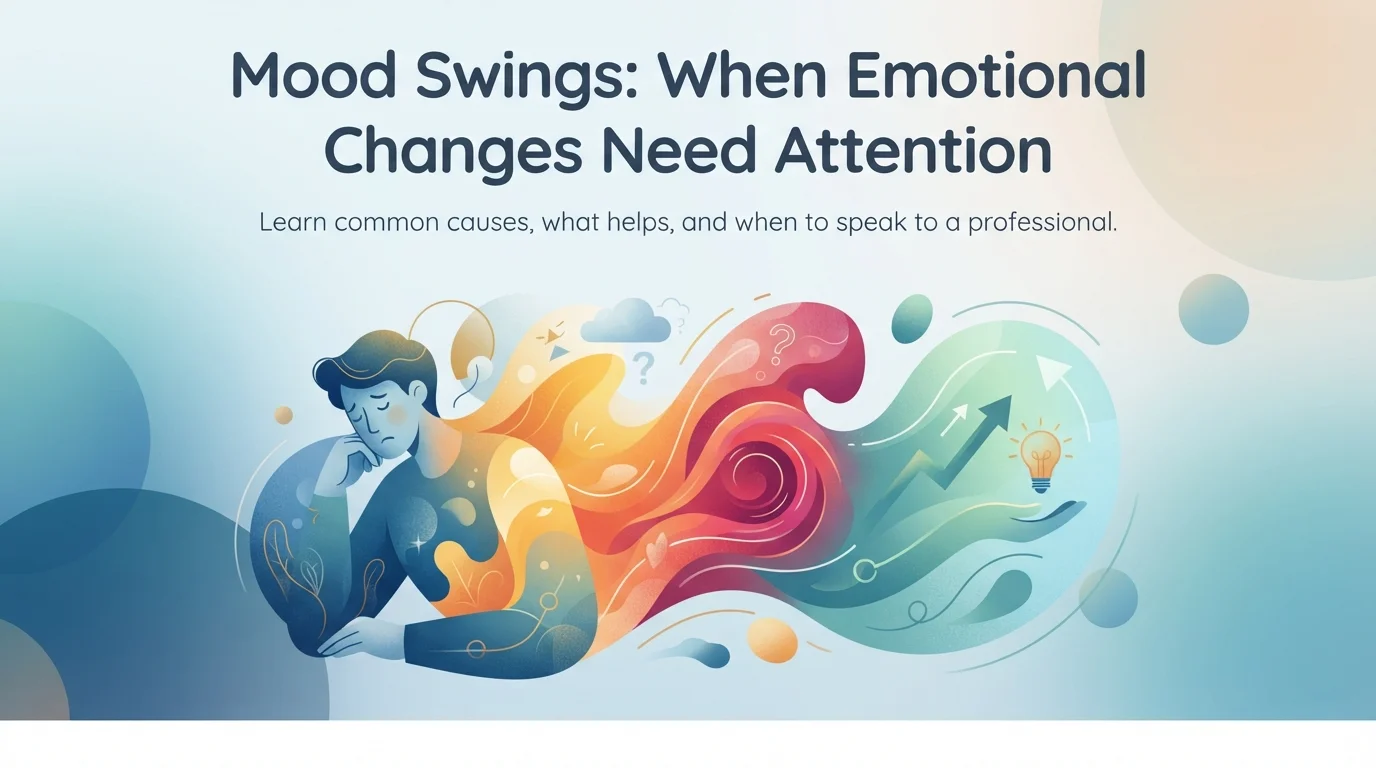
In the morning you feel fine, even upbeat. By lunchtime a small comment has you close to tears, and by evening you are snapping at the people you love most, then lying awake wondering what is wrong with you. If your emotions seem to change direction faster than you can keep up, you are probably asking the same question many people type late at night: why do I have such strong mood swings? The answer is rarely simple, but it is almost always understandable.
This guide explains what mood swings are, the difference between ordinary emotional ups and downs and patterns worth looking into, the most common causes, and when it makes sense to speak with a psychologist or psychiatrist. It is written to inform, not to diagnose. Only a qualified professional can assess what is behind your own experience.
What Are Mood Swings?
Mood swings are noticeable shifts in emotional state, often from feeling calm or content to feeling irritable, low, anxious or angry, sometimes with no obvious reason. People describe them in different ways: “My mood flips like a switch,” “I overreact and then feel terrible,” or “I can’t predict how I’ll feel tomorrow.” The shifts may last minutes, hours or days.
The term “mood swings” is not a diagnosis. It describes an experience that can have many different causes, from tiredness and stress to hormonal changes, anxiety, depression or, less commonly, a mood disorder such as bipolar disorder. Understanding the pattern is the key to understanding the cause.
Everyday Emotional Ups and Downs
Feelings are meant to change. Disappointment after bad news, irritability after a sleepless night, or a lift in mood after good news are all normal emotional ups and downs. Even fairly strong reactions can be perfectly healthy when they make sense in context and settle within a reasonable time.
When Mood Swings Become a Concern?
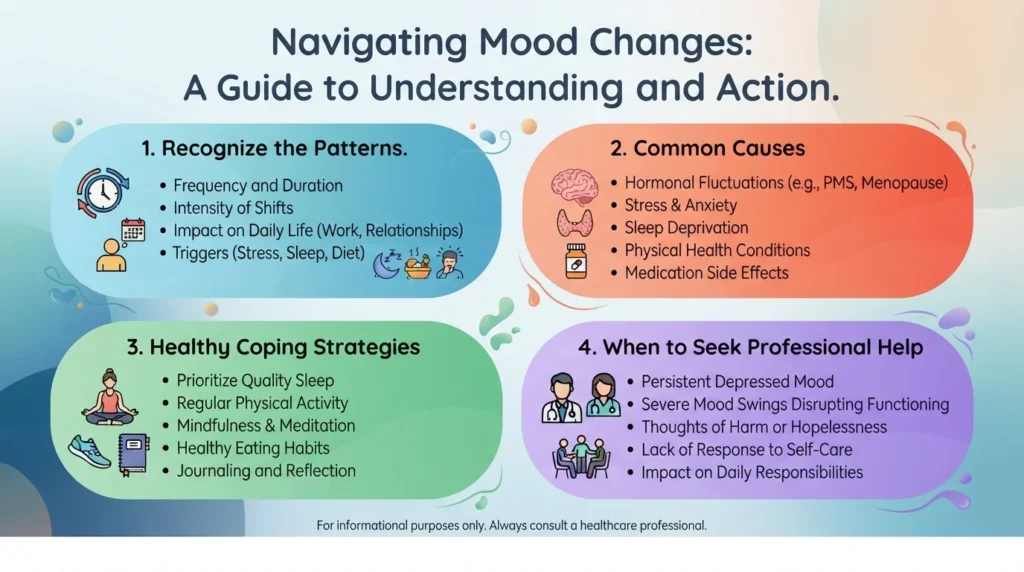
Mood swings deserve closer attention when they feel out of proportion to what is happening, happen frequently, are hard to recover from, or start affecting relationships, work, studies or self-esteem. Another important signal is change: if your moods have become noticeably more intense or unpredictable than they used to be, something may be contributing that is worth exploring.
Common Causes of Mood Swings
Because mood swings can have so many sources, it helps to think in layers: the body, everyday pressures, and psychological patterns. Often more than one layer is involved at the same time.
Sleep, Stress and Exhaustion
Poor sleep is one of the most common and most overlooked causes of mood swings and sudden mood changes. Sleep loss makes the brain’s emotional centres more reactive and weakens the ability to pause before reacting, which is why small frustrations feel enormous after a bad night. Ongoing stress has a similar effect. When the nervous system is running on high alert for weeks or months, irritability and tearfulness become more likely. If stress has become a constant part of life, our guide to coping with chronic stress offers practical strategies, and our article on anxiety and sleep problems explains how those two feed each other.
Hormonal and Physical Factors
The body has a strong influence on mood, and many mood swings have a physical component. Many women notice mood changes linked to the menstrual cycle; for some, the symptoms are severe enough to meet criteria for premenstrual dysphoric disorder (PMDD), which is recognised in the DSM-5. Pregnancy, the months after giving birth, and perimenopause can also bring significant mood shifts. Medical conditions such as thyroid problems, as well as some medications, can affect mood too. This is why a check-up with a doctor is often a sensible early step, particularly when mood swings are new or have changed noticeably.
Caffeine, Alcohol and Other Substances
Alcohol, cannabis, stimulants and even large amounts of caffeine can trigger or worsen mood swings, both while using them and as their effects wear off. Many people use these substances to manage difficult feelings, which can create a cycle in which the “solution” quietly makes the problem worse.
Anxiety and Depression
Anxiety and depression are common drivers of mood swings. Anxiety often shows up as irritability, tension and quick frustration rather than visible worry. Depression does not always look like sadness either; it can appear as short temper, emotional numbness that breaks into tears, or swings between feeling flat and feeling overwhelmed. If low mood has lasted for weeks, our article What Is Depression? explains the signs to look for.
Mood Swings and Difficulty Regulating Emotions
Some people feel emotions very intensely and find it hard to bring them back down once they rise. This can be linked to temperament, early experiences, trauma, ADHD or long-standing relationship patterns. Emotional sensitivity is not a flaw; it often comes with deep empathy and strong attachment to people. But when intense feelings repeatedly lead to regretted words or actions, learning emotion-regulation skills can make a real difference.
Mood Swings vs. Bipolar Disorder
Many people who search for information on mood swings worry that they might have bipolar disorder. It is an understandable concern, but it is important to know that bipolar disorder is quite specific and is not the most common reason for changing moods.
What Makes Bipolar Disorder Different
Bipolar disorder involves distinct mood episodes, not shifts within a single conversation or afternoon. According to the DSM-5, a manic episode lasts at least a week (or any duration if hospitalisation is needed), and a hypomanic episode lasts at least four consecutive days. During these periods, people may experience unusually elevated or irritable mood together with clearly increased energy, a reduced need for sleep without feeling tired, racing thoughts, rapid speech, inflated self-confidence and risky behavior, such as spending heavily or making impulsive decisions. Many people with bipolar disorder also experience periods of depression.
Ordinary mood swings, such as feeling happy in the morning and frustrated in the evening, are not, on their own, what clinicians mean by bipolar disorder. That said, only a qualified professional can make this distinction. If you recognise several of the features above, especially reduced need for sleep combined with high energy lasting for days, it is important to speak with a psychiatrist or psychologist.
Why Self-Diagnosis Can Mislead?
Online quizzes and social media content can raise useful questions, but they cannot capture the timing, intensity and context that a proper assessment considers. Many conditions overlap, and the same experience can have very different causes in different people. Our article on whether you need a diagnosis before therapy explains how professionals approach this.
How to Understand Your Own Mood Swings?
One of the most useful things you can do is observe your mood swings for a few weeks before drawing conclusions. A simple daily note, on paper or in a phone app, can reveal patterns that are invisible in the moment. Consider recording:
- Your mood, rated from 1 to 10, at a few points in the day.
- How many hours you slept and how rested you felt.
- Stressful events, conflicts or triggers.
- Caffeine, alcohol or other substances.
- Where relevant, your menstrual cycle.
After two to four weeks, many people notice clear links, for example that their worst days follow short nights, arguments, or particular times of the month. If you decide to see a professional, bringing this record makes the first conversation far more productive.
An Illustrative Example
The following is a composite based on common patterns, not a real client. Rania, 33, works long hours as a pharmacist in Mount Lebanon. Over the past year she has noticed that she swings from calm to furious over small things, then cries and feels guilty. She began to worry she might have bipolar disorder after reading about it online.
Her doctor checked her thyroid function, which was normal, and suggested she see a psychologist. Rania kept a mood log for three weeks. It showed that her worst days followed nights of five hours’ sleep or less and clustered in the week before her period, and that her shortest fuse came on days after conflict with her manager. There were no episodes of high energy or reduced need for sleep. In therapy, she worked on protecting her sleep, setting clearer boundaries at work and practising emotion-regulation skills for the moments when anger rose quickly. Her doctor also discussed options for premenstrual symptoms. Within a few months, her mood swings were less frequent and, more importantly, much easier to manage when they came.
When to Seek Help for Mood Swings?
Consider speaking with a psychologist if your mood swings are frequent or intense, if they are damaging relationships or affecting work and studies, if you often regret how you react, if they have lasted more than a few weeks, or if you simply feel you no longer recognise yourself. You do not need to wait until things feel unmanageable.
When to Seek Help Urgently?
Some situations need immediate attention. If you are having thoughts of harming yourself or ending your life, if you have gone several days with very little sleep while feeling unusually energetic or invincible, if you are taking serious risks you would not normally take, or if you are seeing or hearing things others do not, please seek urgent help. Contact local emergency services, go to the nearest hospital emergency department, or reach a doctor straight away.
How a Psychologist Can Help With Mood Swings?
Support usually begins with understanding. A psychologist will explore when your mood swings happen, what triggers them, how long they last and how they affect your life, and will consider physical, emotional and relational factors. Where the picture is unclear, a structured psychological assessment can help clarify what is going on.
Therapy then focuses on what is driving the pattern. Cognitive behavioral therapy helps people notice the thoughts and interpretations that intensify emotional reactions and build more balanced responses. Emotion-regulation skills, many drawn from dialectical behavior therapy (DBT), developed by psychologist Marsha Linehan, help people recognise rising emotions early, tolerate distress and respond in ways that match their values rather than the intensity of the moment. Practical work on sleep, routines, stress and boundaries is often part of the plan.
When a mood disorder such as bipolar disorder is suspected, assessment and treatment by a psychiatrist are essential, because medication is usually central to care. Clinical guidelines, including those from the UK’s National Institute for Health and Care Excellence (NICE), also recommend psychological therapy as part of the wider treatment plan. Yusra’s practice offers collaborative care with psychiatry so that psychological and medical support can work together.
Supporting Someone With Mood Swings
Living with someone whose emotions shift rapidly can be confusing and tiring. It helps to talk about concerns during calm moments rather than in the middle of an argument, to focus on specific behaviors rather than character (“When you shouted yesterday, I felt scared” rather than “You’re always unstable”), and to encourage professional support gently rather than as an ultimatum. Looking after your own wellbeing matters too, and family or couples sessions can sometimes help everyone understand the pattern together.
Frequently Asked Questions
Some emotional ups and downs are a normal part of life, especially during stress, illness, poor sleep or hormonal changes. Mood swings become a concern when they are frequent, intense, out of proportion to events, or affect relationships and daily functioning.
Rapid mood changes are often linked to sleep loss, stress, hormonal shifts, substances, anxiety, depression or difficulties regulating intense emotions. Tracking your mood alongside sleep and triggers for a few weeks can help reveal what is driving them.
Not necessarily. Bipolar disorder involves distinct episodes lasting days or longer, with features such as reduced need for sleep and unusually high energy. Most mood swings have other causes. Only a qualified professional can assess whether a mood disorder is present.
Yes. The menstrual cycle, pregnancy, the postpartum period, perimenopause and thyroid conditions can all affect mood. A doctor can help assess physical causes, and psychological support can help manage the emotional impact.
Cognitive behavioral therapy and emotion-regulation skills, including those drawn from DBT, are commonly used. The right approach depends on the cause, which is why a careful assessment of your pattern comes first.
Understanding Your Moods Is the First Step
Mood swings can leave you feeling out of control and confused about yourself, but they are usually a signal worth listening to rather than a verdict on who you are. Whether they come from exhaustion, stress, hormones, anxiety or something that needs specialist care, understanding the pattern opens the door to support that genuinely helps.
If your emotions have been harder to manage lately, you do not have to figure it out alone. Learn more about individual psychotherapy in Lebanon, book a confidential consultation, or send a message on WhatsApp with any questions first.
About this article: This content is for general education and does not diagnose or replace individual assessment, medical advice or treatment. It was reviewed by Yusra Imad, Licensed Clinical Psychologist and CBT Psychotherapist. Decisions about medication should be made with a qualified medical professional. If you are in immediate danger or thinking of harming yourself, contact local emergency services or go to the nearest hospital.
Reviewed by Yusra Imad, Licensed Clinical Psychologist and CBT Psychotherapist in Lebanon.