
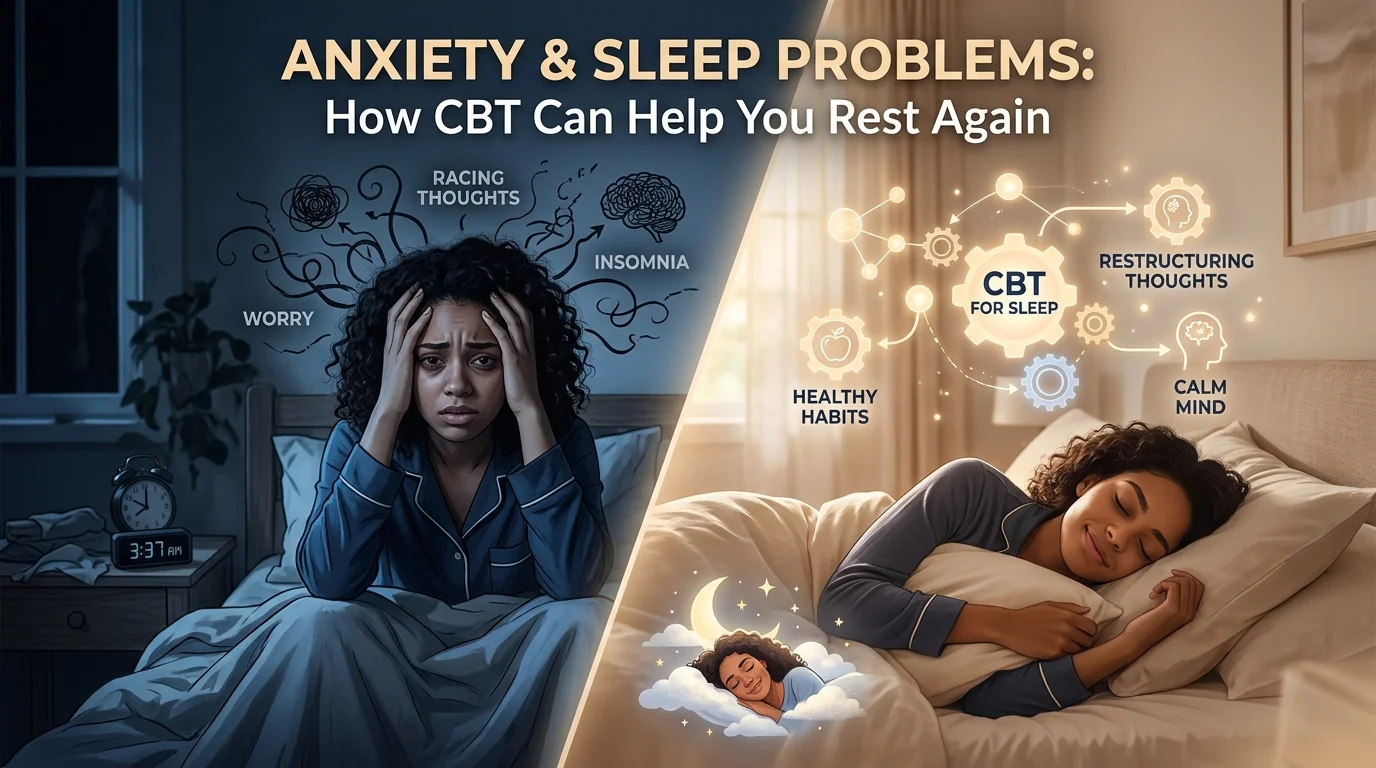
The day is finally over. You are exhausted, you get into bed, and the moment the lights go off your mind switches on. Tomorrow’s meeting. A conversation you regret. The bills. The clock. Every hour that passes adds a new worry: “If I don’t sleep now, I won’t cope tomorrow.” Anxiety and sleep problems are one of the most common and frustrating combinations people bring to therapy, and the two have a way of feeding each other night after night.
The encouraging part is that this cycle is well understood, and psychological approaches based on cognitive behavioral therapy can help break it. This guide explains how anxiety disrupts sleep, why worrying about sleep often makes things worse, what CBT-based approaches involve, and when a sleep problem needs medical attention.
How Anxiety and Sleep Problems Are Connected?
Most people notice that when they are anxious, they sleep badly. Fewer realise the relationship runs both ways.
A Two-Way Relationship
Anxiety makes it harder to fall and stay asleep, and poor sleep makes anxiety worse. Research from the University of California, Berkeley, led by sleep scientist Matthew Walker and published in Nature Human Behaviour in 2019, found that a single night of sleep deprivation raised people’s anxiety levels the following day, while deep sleep appeared to help calm the anxious brain. This is why anxiety and sleep problems so often become a cycle: a bad night leaves you more anxious, and more anxiety leads to another bad night.
Why the Body Won’t Switch Off?
Sleep requires the body and mind to wind down. Anxiety does the opposite. It activates the body’s threat response, raising heart rate, muscle tension and alertness, all of which are useful when facing danger but unhelpful when trying to sleep. Sleep researchers use the term hyperarousal to describe this state of being “tired but wired,” and it is one of the central features of anxiety-related insomnia.
Common Ways Anxiety Disrupts Sleep
Anxiety does not affect everyone’s sleep in the same way, and anxiety and sleep problems can take several forms. Recognising your own pattern helps you and your therapist decide where to focus.
Trouble Falling Asleep
This is the classic pattern of anxiety insomnia. Without the distractions of the day, worries rush in as soon as your head touches the pillow. Many people describe lying awake for an hour or more, replaying the day or rehearsing tomorrow. If racing, repetitive thoughts are the main issue, our article on CBT for overthinking looks at those loops in more detail.
Waking in the Night or Too Early
Others fall asleep easily but wake at 3 or 4 a.m. with a jolt of worry and find it hard to drift off again. Early-morning waking can also be associated with low mood, so if it comes with persistent sadness, loss of interest or fatigue, it is worth mentioning to a professional. Our article What Is Depression? describes those signs.
Night-Time Panic
Some people wake suddenly with a racing heart, shortness of breath and intense fear, sometimes without remembering any dream. These can be nocturnal panic attacks. They are frightening but not dangerous in themselves, although new or unusual symptoms such as chest pain should always be checked by a doctor. Our guide to panic attack vs anxiety attack explains what happens in the body during these episodes.
When Worry About Sleep Becomes the Problem?
One of the most important ideas in understanding anxiety and sleep problems is that, over time, the worry often shifts from life in general to sleep itself. After several bad nights, people start dreading bedtime. They check the clock, calculate how many hours are left, and predict how terrible tomorrow will be. That pressure increases arousal, which makes sleep even less likely.
The bed can also become linked with frustration and alertness rather than rest. Psychologists describe this as conditioned arousal: the brain learns that bed is a place for worrying, scrolling or struggling. Some people notice they feel sleepy on the sofa but wide awake the moment they get into bed. If you can’t sleep because of anxiety and that pattern sounds familiar, you are describing a well-known process, and one that CBT approaches target directly.
How CBT Helps With Anxiety and Sleep Problems?
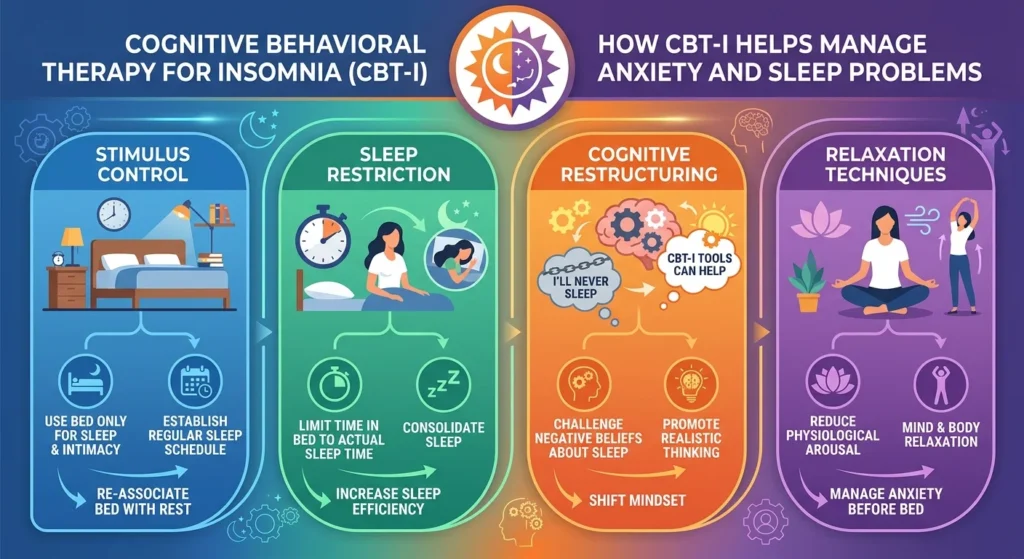
Cognitive behavioral therapy for insomnia, known as CBT-I, is recommended as the first-line treatment for chronic insomnia by bodies including the American College of Physicians and the American Academy of Sleep Medicine. When sleep difficulties are driven largely by anxiety, a therapist will often combine elements of CBT-I with CBT for the anxiety itself. Here is how the work typically fits together.
Working on the Daytime Anxiety
Anxiety and sleep problems rarely improve fully while the underlying worry is left untouched. Therapy addresses the worries, beliefs and habits driving anxiety during the day, so that less of it follows you to bed. Techniques such as scheduled worry time, where you set aside time earlier in the evening to deal with concerns, can reduce how much the mind tries to process at night. You can read more about this approach in our introduction What Is CBT?
Re-linking Bed With Sleep
A core CBT-I technique, known as stimulus control, aims to rebuild the connection between bed and sleep. It usually involves going to bed only when sleepy, using the bed mainly for sleep, and getting up if you have been lying awake for a long time, doing something calm in dim light, then returning when sleepy. It feels counterintuitive at first, but over time it helps the brain unlearn the link between bed and wakefulness.
Rebuilding a Natural Sleep Rhythm
CBT-I often includes adjusting the time you spend in bed so that it matches the sleep you are actually getting, then gradually extending it as sleep becomes more consolidated. Keeping a consistent wake-up time, even after a poor night, is a key part of this. Because these techniques can temporarily increase tiredness, they are best done with professional guidance rather than alone, and they are not suitable for everyone.
Changing Unhelpful Beliefs About Sleep
Thoughts such as “I need eight hours or I can’t function” or “One bad night will ruin my week” add pressure that keeps people awake. CBT helps you examine these beliefs and replace them with more balanced ones, such as “I’ve coped after poor nights before” or “My body will catch up on sleep over time.” Reducing the fear of not sleeping is often what finally allows sleep to return.
Calming the Body
Relaxation techniques, including slow breathing, progressive muscle relaxation and mindfulness, can lower physical arousal before bed. They work best when practised regularly, including during the day, rather than used only as an emergency tool when you are already struggling to sleep.
What About Sleep Hygiene?
Sleep hygiene refers to everyday habits that support good sleep. It is useful, but on its own it is rarely enough to resolve persistent anxiety-related sleep difficulties. Still, a few basics make a real difference for many people:
- Keep a regular wake-up time, including on weekends.
- Limit caffeine in the afternoon and evening.
- Reduce screens and work in the hour before bed.
- Keep the bedroom cool, dark and quiet.
Think of these as the foundation. CBT works on the anxious thoughts and habits built on top of it.
An Illustrative Example
The following is a composite based on common patterns, not a real client. Nour, 44, is a secondary school teacher in Beirut. For months she has been waking at around 3 a.m., her mind immediately filling with worries about her students, her elderly mother and money. She lies awake checking the time and often gets up feeling drained. She has started going to bed earlier to “catch up,” but this only gives her more time lying awake.
In therapy, Nour and her therapist map the cycle: daytime stress, worry carried into the night, clock-watching, frustration and anxious predictions about the next day. She starts a short worry-and-planning session at 7 p.m., stops checking the clock at night, and gets up to read in another room if she cannot fall back asleep. Together they adjust her schedule to a consistent wake-up time and stop the early bedtimes. Therapy also addresses the beliefs behind her worries about her mother’s care. Over several weeks, her night-time waking becomes less frequent and less distressing, and when it does happen, she finds she can return to sleep more easily.
When Sleep Problems Need Medical Attention?
Not all sleep difficulties are caused by anxiety, and some apparent anxiety and sleep problems turn out to have a medical cause. It is important to speak with a doctor if you snore loudly, stop breathing or gasp during sleep, feel very sleepy during the day despite enough time in bed, have uncomfortable sensations or urges to move your legs at night, or if sleep problems began after starting a new medication. These can point to medical conditions such as sleep apnoea or restless legs syndrome, which need medical assessment.
Sometimes medication may be considered alongside therapy, particularly for short-term relief or when anxiety or depression is severe. Decisions about medication should always be made with a qualified medical professional. Yusra’s practice offers collaborative care with psychiatry for situations where psychological and medical support work best together.
When to Seek Support?
Consider speaking with a professional if anxiety has been disrupting your sleep for several weeks, if poor sleep is affecting your mood, work, studies or relationships, if you have started to dread bedtime, or if you are relying more on caffeine, alcohol or sleep aids to get through. In clinical terms, sleep difficulties that occur at least three nights a week for three months or more are considered chronic and deserve proper attention. You do not need to wait that long to ask for help.
A psychologist can help you understand what is keeping your sleep problems going and build a plan that addresses both the anxiety and the sleep pattern. You can learn more on our page on CBT therapy in Lebanon.
Frequently Asked Questions
Yes. Anxiety activates the body’s alert system, making it harder to relax enough to fall or stay asleep. Over time, worry about sleep itself can keep insomnia going even when the original stressor has eased.
Many people find it helpful to deal with worries earlier in the evening, keep a consistent routine, avoid clock-watching, and get up briefly if they cannot sleep rather than lying in bed frustrated. Persistent night-time anxiety is best addressed with professional support.
CBT for insomnia has strong research support and is often helpful when anxiety is involved, especially when combined with CBT for the anxiety itself. A therapist will tailor the approach to your situation and review progress regularly.
Medication is a medical decision that should be discussed with a doctor or psychiatrist. Psychological approaches such as CBT are generally recommended first for chronic insomnia, and in some cases medication and therapy are used together.
Waking in the early hours is common during periods of stress. Lighter sleep stages later in the night, combined with an alert nervous system, make it easier for worries to surface. If early waking comes with persistent low mood, it is worth discussing with a professional.
Rest Is Possible Again
Anxiety and sleep problems can feel like an endless loop, but they respond well to the right approach. By calming daytime anxiety, rebuilding a healthy link between bed and sleep, and loosening the fear of not sleeping, many people find their nights become calmer and their days more manageable.
If worry is keeping you awake, support is available. Explore cognitive behavioral therapy in Lebanon, book a confidential consultation, or send a message on WhatsApp with any questions first.
About this article: This content is for general education and does not diagnose or replace individual assessment, medical advice or treatment. It was reviewed by Yusra Imad, Licensed Clinical Psychologist and CBT Psychotherapist, holding CBT certification from ALTCC. If you have symptoms such as loud snoring with pauses in breathing, chest pain or severe daytime sleepiness, please consult a doctor. If you are in immediate danger or thinking of harming yourself, contact local emergency services or go to the nearest hospital.
Reviewed by Yusra Imad, Licensed Clinical Psychologist and CBT Psychotherapist