


You are holding a baby and a sudden image flashes through your mind of dropping them. You are standing on a balcony and think, “What if I jumped?” You are praying and a disrespectful thought appears out of nowhere. The thought lasts a second, but the fear it leaves behind can last for days: “Why would I think that? What does it say about me?” These are intrusive thoughts, and if you have them, you are in very large company.
This guide explains what intrusive thoughts are, why almost everyone has them, why they sometimes get stuck, and how they relate to anxiety and obsessive-compulsive patterns. Most importantly, it explains why these thoughts usually say far less about you than they seem to, and when it makes sense to seek support.
What Are Intrusive Thoughts?
Intrusive thoughts are unwanted thoughts, images or urges that pop into the mind suddenly and feel disturbing, out of character or wrong. They arrive without being invited, and they often clash with your values. That clash is the key feature: intrusive thoughts are upsetting precisely because they go against what you want, believe or would ever choose to do.
Common Themes
The content of unwanted thoughts varies widely, but some themes appear again and again:
- Harm: thoughts of accidentally or deliberately hurting yourself or someone you love.
- Contamination: fears of germs, illness or spreading something harmful.
- Doubt: “Did I lock the door? Did I hit someone while driving?”
- Taboo content: sexual, blasphemous or socially unacceptable thoughts.
- Relationships: sudden doubts about whether you really love your partner.
Why Having Them Doesn’t Define You?
People often fear that an intrusive thought reveals a hidden desire or a dangerous side of themselves. In fact, the distress you feel is usually evidence of the opposite. A thought about harming a loved one is frightening because you care about protecting them. A blasphemous thought is upsetting because your faith matters to you. Thoughts are mental events, not intentions, predictions or reflections of character.
How Common Are Intrusive Thoughts?
Very common. In a classic 1978 study, psychologists Stanley Rachman and Padmal de Silva found that most people without any mental health condition reported intrusive thoughts, and that their content was strikingly similar to the obsessions of people with OCD. A much larger international study led by psychologist Adam Radomsky, published in 2014 and involving participants across six continents, found that the vast majority of people reported experiencing at least one unwanted intrusive thought in the previous three months.
In other words, the difference between people who struggle with intrusive thoughts and people who do not is usually not whether the thoughts appear. It is how the person interprets and responds to them.
Why Intrusive Thoughts Get Stuck?
For most people, intrusive thoughts come and go without much attention. For others, they become sticky, frequent and distressing. Cognitive models of anxiety and OCD explain why.
The Meaning You Attach to the Thought
When a thought is interpreted as dangerous or significant, such as “Having this thought means I might do it” or “Thinking it is as bad as doing it,” it triggers anxiety and demands attention. Psychologists Stanley Rachman and Roz Shafran described a pattern called thought-action fusion: the belief that thinking something makes it more likely to happen, or is morally equivalent to acting on it. This belief turns an ordinary mental event into an emergency.
Trying to Push the Thought Away
The natural response is to try not to think the thought. Unfortunately, suppression tends to backfire. In well-known experiments, social psychologist Daniel Wegner asked people not to think about a white bear; those who tried to suppress the thought often experienced it more frequently afterward. The harder you push intrusive thoughts away, the more the brain flags them as important.
Checking, Reassurance and Avoidance
To reduce anxiety, people often check (for example, looking repeatedly to make sure the stove is off), seek reassurance (“Do you think I’m a bad person?”), mentally review or “cancel” the thought, or avoid situations that trigger it, such as no longer holding knives or avoiding being alone with a child. These actions bring short-term relief, but they also teach the brain that the thought was dangerous, so it returns with more force.
Intrusive Thoughts and Anxiety
Anxiety and intrusive thoughts feed each other. When you are stressed, tired or anxious, intrusive thoughts tend to appear more often and feel more convincing. In turn, the fear they trigger raises anxiety further. This is why many people notice intrusive thoughts intensify during demanding life periods, such as exams, a new job, becoming a parent, or times of wider uncertainty. Understanding the general patterns of anxiety, explained in our article on generalized anxiety vs social anxiety, can help put these thoughts in context.
Intrusive Thoughts and OCD
In obsessive-compulsive disorder (OCD), intrusive thoughts become obsessions: persistent, distressing and time-consuming. They are typically paired with compulsions, which are repetitive behaviors or mental acts carried out to reduce anxiety or prevent a feared outcome. Compulsions can be visible, such as washing or checking, or hidden inside the mind, such as praying a certain number of times, repeating phrases, or mentally reviewing events. Some people experience mostly mental rituals, which can make OCD hard to recognise from the outside.
Having intrusive thoughts OCD-style themes does not mean you have OCD. The difference lies in how much time the thoughts and rituals take, how much distress they cause, and how much they interfere with daily life. Only a qualified professional can make an assessment. Our article on CBT for OCD explains how that pattern is understood and treated.
Intrusive Memories After Trauma
Not all intrusive thoughts relate to anxiety or OCD. After distressing or traumatic experiences, people may have intrusive memories, images or flashbacks of what happened. These feel different from the “what if” quality of obsessional thoughts, because they replay something real. If intrusive memories are part of your experience, our article What Is Trauma? explains how trauma can affect the mind and body.
When Intrusive Thoughts Involve Faith?
For people of faith, intrusive thoughts with religious content can be especially painful. Someone may fear that a blasphemous thought is a sin, or feel compelled to repeat prayers or seek repeated reassurance from religious figures until they feel “right.” Clinicians sometimes call this pattern scrupulosity. Importantly, therapy does not ask anyone to question their faith. It aims to help people practise their beliefs in the way they want to, without being controlled by fear. Many people find that easing the anxiety allows their faith to feel more peaceful again.
An Illustrative Example
The following is a composite based on common patterns, not a real client. Sami, 31, recently became a father. A few weeks after his daughter’s birth, he started having sudden thoughts of accidentally hurting her while bathing her. The thoughts horrified him. He began avoiding bath time, asked his wife to handle it, and spent hours searching online whether such thoughts meant he was dangerous. The more he searched, the more anxious he felt.
In therapy, Sami learns that thoughts like his are extremely common among new parents and are linked to the intense responsibility of caring for a baby. Together with his therapist, he identifies the beliefs that make the thoughts feel threatening (“If I think it, I might do it”) and notices how avoidance and online checking keep the fear alive. Step by step, he returns to bathing his daughter, allowing the thoughts to come and go without arguing with them or seeking reassurance. Over time, the thoughts become less frequent and, more importantly, far less frightening. He describes them as “background noise” rather than a warning.
How CBT Helps With Intrusive Thoughts?
Cognitive behavioral therapy is one of the most effective and widely studied approaches for distressing intrusive thoughts. It usually works on several fronts. First, it helps you understand that intrusive thoughts are normal and that their content does not reflect your intentions. Next, it examines the meaning you give the thoughts and the beliefs that make them feel dangerous. Then it gradually reduces the behaviors that keep them going, such as checking, reassurance-seeking, mental rituals and avoidance.
When intrusive thoughts are part of OCD, a specific form of CBT called exposure and response prevention (ERP) is recommended in clinical guidelines from the UK’s National Institute for Health and Care Excellence (NICE). ERP involves gradually and safely facing the thoughts or situations that trigger anxiety while resisting the urge to perform rituals, so the brain learns that the feared outcome does not occur and the anxiety fades on its own. It is always done collaboratively and at a pace the person agrees to. You can read more about the approach in What Is CBT? and on our page on CBT therapy in Lebanon.
What You Can Try Now?
A few shifts can make intrusive thoughts less powerful. Try labelling the thought for what it is: “This is an intrusive thought,” rather than treating it as a message you must act on. Allow it to be there without arguing with it or pushing it away, much like noticing a car passing outside. Gently notice the urge to check or seek reassurance and, where you safely can, delay acting on it. And remind yourself that the discomfort will rise and then fall if you let it.
These strategies are not about forcing thoughts to stop. They are about changing your relationship with them, which is often what finally allows them to fade.
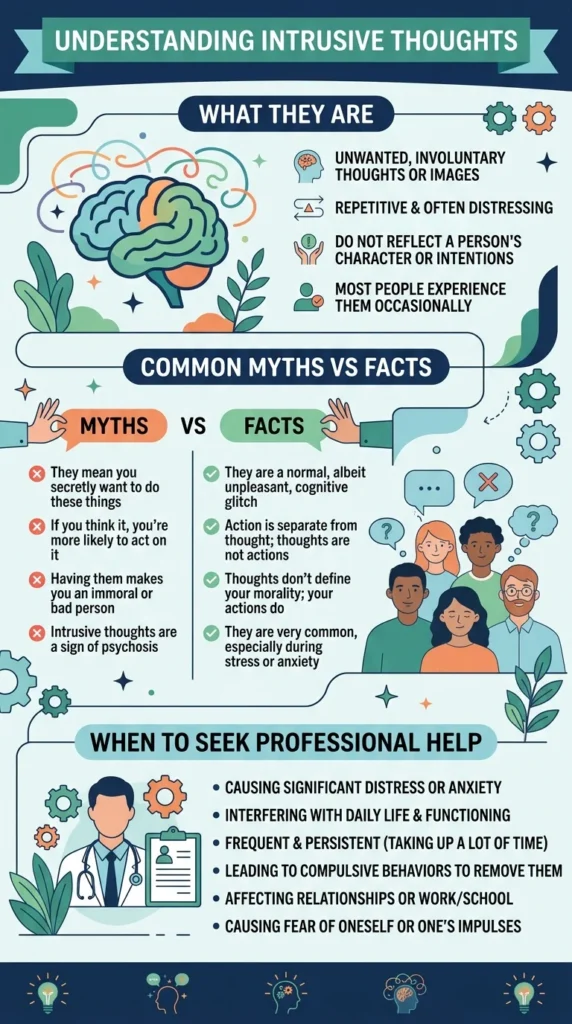
When to Seek Help?
Consider speaking with a psychologist if intrusive thoughts are frequent or intensely distressing, if you spend a lot of time trying to neutralise them through checking, rituals or reassurance, if you are avoiding people, places or responsibilities because of them, or if they are affecting your work, relationships or sleep. New parents experiencing distressing thoughts are also encouraged to speak with their doctor or a mental health professional; such thoughts are common and support is available.
It is important to distinguish intrusive thoughts, which are unwanted and feel alien, from thoughts of harming yourself that come with a sense of wanting to act on them, feeling hopeless, or making plans. If you are having thoughts of ending your life or harming yourself and feel at risk of acting on them, please contact local emergency services or go to the nearest hospital straight away.
Frequently Asked Questions
Yes. Research shows that the vast majority of people experience intrusive thoughts from time to time, including thoughts about harm, taboo subjects or doubt. Having them is part of how the human mind works.
No. Intrusive thoughts are unwanted and usually go against your values, which is why they feel distressing. The anxiety they cause is generally a sign that you do not want to act on them.
Trying hard to stop them usually makes them stronger. A more helpful approach is to label them, allow them to pass without engaging, and reduce checking or reassurance-seeking. If they remain distressing, CBT can help change how you respond to them.
Intrusive thoughts are common and usually pass quickly. In OCD, they become persistent obsessions accompanied by compulsions or mental rituals that take significant time, cause distress and interfere with daily life. A professional assessment can clarify which applies.
Anxiety and stress can make intrusive thoughts more frequent and more distressing. Calming general anxiety and changing how you respond to the thoughts often reduces their intensity.
A Thought Is Just a Thought
Intrusive thoughts can be frightening, but they are among the most common experiences of the human mind, and they do not define who you are. With understanding and the right support, most people learn to let these thoughts pass through without fear, and to reclaim the time and peace of mind they had been taking.
If unwanted thoughts are causing you distress, you do not have to face them alone. Learn more about cognitive behavioral therapy in Lebanon, book a confidential consultation, or send a message on WhatsApp with any questions first.
About this article: This content is for general education and does not diagnose or replace individual assessment or treatment. It was reviewed by Yusra Imad, Licensed Clinical Psychologist and CBT Psychotherapist, holding CBT certification from ALTCC. If you are in immediate danger or thinking of harming yourself, contact local emergency services or go to the nearest hospital.
Reviewed by Yusra Imad, Licensed Clinical Psychologist and CBT Psychotherapist in Lebanon.