
It is not one crisis. It is everything, all the time. The workload that never shrinks, the bills, the family responsibilities, the news, the background worry about what comes next. You keep going because you have to, but your shoulders never quite drop, your sleep is light, and small things set you off more easily than they used to. This is what chronic stress feels like: not a single storm, but weather that never clears.
This guide explains what chronic stress is, why it is so hard to shake, and practical, therapy-based strategies that help. It also covers when it may be time to seek professional support. If you are unsure whether you are dealing with stress or something deeper, our article on stress vs burnout explains the difference.
What Is Chronic Stress?
To understand chronic stress, it helps to start with stress itself. Stress is the body’s natural response to demands and threats. It prepares you to act by raising your heart rate, sharpening your focus and releasing energy. In short bursts, this response is useful. It helps you meet a deadline, react in an emergency or rise to a challenge.
Acute Stress vs. Chronic Stress
Acute stress is short-lived. The challenge arrives, you respond, and your body returns to balance. Chronic stress is different: the pressure continues for weeks, months or even years, and the stress response never fully switches off. Common sources include demanding jobs, long-term financial strain, caring for a family member, relationship difficulties, health problems and living with ongoing uncertainty.
How Chronic Stress Affects Body and Mind
Neuroscientist Bruce McEwen described the cumulative wear and tear of prolonged stress as “allostatic load.” When the body stays in a heightened state for too long, it begins to pay a price. People living with chronic stress often notice poorer sleep, headaches, muscle tension, digestive problems, frequent minor illnesses, low energy and difficulty concentrating. Emotionally, it can show up as irritability, anxiety, feeling overwhelmed, or a sense of being permanently on edge. Over time, chronic stress is linked to a higher risk of anxiety, depression and physical health problems, which is why it deserves attention rather than endurance.
Signs Chronic Stress Is Taking a Toll
Because chronic stress builds gradually, many people get used to it and stop noticing how much it affects them. Some useful questions to ask yourself: Do I feel tense most days, even when nothing specific is wrong? Is it hard to relax, even on days off? Am I more irritable or tearful than usual? Has my sleep, appetite or energy changed? Am I relying more on caffeine, sugar, alcohol or screens to get through the day? If several answers are yes, stress may be affecting you more than you realise.
Why Chronic Stress Is So Hard to Shake
Psychologists Richard Lazarus and Susan Folkman proposed that stress depends not only on what happens to us but also on how we appraise it: how threatening a situation seems and how able we feel to cope. When demands feel high and our resources feel low, stress rises. With chronic stress, that imbalance becomes the default.
Habits also keep chronic stress going. Under pressure, people often cut back on the very things that protect them: sleep, exercise, time with friends, rest. They may push harder, skip breaks or ruminate late into the night. These patterns make sense in the moment but drain the reserves needed to cope. Breaking the cycle involves addressing both the sources of stress and the habits that keep it alive.
Therapy-Based Strategies for Coping With Chronic Stress
There is no single trick that makes chronic stress disappear. What helps is a combination of approaches, many drawn from cognitive behavioral therapy and other evidence-based practices. If you are wondering how to manage chronic stress in a sustainable way, these strategies are a good place to start.
Separate What You Can and Cannot Control
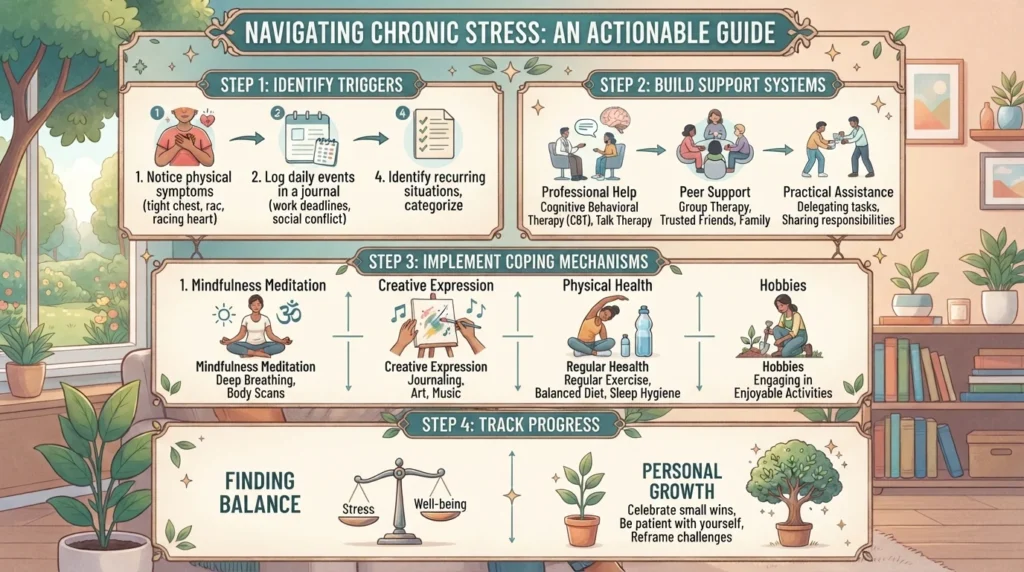
Much chronic stress comes from trying to fix things that cannot be fixed, or from feeling powerless about things that can. Try listing your main stressors and sorting them into three groups: things you can change, things you can influence, and things outside your control. Put your energy into the first two. For the third, the goal shifts from solving to coping, which might mean accepting limits, seeking support or finding ways to reduce the stress’s impact on you.
Problem-Solve What Is Solvable
For stressors you can change, structured problem-solving is often more effective than worrying. A simple approach used in therapy looks like this:
- Define the problem clearly and specifically.
- Brainstorm several possible solutions without judging them.
- Weigh the pros and cons of each option.
- Choose one, try it, then review how it went.
Breaking a large, vague problem into a small, concrete next step often reduces stress immediately, because the mind shifts from threat to action.
Change the Stress Story
CBT pays close attention to the thoughts that amplify stress. Beliefs such as “I must handle everything myself,” “If I rest, I’m failing” or “Everything will fall apart if I don’t do it perfectly” add pressure on top of real demands. Learning to notice and question these thoughts, and replacing them with more balanced ones such as “I can ask for help” or “Good enough is enough today,” can lighten the load considerably. If constant mental loops are part of your stress, our guide to CBT for overthinking offers specific tools.
Build Recovery Into Every Day
With chronic stress, waiting for a holiday to recover is rarely enough. Recovery needs to happen in small doses daily. Short breaks during work, a walk at lunch, a clear end to the working day, and protected time for activities you enjoy all help the body return to balance. Setting boundaries, such as not checking work messages late at night or saying no to some requests, is part of this.
Calm the Body Directly
Stress lives in the body as well as the mind. Slow breathing, especially with a longer exhale than inhale, can help calm the nervous system. Progressive muscle relaxation and mindfulness practices, including approaches such as mindfulness-based stress reduction developed by Jon Kabat-Zinn, help many people reduce tension. Regular physical activity is one of the most effective stress buffers; the World Health Organization recommends that adults aim for 150 to 300 minutes of moderate activity per week, but even short daily walks make a difference.
Protect Your Sleep
Stress disrupts sleep, and poor sleep makes stress harder to handle. Keeping consistent sleep and wake times, reducing late caffeine and screens, and creating a short wind-down routine all help. If worry is keeping you awake, our article on anxiety and sleep problems explains how to break that cycle.
Lean on Connection to Ease Chronic Stress
Social support is one of the strongest protective factors against chronic stress. Talking to someone you trust, spending time with friends or family, and simply not carrying everything alone can reduce how heavy stress feels. Many people under chronic stress withdraw because they feel too tired to socialise, which unfortunately removes an important source of relief.
Watch the Coping Shortcuts
Under pressure, it is natural to reach for quick relief: extra coffee, comfort eating, alcohol, endless scrolling or working even longer hours. These offer short-term escape but often worsen stress over time. Noticing these patterns without judgment, and gradually replacing some of them with more restorative habits, is an important part of coping.
An Illustrative Example
The following is a composite based on common patterns, not a real client. Samir, 45, runs a small business in Beirut. For the past two years, he has been juggling rising costs, staff changes and supporting his elderly parents. He works late most nights, sleeps poorly and snaps at his children more than he would like. He has started to feel a constant tightness in his chest, which his doctor says is not a heart problem but is likely stress-related.
In therapy, Samir maps his stressors and realises he has been treating everything as equally urgent and entirely his responsibility. He starts sorting problems by what he can control, delegates some tasks to a trusted employee, and sets a firm end to his working day three evenings a week. He challenges the belief that “if I’m not working, I’m letting everyone down.” He also begins walking for 20 minutes each morning. The external pressures do not disappear, but within a couple of months he is sleeping better, feels less tense and is more patient at home.
When Stress Comes From Circumstances You Can’t Change
Some sources of chronic stress cannot be solved quickly: economic pressures, long-term illness in the family, or wider uncertainty that many people in Lebanon live with. In these situations, coping focuses less on removing the stressor and more on protecting your wellbeing within it. That includes accepting what cannot be controlled, staying connected to people and values that matter, maintaining routines that steady you, and allowing yourself to feel frustration or grief without being consumed by it. Therapy does not pretend difficult realities are fine; it helps you respond to them in ways that preserve your health and relationships.
How Therapy Helps With Chronic Stress?
Self-help strategies are valuable, but chronic stress can make it hard to apply them consistently. Working with a psychologist provides structure, accountability and a space to understand your personal patterns. Stress management therapy in Lebanon often draws on cognitive behavioral therapy to address unhelpful thoughts and habits, problem-solving approaches for practical stressors, and relaxation and mindfulness skills for the body.
In Yusra’s practice, CBT is combined with the analytical-systemic approach. This is especially useful when stress is tied to family roles, relationship patterns or long-held expectations, such as always being the one who holds everything together. Understanding where those patterns come from often makes it easier to change them. You can learn more about individual psychotherapy in Lebanon on our service page.
When to Seek Support?
Consider speaking with a psychologist about chronic stress if it has lasted for months, if it is affecting your sleep, health, work or relationships, if self-help strategies are not making a difference, or if you notice signs of anxiety, low mood or burnout. Seek support sooner if you feel hopeless, are relying heavily on alcohol or other substances, or are struggling to function day to day. Physical symptoms such as chest pain should always be checked by a doctor first.
Frequently Asked Questions
Common signs include constant tension, irritability, difficulty relaxing, poor sleep, headaches, muscle tightness, digestive issues, low energy, trouble concentrating and relying more on caffeine, alcohol or screens to cope.
Focus on what you can influence, such as your routines, boundaries, sleep, physical activity and support network. Accepting what you cannot control, while protecting your wellbeing within it, is an important part of coping.
Prolonged stress is associated with poorer sleep, lowered immunity, headaches, digestive problems and a higher risk of some long-term health conditions. If you have physical symptoms, it is important to see a doctor as well as addressing stress.
Therapy is very helpful for stress. You do not need a diagnosis to benefit. Many people seek therapy to manage pressure, build coping skills and prevent stress from turning into burnout, anxiety or depression.
Some strategies, such as breathing exercises or problem-solving a specific issue, can bring quick relief. Lasting change in long-standing stress patterns usually takes weeks to months of consistent practice and support.
You Don’t Have to Just Endure It
Chronic stress can start to feel like a normal part of life, but living constantly on edge carries a real cost. With practical strategies, healthier boundaries and the right support, it is possible to carry your responsibilities without being worn down by them.
If long-term stress is affecting your health, sleep or relationships, support is available. Learn more about individual psychotherapy in Lebanon, book a confidential consultation, or send a message on WhatsApp with any questions first.
About this article: This content is for general education and does not diagnose or replace individual assessment, medical advice or treatment. It was reviewed by Yusra Imad, Licensed Clinical Psychologist and CBT Psychotherapist. If you have physical symptoms such as chest pain, please consult a doctor. If you are in immediate danger or thinking of harming yourself, contact local emergency services or go to the nearest hospital.
Reviewed by Yusra Imad, Licensed Clinical Psychologist and CBT Psychotherapist