

“I’m so burned out.” People say it after a long week, a tough project or a sleepless month with a newborn. Sometimes it is true. Often, what they are describing is intense stress, which is related but different. Understanding stress vs burnout matters, because the two call for different responses. A long weekend can ease stress. It rarely fixes burnout. Treating one as the other can leave you exhausted, confused about why rest is not working, and further from recovery.
This guide explains the difference between stress and burnout, how one can turn into the other, how burnout differs from depression, and what kind of support helps each.
Stress vs Burnout: The Short Answer
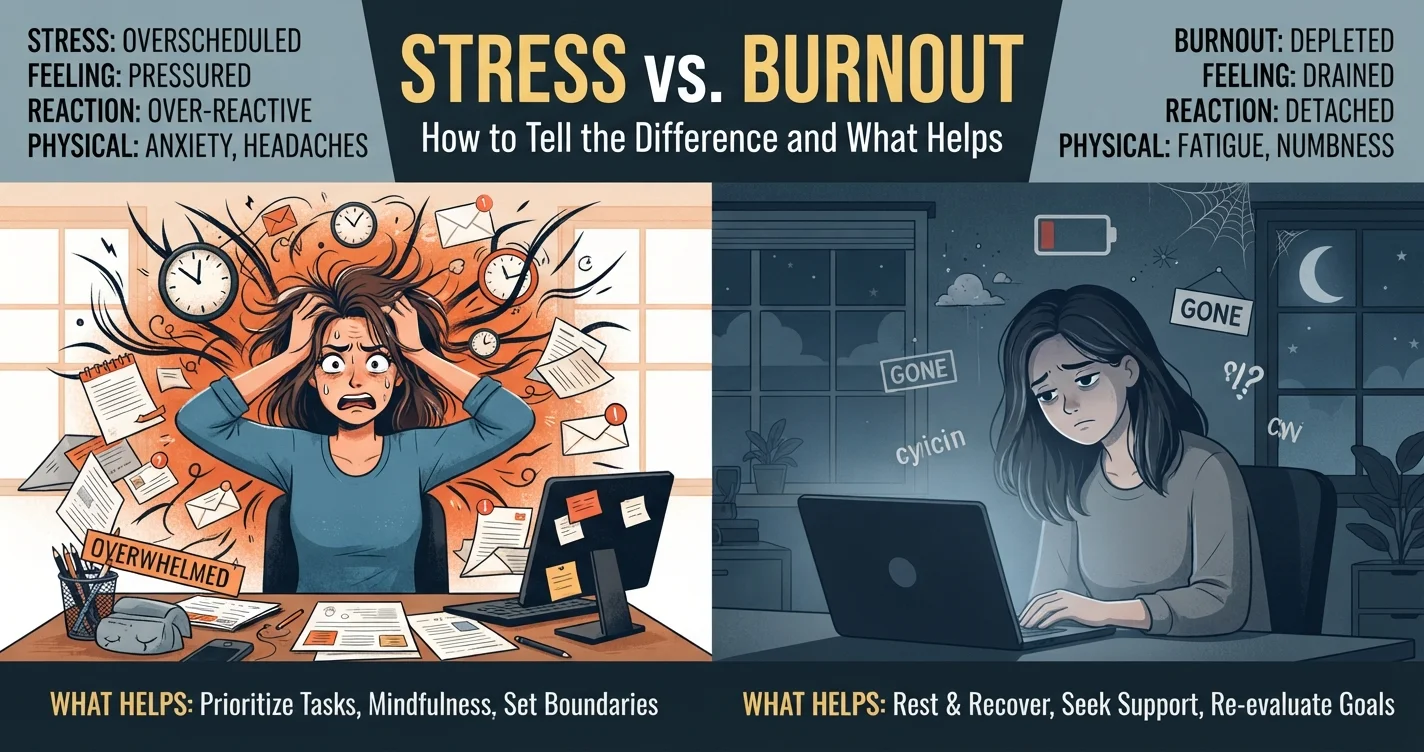
Stress is usually about too much: too many demands, too much pressure, too little time. People under stress often feel urgent, wired and over-engaged; they are fighting hard to keep up. Burnout is usually about not enough: not enough energy, motivation or hope left. People with burnout often feel empty, detached and disengaged; they have been fighting so long that they have little left to fight with.
In simple terms, stress feels like drowning in responsibilities. Burnout feels like being dried up. That is a useful shorthand for stress vs burnout, though in real life the two often blend, especially during the transition from one to the other.
What Is Stress?
Stress is the body and mind’s response to demands or threats. In the short term, it is helpful. Stress hormones sharpen focus, boost energy and help you meet a deadline or handle an emergency. Once the challenge passes, the body returns to balance.
When Stress Becomes Chronic?
Problems start when stress does not switch off. Ongoing work pressure, financial strain, caring responsibilities or living with continuous uncertainty can keep the stress response activated for months. Over time, this chronic stress takes a toll on sleep, mood, concentration, relationships and physical health.
Chronic Stress Symptoms
Common chronic stress symptoms include irritability, racing thoughts, difficulty switching off, tension headaches, muscle tightness, sleep problems, changes in appetite and feeling constantly “on.” People under chronic stress usually still care intensely about their work and responsibilities; they simply feel they cannot keep up. Practical ways to manage chronic stress deserve a guide of their own, and we cover them separately.
What Is Burnout?
The World Health Organization describes burnout in its International Classification of Diseases (ICD-11) as an occupational phenomenon resulting from chronic workplace stress that has not been successfully managed. It is not classified as a medical condition. The WHO identifies three dimensions, which reflect decades of research by psychologist Christina Maslach: feelings of energy depletion or exhaustion, increased mental distance from one’s job or feelings of cynicism about it, and reduced professional efficacy.
Our article What Is Burnout? Signs, Causes, and What Helps covers the full range of symptoms in detail. Here, the focus is on stress vs burnout and what separates them.
The Key Differences Between Stress and Burnout
When comparing stress vs burnout, several patterns stand out. No single feature is decisive, but together they paint a clear picture.
Over-Engagement vs. Disengagement
Under stress, people tend to over-engage. They work longer, try harder and push to stay on top of everything. Once depletion takes hold, engagement drops. Tasks that once mattered feel pointless, and people pull back, sometimes doing the minimum to get through the day.
Urgency vs. Emptiness
Stress brings a sense of urgency and hyperactivity, as if there is never enough time. Burnout brings a flatter emotional state: numbness, indifference or a sense of being hollowed out. Many people with burnout say they feel nothing about work at all.
Anxiety vs. Detachment
Stress is often accompanied by anxiety: worry about falling behind, fear of failing. Burnout is more often accompanied by detachment and cynicism: “What’s the point?” “Nothing I do makes a difference.” This cynicism is one of the clearest markers that stress has moved into burnout.
What Rest Does?
Rest usually helps stress. A good weekend, a holiday or a lighter week can restore energy. When depletion sets in, rest often feels insufficient. People return from holidays still exhausted, or feel dread return the moment they think about work. This is one of the most common clues that what someone is experiencing is more than ordinary stress.
How You See the Future?
People under stress often believe things will improve once the pressure eases: “If I can just get through this quarter.” People with burnout often lose that sense of a better future. Hopelessness about their work or role is common in this state.
How Stress Turns Into Burnout?
It rarely appears overnight. Burnout usually develops gradually after long periods of chronic stress without enough recovery, support or sense of control. Common contributing factors include unmanageable workloads, lack of control over decisions, insufficient recognition, unfairness, conflict with personal values, and poor boundaries between work and home life.
The transition is often subtle. Warning signs include feeling tired even after sleep, losing interest in work you once cared about, becoming more cynical or irritable with colleagues, withdrawing from people, and relying more on caffeine, alcohol or screens to cope. Noticing these early signs, and understanding stress vs burnout, creates an opportunity to act before exhaustion fully sets in.
Burnout Outside the Workplace
Although the WHO definition focuses on work, many people experience similar exhaustion in other demanding roles. Researchers such as Moïra Mikolajczak and Isabelle Roskam have studied parental burnout, describing intense exhaustion, emotional distance from one’s children and a loss of fulfilment in parenting. Caregivers looking after ill or elderly relatives, and students under prolonged academic pressure, can experience similar patterns. If you are a student, our guide to exam anxiety for university students in Lebanon may also be relevant.
Burnout, Stress or Depression?
Burnout and depression share features such as exhaustion, low motivation and reduced concentration, which is why they are often confused. A key difference is scope. The first is typically linked to a specific context, usually work, and people may still enjoy other parts of their lives. Depression tends to affect all areas of life, with persistent low mood, loss of interest in almost everything, and sometimes feelings of worthlessness or guilt.
That said, prolonged depletion of this kind can increase the risk of depression, and the two can coexist. If low mood is spreading beyond work, or you are struggling to find enjoyment anywhere, our article What Is Depression? explains the signs, and it is worth speaking with a professional.
A Quick Self-Reflection
This is not a diagnostic test, but asking yourself a few honest questions can help clarify where you are. Do I feel overwhelmed but still committed, or empty and detached? Does rest restore me, or do I return as exhausted as before? Do I still believe things will improve, or have I stopped expecting change? Do I feel anxious about my work, or indifferent to it? If your answers lean toward the second option in each pair, you may be further along the stress vs burnout spectrum than you thought.
An Illustrative Example
The following is a composite based on common patterns, not a real client. Dana, 35, is a nurse in Beirut. Two years ago, she felt stressed: long shifts, staff shortages and constant pressure. She worked extra hours, worried about her patients and felt drained, but she still cared deeply and felt proud of her work. A week off helped her recharge.
Over time, the pressure continued without relief. Gradually, Dana noticed changes. She stopped feeling anything when patients thanked her. She dreaded going to work, felt cynical about her hospital and doubted she was making any difference. Holidays no longer helped; she felt the same exhaustion the morning she returned. In therapy, she recognised that her stress had turned into something deeper. Recovery involved more than rest: reconnecting with her values, renegotiating her workload, setting firmer boundaries and addressing the self-critical beliefs that had kept her pushing past her limits.
What Helps With Stress vs. What Helps With Burnout?
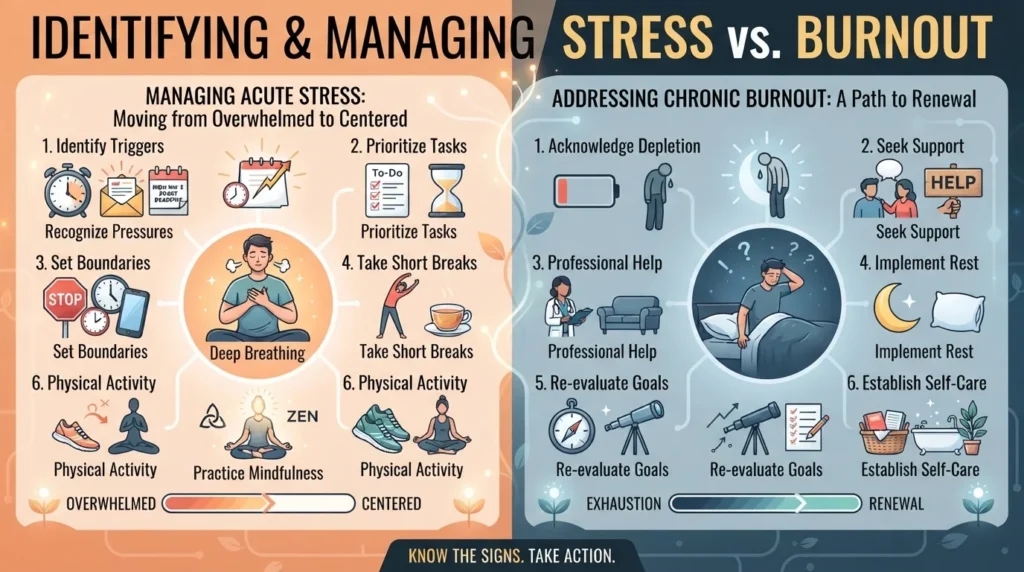
Because the problems differ, so does the support. For stress, the focus is usually on reducing or managing demands, improving time management, building coping skills, protecting sleep and making room for rest. These steps often bring relief fairly quickly.
Burnout usually needs a deeper response than stress, which is why distinguishing stress vs burnout matters so much. Recovery often involves reducing load more substantially, sometimes including time away from the source of burnout; examining the conditions that led to it; rebuilding a sense of meaning and control; addressing perfectionism or difficulty saying no; and gradually restoring energy before returning to full demands. Therapy can support each of these steps. Cognitive behavioral approaches, for example, help people identify the beliefs that keep them overextending and build more sustainable habits, which we explain in our article on CBT for burnout.
Organisational factors matter too. It is not simply an individual weakness; workplace conditions play a major role. Employers who want to protect their teams can learn more on our employee assistance program page.
When to Seek Support?
Consider reaching out to a psychologist if stress has lasted for months, if rest no longer restores you, if you feel detached or cynical about work you once cared about, or if exhaustion is affecting your health, relationships or ability to function. Seek support sooner if you notice persistent low mood, hopelessness or thoughts of not wanting to go on. You do not need to wait for things to become severe before asking for help.
Frequently Asked Questions
Stress usually involves feeling overwhelmed by too many demands while still feeling engaged. Burnout involves exhaustion, detachment and a loss of motivation or meaning, often after long periods of unmanaged stress.
Yes. Burnout typically develops after prolonged chronic stress without enough recovery, support or control. Recognising early warning signs can help prevent stress from progressing into burnout.
The World Health Organization classifies burnout as an occupational phenomenon rather than a medical condition. However, it can significantly affect health and wellbeing and may overlap with conditions such as anxiety or depression.
A holiday may help with stress, but it rarely resolves burnout on its own. Lasting recovery usually requires changes to workload, boundaries, coping patterns and sometimes the work environment itself.
Recovery time varies widely depending on how long burnout has developed, its severity and what changes are possible. Some people improve within months; others need longer. Support from a professional can make recovery more structured and sustainable.
Knowing the Difference Is the First Step
When it comes to stress vs burnout, the difference lies in direction: stress pulls you into overdrive, while burnout pulls you into depletion. Recognising which one you are facing helps you choose the right response, whether that means managing demands more effectively or making deeper changes to recover.
If you are feeling stretched thin or running on empty, support is available. Learn more about individual psychotherapy in Lebanon, book a confidential consultation, or send a message on WhatsApp with any questions first.
About this article: This content is for general education and does not diagnose or replace individual assessment or treatment. It was reviewed by Yusra Imad, Licensed Clinical Psychologist and CBT Psychotherapist. If you are in immediate danger or thinking of harming yourself, contact local emergency services or go to the nearest hospital.
Reviewed by Yusra Imad, Licensed Clinical Psychologist and CBT Psychotherapist in Lebanon.