

You have been thinking about therapy for a while. Something feels off: stress that will not ease, a relationship that keeps going in circles, a low mood you cannot shake. But a question holds you back. “I don’t have a diagnosis. Is my problem serious enough? Do I need to be told what’s wrong with me first?” If you have been asking yourself do I need a diagnosis for therapy, the short answer is no. You can start therapy without one, and many people do.
This guide explains why a diagnosis is not a requirement, what a first consultation does instead, when an assessment genuinely helps, and how to think about labels in a way that serves you.
Do I Need a Diagnosis for Therapy? The Short Answer
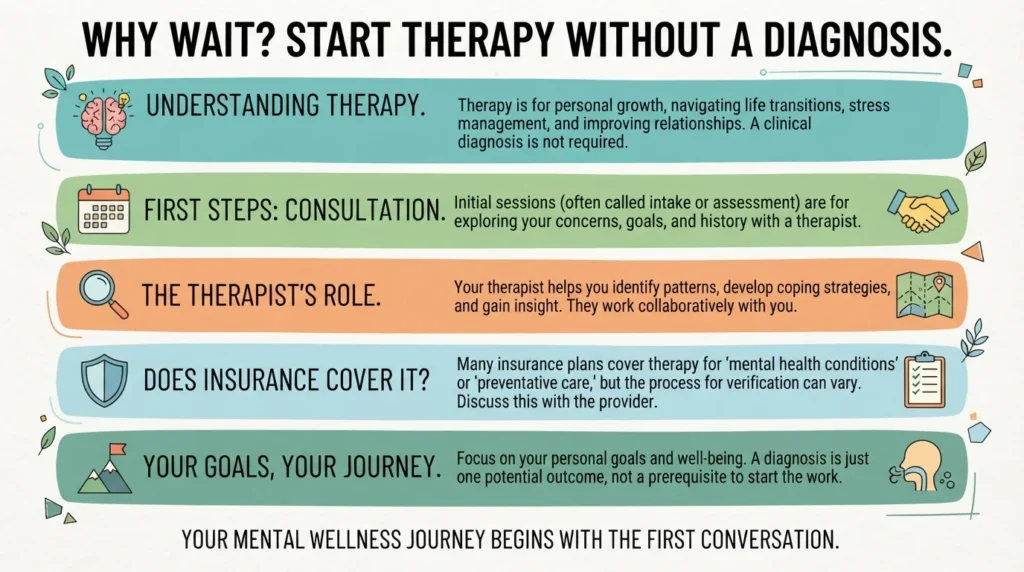
No. Therapy is for anyone who wants support with emotional, psychological or relational difficulties, whether or not those difficulties fit a formal category. People come to therapy for anxiety and low mood, but also for stress at work, relationship conflict, grief, life transitions, decision-making, self-esteem, family tension and personal growth. None of these require a diagnosis to be taken seriously.
So if you are wondering do I need a diagnosis for therapy before booking, you can set that worry aside. What you need is simply a reason that matters to you. “I’m not coping as well as I’d like” is enough. So is “I keep repeating the same patterns and want to understand why.”
What Happens Instead of a Diagnosis?
When you start therapy, the first sessions focus on understanding your situation rather than labelling it. Your therapist will ask about what brings you in, how the difficulty affects your daily life, your history and what you hope will change. If you would like to know more about what that first meeting looks like, our article on what to expect during your first therapy session in Lebanon covers it in detail.
Formulation: Understanding Over Labels
Instead of starting with a diagnosis, many therapists build what is called a formulation: a shared understanding of how your difficulties developed and what keeps them going. In cognitive behavioral therapy, this often links situations, thoughts, emotions, physical sensations and behaviors. In the analytical-systemic approach, it also considers family patterns and relationships. A formulation is personal and specific to you, which is often more useful for guiding therapy than a category name. You can read more about this approach on our page about individual psychotherapy in Lebanon.
Therapy Can Begin Right Away
Because the focus is on understanding and goals, therapy can begin from the very first session. You do not need to complete testing, obtain a referral or wait for a formal label before receiving support.
When Is Assessment Needed?
Although a diagnosis is not required to start therapy, there are situations where a formal psychological assessment can be genuinely helpful. Understanding when assessment is needed helps you decide whether to request one.
When the Picture Is Unclear?
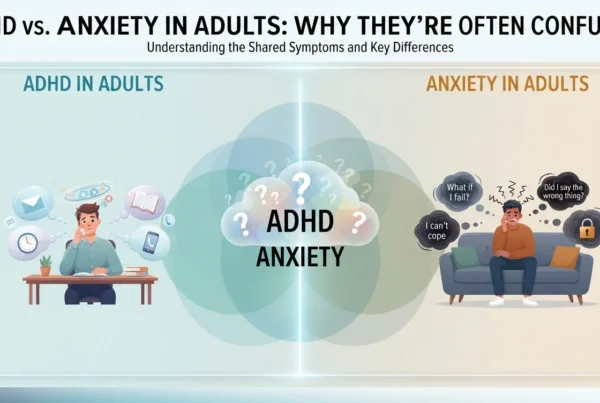
Sometimes several explanations are possible. Concentration problems, for example, might relate to anxiety, ADHD, depression, sleep or a learning difficulty. An assessment helps untangle these possibilities so that support targets the right issue. Our article on ADHD vs anxiety in adults shows how easily such patterns overlap.
When Therapy Isn’t Working as Expected?
If you have been in therapy for a while without the progress you hoped for, an assessment can uncover factors that were missed, such as longer-standing personality patterns, attention difficulties or a mood condition that needs a different approach.
When Medication May Be Considered?
If symptoms are severe or persistent, a psychiatric evaluation may be recommended to consider whether medication could help alongside therapy. A clear diagnostic picture supports that conversation. Yusra’s practice offers collaborative care with psychiatry for exactly these situations.
When You Need Formal Documentation?
Universities, schools or employers sometimes require a formal report before granting adjustments such as extra exam time. Some insurance policies or official processes may also require documentation. In these cases, a formal assessment and written report are often necessary.
You can read more about the process on our page about psychological assessment and diagnosis in Lebanon.
The Benefits and Limits of a Diagnosis
A diagnosis can be helpful. Many people feel relief when their experience finally has a name; it validates that their struggles are real and shared by others. A diagnosis can guide treatment choices, open access to specific support and help professionals communicate clearly with each other.
At the same time, a diagnosis has limits. It describes a pattern of symptoms, not a whole person. Two people with the same diagnosis can have very different experiences, causes and needs. Some people worry about stigma, or about seeing themselves only through a label. Many modern therapy approaches recognise that the same underlying processes, such as avoidance, rumination or harsh self-criticism, appear across many conditions, so working on those processes can help whatever the label.
The healthiest way to view a diagnosis is as a tool: useful when it helps you understand yourself and access support, less useful when it starts to define who you are.
A Word About Self-Diagnosis Online
Social media and online quizzes have made it easy to come across mental health terms. This has real benefits: people recognise their experiences, feel less alone and are more likely to seek help. But self-diagnosis also carries risks. Many conditions share overlapping symptoms, normal experiences can be misread as disorders, and online content is not always accurate.
If something you read online resonates, take it as a reason to explore further with a professional, not as a conclusion. You are very welcome to bring those questions to your first session. A good therapist will take them seriously and help you make sense of them.
An Illustrative Example
The following is a composite based on common patterns, not a real client. Omar, 37, delayed contacting a therapist for over a year. He felt constantly irritable, was sleeping badly and had lost interest in things he used to enjoy, but he kept telling himself, “I don’t have depression or anything; I’m just tired.” He worried that therapy was only for people with a serious condition.
When he finally booked a consultation, he was surprised that no one asked him to prove anything. The first sessions focused on understanding his situation: long hours, financial pressure, a strained relationship with his father and very little time for himself. Together, he and his therapist set goals around stress, sleep and communication at home. A few weeks in, his therapist suggested a brief mood questionnaire to track progress, which showed moderate symptoms of low mood that improved as therapy continued. A diagnosis was not the starting point; understanding was.
Common Myths About Starting Therapy Without a Diagnosis
Several beliefs stop people from reaching out. The first is that therapy is only for “serious” mental illness. In reality, much of the work therapists do involves everyday struggles that have become heavy to carry alone: stress, conflict, uncertainty and loss. Waiting until things become severe usually makes change harder, not easier.
A second myth is that you will be labelled the moment you walk in. Good therapy is collaborative. Any assessment or diagnosis is discussed openly, explained in plain language and only pursued when it offers a clear benefit to you.
A third myth is that without a diagnosis, therapy has no direction. The opposite is often true. Clear, personal goals, such as sleeping better, arguing less with your partner or feeling calmer before work meetings, give therapy a strong focus. Progress is measured against those goals, not against a label.
Finally, some people believe they must already understand their problem before seeking help. You do not. Making sense of what is happening is part of what therapy is for. Many people arrive saying “I don’t really know what’s wrong,” and that is a perfectly good place to start.
How First Consultations Work in Yusra’s Practice?
In Yusra’s practice, the first consultation is a space to understand your concerns, your history and your goals, and to agree together on the most helpful next step. For many people that step is starting therapy directly, often combining CBT with the analytical-systemic approach. For others, a structured psychological assessment comes first because it will make therapy more focused. Either way, the decision is explained and made with you, so you always know why a particular path is being recommended and what it involves.
What to Say in Your First Session?
If you are unsure how to begin, you do not need to describe your situation in clinical terms. It is enough to say what you have noticed and what you would like to change. “I’ve been feeling overwhelmed for months,” “I keep arguing with my partner about the same things,” or “I don’t feel like myself anymore” are all perfect starting points. Your therapist will guide the conversation from there and, if an assessment would be useful, will discuss it with you openly.
Frequently Asked Questions
Yes. Most people start therapy without a formal diagnosis. Therapy focuses on your difficulties and goals, and the first sessions are about understanding your situation rather than labelling it.
Not necessarily. Some therapy proceeds without any formal diagnosis. If a diagnosis or assessment would help guide treatment or meet a specific need, your therapist will discuss it with you first.
An assessment is often recommended when the cause of difficulties is unclear, when therapy is not progressing as expected, when medication is being considered, or when formal documentation is required for school, work or other purposes.
If it affects your wellbeing, relationships, work or daily life, or if it simply matters to you, it is worth exploring. You do not need to wait for things to become severe. Early support often makes change easier.
A diagnosis is a standardised label describing a pattern of symptoms. A formulation is a personal explanation of how your difficulties developed and what maintains them. Therapy often relies more on formulation, with diagnosis used when it adds value.
You Don’t Need a Label to Deserve Support
If you have been asking do I need a diagnosis for therapy, the answer should be reassuring: you do not. Therapy starts with your experience, your goals and a conversation, not a label. When a diagnosis or assessment would genuinely help, it can be added along the way, thoughtfully and with your agreement.
If you have been holding back from reaching out, this may be the right moment. Learn more about individual psychotherapy in Lebanon, book a confidential consultation, or send a message on WhatsApp with any questions first.
About this article: This content is for general education and does not diagnose or replace individual assessment or treatment. It was reviewed by Yusra Imad, Licensed Clinical Psychologist and CBT Psychotherapist. If you are in immediate danger or thinking of harming yourself, contact local emergency services or go to the nearest hospital.
Reviewed by Yusra Imad, Licensed Clinical Psychologist and CBT Psychotherapist in Lebanon