
You sit down to work and within minutes your mind is somewhere else. Tasks pile up, deadlines slip, and you lie awake at night with your thoughts racing. Is it anxiety? Is it ADHD? Is it just stress? When it comes to ADHD vs anxiety in adults, the confusion is understandable, because the two can look remarkably similar from the outside and sometimes even from the inside. Many adults spend years treating the wrong problem, or only half of it.
This guide explains why ADHD and anxiety are so easily mixed up, the key differences clinicians look for, why they often occur together, and why a proper psychological assessment is the most reliable way to get clarity.
ADHD vs Anxiety in Adults: The Short Answer
The simplest way to describe the difference is this: with ADHD (attention-deficit/hyperactivity disorder), attention difficulties are a lifelong feature of how the brain regulates focus, activity and impulses, usually present since childhood and across most situations. With anxiety, difficulty concentrating is mainly caused by worry and fear taking up mental space, and it tends to rise and fall with stress.
Put another way, someone with ADHD often struggles to stay focused even when they feel calm and the task is low-stakes. Someone with anxiety often struggles to focus because their mind is pulled toward worries. But real life is rarely that tidy, and many adults experience both.
Why ADHD and Anxiety Look So Similar?
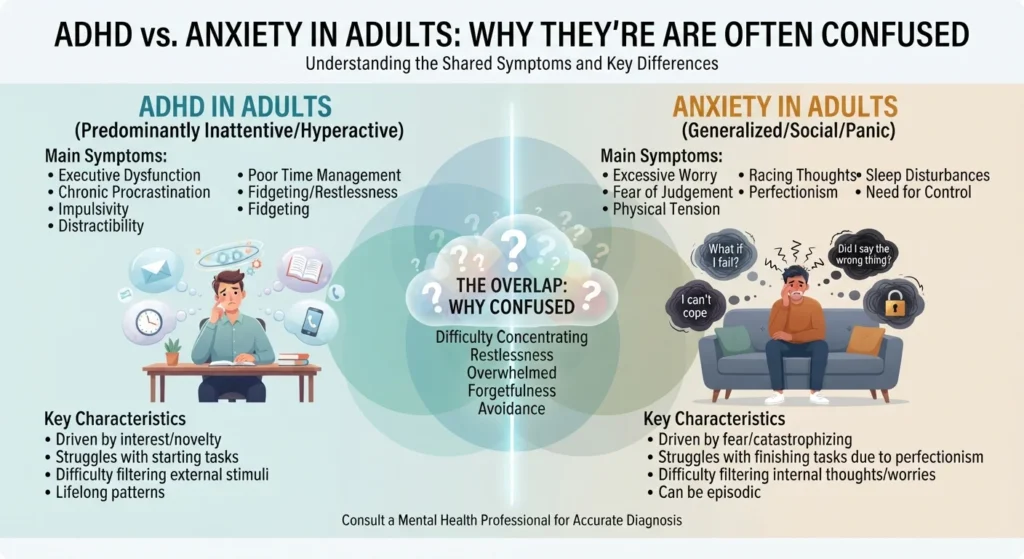
The overlap in symptoms is the main reason adults ask, “Do I have ADHD or anxiety?” Both can involve:
- Difficulty concentrating and following through on tasks.
- Restlessness and trouble sitting still or relaxing.
- Sleep problems and racing thoughts at night.
- Irritability and feeling easily overwhelmed.
- Procrastination and missed deadlines.
Because these surface signs are shared, a quick self-check or online quiz can easily point in the wrong direction. The underlying reasons for the symptoms are what really distinguish the two.
Key Differences Between ADHD and Anxiety
When clinicians assess ADHD vs anxiety in adults, they look beneath the symptoms at patterns. Several questions are especially helpful.
When Did It Start?
According to the Diagnostic and Statistical Manual of Mental Disorders (DSM-5), several ADHD symptoms must have been present before the age of 12, even if they were not recognised at the time. It is a neurodevelopmental condition, so affected adults can usually trace attention or impulsivity difficulties back to school years: report cards mentioning daydreaming or disruption, lost belongings, unfinished homework. Anxiety can also begin in childhood, but it often starts or intensifies later, frequently linked to life stresses.
What Pulls Your Attention Away?
This is one of the most revealing differences. In anxiety, attention is pulled toward worries: “What if I fail? What did they mean by that? What if something happens to my family?” In ADHD, attention tends to drift toward whatever is more stimulating, such as a noise, a new idea, a phone notification, or an unrelated interesting thought, even when nothing is worrying you.
Is It There When You Feel Calm?
If your concentration improves noticeably when stress drops, on holiday or after a worry is resolved, anxiety may be playing a major role. Attention-related difficulties of this kind tend to persist even during calm, relaxed periods, especially with tasks that feel boring or repetitive. Many of these adults notice they can hyperfocus on things they find genuinely interesting, yet struggle to start simple but dull tasks.
What Kind of Restlessness Is It?
Anxious restlessness usually feels tense and keyed up, a sense that something bad might happen. The restlessness of attention difficulties often feels more like an internal motor: a need for movement or stimulation, fidgeting, finding it hard to sit through long meetings or films, even when nothing is wrong.
Why Do Tasks Get Delayed?
Both groups procrastinate, but often for different reasons. People with anxiety may delay tasks because they fear doing them badly or facing judgment. People with ADHD may delay tasks because starting feels genuinely difficult, they lose track of time, or they get distracted by something else midway. The outcome looks the same; the engine behind it differs.
Adult ADHD Symptoms That Often Go Unrecognised
Many people still picture the condition as belonging to a hyperactive young boy. In reality, adult ADHD symptoms are often quieter. Adults may experience chronic disorganisation, losing things, forgetting appointments, poor time management, difficulty finishing projects, interrupting others, impulsive decisions, emotional reactivity and a sense of underachievement despite real ability. Hyperactivity in adults often shows up as inner restlessness rather than visible movement.
Some groups are particularly likely to be overlooked, including women and girls, whose symptoms are more often inattentive than disruptive, and high-achieving adults who compensate with intelligence, structure and sheer effort. These compensations can work for years, then break down when demands increase, for example at university, in a demanding job or after becoming a parent. At that point, the exhaustion of constant compensation can itself produce anxiety, which is often what gets noticed first.
When It’s Both ADHD and Anxiety?
ADHD and anxiety are not mutually exclusive. They frequently occur together. Large population studies, including the US National Comorbidity Survey Replication published by Ronald Kessler and colleagues in 2006, found that adults with ADHD had substantially higher rates of anxiety disorders than adults without ADHD.
The relationship can work in several ways. Years of missed deadlines, forgotten commitments and criticism can lead someone with ADHD to develop real anxiety about letting people down. Anxiety can also hide ADHD, because some people manage their attention difficulties through constant worry and over-checking. In other cases, both conditions develop independently. This is exactly why the question is not always “ADHD or anxiety?” but sometimes “how much of each, and how do they interact?”
Other Things That Can Look Like Either
Difficulty concentrating and restlessness are not unique to ADHD and anxiety. Depression can slow thinking and reduce motivation. Chronic sleep deprivation affects attention, memory and mood. Burnout, which we describe in our article What Is Burnout?, can cause foggy thinking and irritability. Trauma can lead to hypervigilance and trouble focusing. Medical issues such as thyroid problems, certain medications, and alcohol or substance use can also play a role. A careful assessment considers these possibilities rather than jumping to a single label.
An Illustrative Example
The following is a composite based on common patterns, not a real client. Lina, 29, works in marketing in Beirut. She was told years ago that she had anxiety and has done some therapy, which helped her worry less. But her work life still feels chaotic. She starts projects with enthusiasm and abandons them halfway, forgets meetings despite reminders, loses her keys several times a week, and feels restless in long meetings even on calm days. Her school reports described her as “bright but distracted.”
Through a psychological assessment, including a detailed developmental history, standardised questionnaires and information from a family member about her childhood, a clearer picture emerges: Lina meets criteria for ADHD, with anxiety that developed partly in response to years of struggling to keep up. With that understanding, her support plan changes. She learns practical strategies for organisation and time management, continues working on anxious thinking, and is referred for a medical consultation to discuss whether medication might help. For the first time, the plan addresses the whole picture.
Why a Professional Assessment Matters?
Self-assessment tools, such as the World Health Organization’s Adult ADHD Self-Report Scale, can be useful starting points, but they cannot provide a diagnosis on their own. Distinguishing ADHD vs anxiety in adults requires looking at history, patterns across different settings, current functioning and other possible explanations.
A professional psychological assessment in Lebanon typically includes a detailed clinical interview, questions about childhood and school experiences, standardised measures, and consideration of anxiety, mood and other factors. Where possible, information from someone who knew you as a child can add valuable perspective. If you would like to understand what the process involves step by step, our article on adult ADHD assessment in Lebanon walks through it in detail.
How Support Differs for ADHD and Anxiety?
Getting the distinction right matters because the most helpful support differs. For anxiety, cognitive behavioral therapy focusing on worry, avoidance and anxious beliefs is one of the most widely recommended approaches. For ADHD, support often includes psychoeducation about how ADHD affects attention and organisation, practical skill-building around planning and time management, and adapted forms of CBT developed specifically for adult ADHD, such as the approach studied by psychologist Steven Safren and colleagues. Medication can also be an important option for many adults with ADHD; this is a medical decision made with a psychiatrist or physician.
When both are present, treatment usually addresses both, often in a coordinated way. Yusra’s practice offers collaborative care with psychiatry for situations where psychological and medical support work best together.
Questions to Reflect On Before an Assessment
If you are considering an assessment, it can help to reflect on a few questions beforehand. Did you have attention, organisation or restlessness difficulties as a child, even if no one named them? Do your concentration problems persist when you feel calm, or mainly when you are worried? Is your attention pulled toward worries, or toward anything more interesting? Have you noticed patterns of impulsivity, forgetfulness or losing track of time across work, home and relationships? Jotting down examples, and if possible finding old school reports, can make the assessment more accurate and useful.
Frequently Asked Questions
Yes. Anxiety can cause difficulty concentrating, restlessness and procrastination, all of which overlap with ADHD. A professional assessment looks at when symptoms began, how they show up across settings, and what drives them, to tell the two apart.
Yes, and it is common. Research shows that adults with ADHD have higher rates of anxiety than the general population. When both are present, support usually addresses both.
Signs that may point toward ADHD include attention difficulties dating back to childhood, problems that persist even when you feel calm, and attention drifting toward stimulating things rather than worries. Only a professional assessment can confirm whether ADHD is present.
Yes. Many adults are diagnosed later in life, especially if their symptoms were mild, inattentive or masked by strong coping strategies. The assessment will still look for signs that symptoms were present earlier in life.
Yes. Anxiety is often treated with CBT focused on worry and avoidance, while ADHD support typically includes psychoeducation, practical organisational strategies, adapted CBT and, in many cases, medication prescribed by a doctor. When both are present, a combined plan is usually best.
Getting Clarity Is the First Step
When it comes to ADHD vs anxiety in adults, the symptoms may look alike, but the causes, and the most helpful support, can be very different. Understanding what is really behind your difficulty concentrating can save years of frustration and open the door to strategies that genuinely fit how your mind works.
If you are unsure whether you are dealing with ADHD, anxiety or both, an assessment can bring clarity. Learn more about psychological assessment and diagnosis in Lebanon, book a confidential consultation, or send a message on WhatsApp with any questions first.
About this article: This content is for general education and does not diagnose or replace individual assessment or treatment. It was reviewed by Yusra Imad, Licensed Clinical Psychologist and CBT Psychotherapist. Decisions about medication should be made with a qualified medical professional. If you are in immediate danger or thinking of harming yourself, contact local emergency services or go to the nearest hospital.
Reviewed by Yusra Imad, Licensed Clinical Psychologist and CBT Psychotherapist in Lebanon.