
Some difficulties feel less like a single problem and more like a pattern. The same kind of conflict keeps appearing in different relationships. You react to criticism in ways that surprise even you. You have tried to change certain habits many times, yet they keep returning. When patterns like these persist, a professional personality assessment in Lebanon can help you understand what is driving them, not to put you in a box, but to give you and your therapist a clearer map to work from.
This guide explains what a personality assessment is, how it differs from online quizzes, what happens during the process, what the results can and cannot tell you, and how they are used in therapy.
What Is a Personality Assessment?
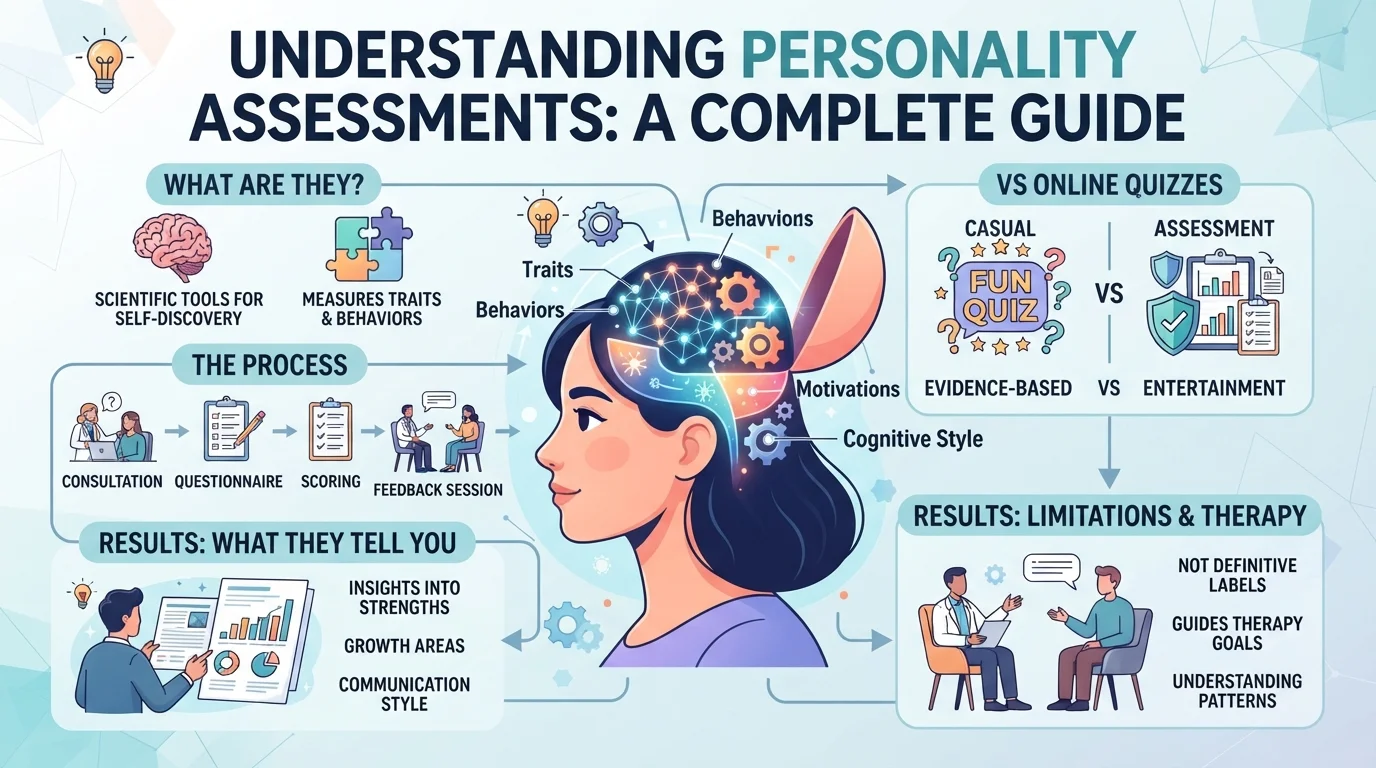
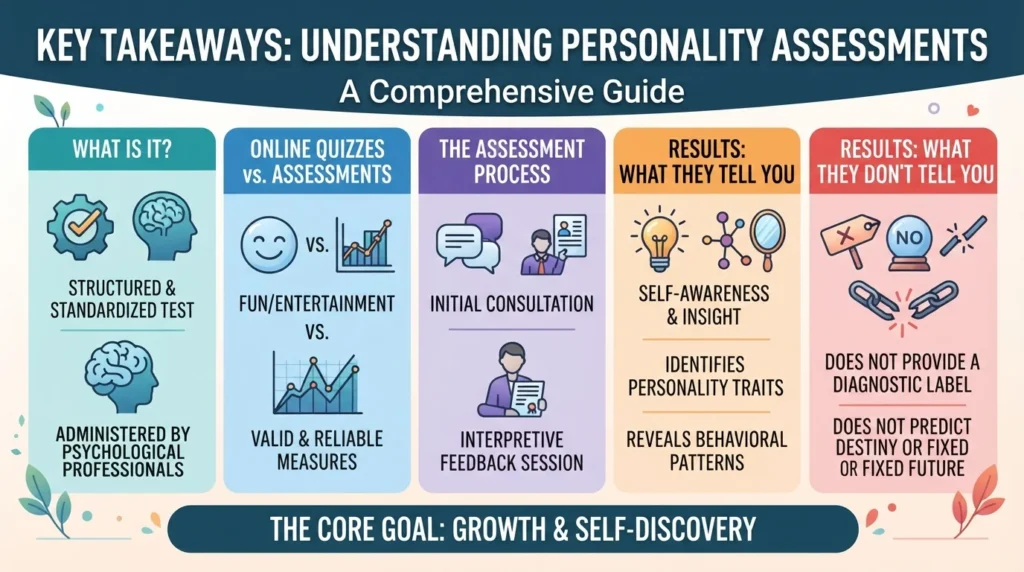
A personality assessment is a structured evaluation, carried out by a qualified psychologist, of your characteristic ways of thinking, feeling, relating to others and coping with stress. It looks at enduring patterns rather than how you felt on a particular day. The goal is understanding: identifying strengths, sensitivities and recurring patterns that influence your wellbeing and relationships.
More Than an Online Quiz
Many people have taken free personality tests online. They can be fun and occasionally insightful, but they are very different from clinical personality testing. Professional instruments are standardised, meaning they are administered and scored in a consistent way, and they are researched for reliability and validity. Results are interpreted by a trained clinician in the context of your history and current situation, rather than reduced to a four-letter type or a shareable label.
Traits, Styles and Patterns
Psychologists often think about personality in terms of traits, such as how outgoing, organised, emotionally reactive, open to new experiences or agreeable someone tends to be. A widely researched framework, the five-factor model, describes personality along five broad dimensions of this kind. Clinicians may also talk about personality styles: characteristic ways of seeing yourself and others, often shaped by early experiences and deeply held beliefs. Everyone has a personality style. It becomes a clinical focus only when certain patterns are rigid, cause distress or repeatedly get in the way of life and relationships.
Why People Seek a Personality Assessment?
People come to a personality assessment for different reasons, and a referral does not mean something is “wrong” with your personality.
Recurring Patterns in Relationships or Work
One of the most common reasons is a sense of repetition: similar conflicts with different partners, difficulty trusting others, fear of abandonment, trouble with authority, or a tendency to take on too much and then burn out. Understanding the underlying style can make these patterns feel less mysterious and more workable.
Clarifying a Complex Picture
Sometimes people have tried therapy for anxiety or low mood and made only partial progress. A personality assessment can reveal longer-standing patterns, such as intense emotional reactions, deep self-criticism or difficulties in relationships, that sit underneath the presenting problem. In some cases, the assessment helps clarify whether a personality-related difficulty is present alongside conditions like anxiety or depression.
Guiding Therapy
Even without a specific concern, assessment results can help tailor therapy. Knowing how someone typically copes with stress, how they relate to others and what beliefs drive their reactions allows a therapist to choose approaches that fit and anticipate where therapy might feel challenging.
What Happens During a Personality Assessment?
The exact process of a personality assessment depends on the reason for referral and the clinician, but most assessments include several stages. For a broader overview of how psychological evaluations work, our article on what to expect from a psychological assessment covers the general process.
The Clinical Interview
A personality assessment usually begins with a detailed conversation about what brings you in, your history, relationships, work or study, family background and how you typically handle stress. This interview provides essential context. Questionnaires alone cannot capture the meaning of your experiences.
Standardised Questionnaires
Next, you may complete one or more standardised personality inventories, the core of formal personality testing. Well-known examples used in clinical psychology include broad measures of personality traits and clinical patterns, such as the Minnesota Multiphasic Personality Inventory (MMPI), the Personality Assessment Inventory (PAI) and trait-based inventories built on the five-factor model. The specific measures chosen depend on the purpose of the assessment and the clinician’s judgment. Some questionnaires take less than an hour; more comprehensive ones take longer. There are no right or wrong answers, and many include built-in checks for consistency.
Integrating the Findings
To complete the personality assessment, the psychologist brings together the interview, questionnaire results and their own observations. Good assessment never relies on a single score. A pattern that appears across several sources is far more meaningful than one elevated scale on one test.
The Feedback Session
Finally, you meet to discuss the findings of your personality assessment. This is a collaborative conversation, not a verdict. A good clinician explains results in plain language, checks whether they fit your experience, highlights strengths as well as difficulties, and discusses practical next steps. You may also receive a written report summarising the findings and recommendations.
Personality Styles vs. Personality Disorders
Many people worry that a personality assessment means being labelled. The term “personality disorder” can sound frightening, and it is often misused in everyday conversation. Clinically, it refers to long-standing patterns of thinking, feeling and relating that are inflexible, cause significant distress or impairment, and appear across many situations. Having a strong personality style, such as being highly organised, sensitive to rejection or very independent, is not the same thing.
Thinking in this field has also moved toward a more dimensional view. The World Health Organization’s latest classification, ICD-11, describes personality difficulties in terms of severity and specific trait areas rather than rigid categories. This shift reflects what many clinicians already see in practice: personality exists on a spectrum, and people are far more than any label. A responsible personality assessment focuses on understanding and support, not stigma.
What a Personality Assessment Can and Can’t Tell You?
A personality assessment can describe your typical patterns, highlight strengths and vulnerabilities, clarify how you tend to respond under stress, and help identify whether certain long-standing difficulties may be contributing to your current concerns. It can also offer language for experiences you have struggled to explain.
What it cannot do is define your worth, predict your future with certainty, or replace the understanding that develops through a therapeutic relationship. Results describe tendencies, not destiny. People continue to grow and change, and therapy often helps patterns become more flexible over time.
An Illustrative Example
The following is a composite based on common patterns, not a real client. Ziad, 36, has had three long-term relationships end in similar ways: he becomes intensely attached, then pulls away when he senses any criticism, and later feels deeply hurt and alone. At work, he is highly capable but struggles with feedback, sometimes leaving jobs after disagreements. He has had therapy for anxiety before, which helped with day-to-day worry but did not touch these patterns.
Through a personality assessment, including a detailed interview and standardised questionnaires, a clearer picture emerges. Ziad shows high sensitivity to rejection, a strong underlying belief that he is not good enough, and a coping style of withdrawal under perceived threat. The findings do not label him; they help explain why certain situations feel so overwhelming. In therapy, he and his psychologist use this understanding to work on his core beliefs and practise new responses to criticism, both at work and in relationships.
How Assessment Results Shape Therapy?
The results of a personality assessment are most valuable when they inform treatment. Cognitive approaches to personality patterns, developed in large part by Aaron Beck and colleagues, focus on the core beliefs and coping strategies that underpin each personality style, for example a belief such as “I must be perfect to be accepted” leading to over-control and anxiety. Therapy then works on testing and softening those beliefs and building more flexible ways of responding. Yusra’s training includes Beck Institute work on personality styles, which you can read more about on the About page.
Personality patterns also develop within relationships and families. The analytical-systemic approach used in Yusra’s practice explores how those early relational patterns continue to shape adult life, complementing the practical, belief-focused work of CBT.
Choosing a Personality Assessment in Lebanon
If you are considering a personality assessment in Lebanon or broader psychological testing in Lebanon, a few points are worth checking. Make sure the assessment is carried out by a qualified clinical psychologist trained in administering and interpreting the measures used. Ask which instruments will be used and why, and how long the process will take. It is also reasonable to ask how cultural and language factors are considered, since many personality measures were originally developed and normed in other countries; a thoughtful clinician interprets results with this in mind. Finally, ask how confidentiality is handled and who will have access to the report.
You can learn more about psychological assessment and diagnosis in Lebanon on our service page.
Preparing for Your Personality Assessment
You do not need to study for a personality assessment or prepare answers, and trying to present yourself in a particular way usually makes results less useful. It helps to think about what you hope to understand, write down patterns or situations that concern you, and bring any previous reports or relevant information. Get a good night’s sleep before questionnaire sessions, answer honestly, and remember that the process is designed to help you, not judge you.
It is also completely normal to feel a little nervous. Many people worry that a personality assessment will uncover something bad about them. In practice, most people find the process interesting and validating, because it puts words to experiences they have lived with for years. If any question feels uncomfortable, you can say so; the psychologist can explain why it is being asked and how the information will be used. You remain in control of what you share throughout the process.
Frequently Asked Questions
A personality assessment is used to understand your characteristic patterns of thinking, feeling and relating to others. It can clarify recurring difficulties, support diagnosis where relevant, and help tailor therapy to your needs and strengths.
It varies depending on the purpose and measures used. Many assessments involve one or more interview sessions, questionnaire completion and a feedback session. Your psychologist will give you a clear estimate beforehand.
No. Most personality assessments simply describe traits and patterns. A personality disorder is considered only when patterns are long-standing, inflexible and cause significant distress or impairment, and this requires careful clinical evaluation.
Core temperament tends to be fairly stable, but how patterns show up can change considerably. Therapy often helps people develop more flexible beliefs and coping strategies, which changes how they experience themselves and relate to others.
Some online tests are based on research, but most are not designed for clinical use and lack the context of a professional interpretation. They can spark reflection, but they should not be used to diagnose or make important decisions.
Understanding Yourself More Clearly
A professional personality assessment in Lebanon can turn confusing, repeating patterns into something you can understand and work with. It does not define who you are; it offers a clearer map of how you tend to think, feel and relate, and a stronger starting point for change.
If recurring patterns are affecting your relationships, work or wellbeing, an assessment may help. Learn more about psychological assessment in Lebanon, book a confidential consultation, or send a message on WhatsApp with any questions first.
About this article: This content is for general education and does not diagnose or replace individual assessment or treatment. It was reviewed by Yusra Imad, Licensed Clinical Psychologist and CBT Psychotherapist. If you are in immediate danger or thinking of harming yourself, contact local emergency services or go to the nearest hospital.
Reviewed by Yusra Imad, Licensed Clinical Psychologist and CBT Psychotherapist in Lebanon