

The assessment sessions are over. Then the document arrives: several pages of headings, scores, percentiles and clinical language. You read it once, then again, and still feel unsure what it really says about you or what to do next. You are not alone. A psychological assessment report is a valuable tool, but it is written in a professional format that can feel dense if no one has walked you through it.
This guide explains what a psychological assessment report usually contains, how to make sense of scores and results, how to use the recommendations, and what questions to ask during your feedback session. If you have not yet had an assessment and want to know what the process involves, start with our article on what to expect from a psychological assessment.
What Is a Psychological Assessment Report?
A psychological assessment report is a written summary of an evaluation carried out by a psychologist. It brings together information from interviews, standardised tests or questionnaires, observations and sometimes input from others, and turns it into a clear picture of your current functioning. Most importantly, it explains what the findings mean and what might help.
Reports are written for different purposes. Some are mainly for you and your therapist, to guide treatment. Others are prepared to support a referral to a psychiatrist, a request for academic accommodations, or another specific need. The purpose shapes the length, language and level of detail, so it is worth knowing why your report was written before you read it.
What’s in a Psychological Assessment Report?
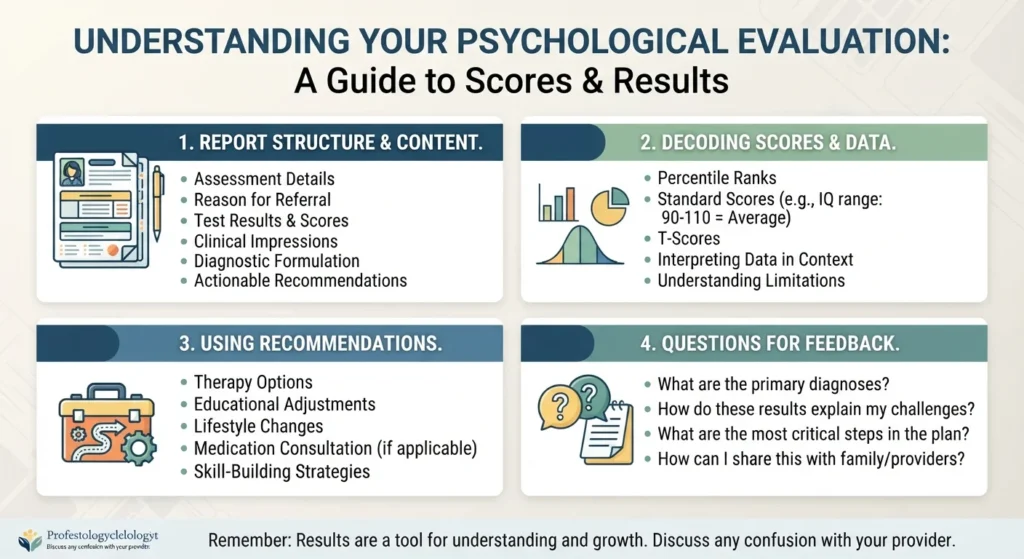
Formats differ between clinicians, but most reports follow a similar structure. Understanding what is in a psychological report section by section makes the whole document easier to follow.
Reason for Referral
This opening section states why the assessment was carried out and the main questions it aimed to answer, for example “to clarify whether attention difficulties are related to ADHD, anxiety or both.” Keep these questions in mind as you read; the rest of the report should answer them.
Background Information
Here the psychologist summarises relevant history: current concerns, personal and family background, education or work, health and any previous assessments or therapy. This section provides the context for interpreting everything that follows.
Assessment Methods
This section lists the methods and measures used, such as clinical interviews, cognitive tests, symptom questionnaires or personality inventories, and sometimes the dates of each session. It shows how the conclusions were reached.
Behavioral Observations
Psychologists usually note how you approached the assessment, for example your mood, concentration, effort and how you responded to challenging tasks. These observations help judge how well the results reflect your typical functioning.
Results
The results section presents scores and findings from each measure, often in tables. This is usually the most technical part of the report, and the part people find hardest to interpret. The next section of this guide explains the most common score types.
Interpretation and Formulation
This is the heart of the report. The psychologist integrates all the information into a coherent explanation of your strengths, difficulties and the factors that may be contributing to them. A good formulation reads like a story that makes sense of your experiences, not just a list of numbers.
Diagnostic Impressions
Where relevant, the report may state whether your difficulties meet criteria for a specific diagnosis, using classification systems such as the DSM-5 or ICD-11. Not every report includes a diagnosis; sometimes the findings describe patterns without a formal label.
Recommendations and Summary
The report usually ends with practical recommendations, such as therapy approaches, further medical consultation, strategies for work or study, or suggestions for family support, followed by a brief summary of key findings. For many people, this is the most useful section of all.
Making Sense of Psychological Evaluation Results
Scores can look intimidating, but most psychological evaluation results use a handful of common formats. Here is how to read them.
Percentiles
A percentile shows how your score compares with a reference group of people of similar age. A score at the 50th percentile means you scored higher than about half of that group. A score at the 25th percentile means you scored higher than about a quarter of it. Percentiles are not the same as percentages of correct answers.
Standard Scores and T-Scores
Many cognitive and intellectual tests use standard scores with an average of 100, where most people fall roughly between 85 and 115. Many symptom and personality measures use T-scores with an average of 50, where scores well above the average range may indicate clinically significant difficulties. Your report should explain which scale each measure uses.
Descriptive Ranges and Confidence Intervals
Scores are often accompanied by descriptive labels such as “average,” “below average” or “elevated.” You may also see a confidence interval, a range within which your true score is likely to fall. This reflects the fact that every test contains some measurement error; a single number is an estimate, not an exact value.
The Score Is Not the Whole Picture
An individual score rarely means much on its own. A psychologist looks at patterns across measures, compares results with your history and observations, and considers factors such as fatigue, anxiety on the day or language. Try not to focus on one number in isolation. The interpretation section explains what the scores mean together.
Understanding Diagnostic Impressions
Reading a diagnosis in writing can bring mixed feelings: relief at finally having an explanation, worry about what it means, or disagreement. A diagnosis is a professional description of a pattern of difficulties, designed to guide support and communication between professionals. It does not define your identity or your potential.
If your report says a diagnosis is “provisional” or “rule out,” this usually means more information is needed, or that the psychologist considered a possibility but could not confirm it. If it describes difficulties “not meeting full criteria,” the findings may still be important and worth addressing, even without a formal label.
Your Feedback Session: Questions Worth Asking
Most psychologists offer a feedback session to go through the report with you. This is your opportunity to make sure you truly understand it. A few questions that many people find helpful:
- What are the main findings in plain language?
- What are my strengths, according to the assessment?
- Which recommendations should I prioritise first?
- Is anything in the report uncertain or in need of follow-up?
- Who should I share this report with, if anyone?
Write your questions down before the session. It is completely normal to need a second conversation once you have had time to absorb the findings.
How to Use Your Psychological Assessment Report?
A psychological assessment report is most valuable when it leads to action. In therapy, it helps your therapist choose approaches that fit your profile and focus on what matters most. If the report recommends medical input, it can be shared with a psychiatrist or doctor to support coordinated care; Yusra’s practice offers collaborative care with psychiatry for this purpose.
For students, a report may support requests for academic adjustments such as extra exam time, depending on the institution’s policies. At work, some people choose to share selected recommendations to request reasonable adjustments, though this is always a personal decision. Families can also benefit from understanding the findings, particularly when they are supporting a teenager or a loved one.
Who Can See Your Report?
Your report contains sensitive personal information and is treated as confidential. In general, it should not be shared with others without your consent, except in limited circumstances defined by professional and legal obligations, such as serious risk to someone’s safety. Your psychologist should explain these limits clearly. If a report is requested by a third party, such as a university, ask what will be shared and whether a shorter summary might be enough.
Store your copy somewhere safe. If you need to share it, consider whether the full report is necessary or whether a summary letter would serve the purpose.
An Illustrative Example
The following is a composite based on common patterns, not a real client. Hiba, 24, completed an assessment after years of struggling to concentrate during her master’s degree. When she first read her report, she focused on a “below average” score on a working memory task and felt discouraged. During the feedback session, her psychologist explained that this score sat alongside above-average verbal reasoning, that her anxiety questionnaire results were elevated, and that the overall pattern suggested anxiety was interfering with attention more than any fixed limitation.
The recommendations made sense of this: CBT for anxiety, practical study strategies, and a request for a quieter exam setting. Reading the report again with that context, Hiba saw not a list of weaknesses but a clear plan. Within a semester, she had begun therapy and reported feeling more in control of her studies.
When the Report Doesn’t Feel Right?
Sometimes parts of a report do not match your own experience. If you notice factual errors, such as an incorrect date or detail in your history, let the psychologist know; these can usually be corrected. If you disagree with an interpretation, raise it calmly in the feedback session. You may learn more about the reasoning, or you may provide information that changes the picture.
It is also worth remembering that a report reflects your functioning at a particular time. People change, circumstances change, and some assessments may need updating after a few years, particularly if they were completed during adolescence or a very difficult period.
Frequently Asked Questions
It depends on the purpose and scope of the assessment. Some reports are a few pages long, while comprehensive evaluations can be considerably longer. Your psychologist can tell you what to expect.
Most reports include the reason for referral, background information, methods used, observations, results, an interpretation of findings, any diagnostic impressions and practical recommendations, followed by a summary.
Yes, if you choose to, and with your consent. It is a personal decision. You may want to share only the relevant recommendations or a summary letter rather than the full report.
Ask your psychologist to go through it with you. Reports contain technical language, and a good clinician will gladly explain findings in plain terms. A feedback session is usually part of the assessment process.
Reports do not expire in a strict sense, but they reflect your functioning at the time of assessment. Some institutions require recent reports, and reassessment may be helpful if significant time has passed or circumstances have changed.
From Report to Next Steps
A psychological assessment report is more than a document to file away. Read with understanding, it becomes a practical guide: a clearer picture of your strengths and challenges, and a set of recommendations you can act on. Asking questions, revisiting the findings and using them to shape support all help turn the assessment into real change.
If you are considering an assessment or would like help understanding your next steps, support is available. Learn more about psychological assessment and diagnosis in Lebanon, book a confidential consultation, or send a message on WhatsApp with any questions first.
About this article: This content is for general education and does not diagnose or replace individual assessment or treatment. It was reviewed by Yusra Imad, Licensed Clinical Psychologist and CBT Psychotherapist. Report formats vary between clinicians; your own psychologist is the best person to explain your results. If you are in immediate danger or thinking of harming yourself, contact local emergency services or go to the nearest hospital.
Reviewed by Yusra Imad, Licensed Clinical Psychologist and CBT Psychotherapist in Lebanon