
Typing “best psychologist in Lebanon” into a search bar feels like a reasonable thing to do. You want good care, you want it quickly, and you’d rather not gamble with something as personal as your mental health. The trouble is that the internet will hand you fifty profiles, a dozen five-star claims, and no clear way to tell them apart.
Here’s the honest truth that most directories won’t say out loud: there is no single best psychologist in Lebanon for everyone. There is, however, a best psychologist for you, and finding that person is a skill you can learn. This guide walks through what “best” actually means in therapy, the qualities that separate excellent practitioners from merely adequate ones, the warning signs worth taking seriously, and the exact questions to ask before you book.
What Does “Best Psychologist in Lebanon” Really Mean?
Start by dropping the idea of a leaderboard. Therapy isn’t a product with a universal top performer. Two people can see the same highly skilled clinician and have completely different experiences, because the outcome depends on the match between the person, the problem, and the approach.
The American Psychological Association defines evidence-based practice as the integration of the best available research with clinical expertise, in the context of the patient’s characteristics, culture, and preferences. Read that again, because it reframes the whole search. The best psychologist in Lebanon for you is someone who knows the research, has the experience to apply it wisely, and fits who you are, including your language, your values, and your situation.
Research on psychotherapy outcomes has pointed in the same direction for decades. Across many studies, the strength of the relationship between client and therapist, often called the therapeutic alliance, is one of the more reliable predictors of whether therapy helps. Technique matters. Training matters. But a skilled clinician you don’t trust will usually get you less far than a skilled clinician you do.
Seven Qualities of the Best Psychologists in Lebanon
When people ask me how to recognize quality, I steer them away from flashy marketing and toward a handful of observable traits. A few come down to paperwork; most come down to how the person makes you feel in the room.
Verifiable Training and a Clear Specialty
A strong psychologist in Lebanon can explain without hesitation where they studied, what degree they hold, how long they’ve practiced, and what they focus on. They’ll also be honest about what they don’t treat. This is a good sign. A practitioner who claims to be equally expert in childhood autism, addiction, trauma, couples conflict, and corporate coaching is either extraordinarily rare or stretching the truth.
Evidence-Based Methods, Explained Plainly
The best psychologists in Lebanon don’t hide behind vocabulary. They can tell you in ordinary language what approach they’d use, such as cognitive behavioral therapy, trauma-focused therapy, or a psychodynamic approach, why it suits your situation, and roughly what progress should look like. If you leave a consultation more confused than when you arrived, that’s information.
Real Listening
You can feel the difference within ten minutes. A good therapist asks questions that show they absorbed what you said earlier. They don’t finish your sentences, rush to reassure you, or reach for a solution before they understand the problem. When someone gets what you mean, even a small thing like the reason you laugh when you describe something painful, you tend to relax.
Cultural and Linguistic Fluency
This one matters more in Lebanon than many people admit. Plenty of clients move between Arabic, English, and French mid-sentence, and the word that captures a feeling often exists in only one of them. Beyond language, a top psychologist in Lebanon understands the surrounding reality: extended-family expectations, the weight of “what will people say,” financial strain, emigration and the guilt of staying or leaving, and collective experiences like the 2020 Beirut port explosion. Therapy that ignores this context tends to feel like advice written for someone else’s life.
Clear Boundaries and Ethics
Excellent practitioners are structured. They explain confidentiality and its limits, discuss fees and cancellations upfront, keep sessions on time, and maintain a professional relationship. They don’t discuss other clients, push you toward dependence, or blur lines socially. Structure isn’t coldness; it’s what makes the space safe.
Willingness to Say “This Isn’t Working”
One of the clearest marks of a great clinician is humility. They check in on progress, invite feedback about the process, and will refer you elsewhere if you’d be better served by a different specialist, or add a psychiatrist to your care when medication might help. A psychologist in Lebanon who protects their caseload at your expense is not the best option, however polished their website looks.
Ongoing Learning
Psychology evolves. Practitioners who attend training, take supervision or peer consultation, and keep up with current research tend to stay sharp. Ask what they’ve studied recently. The answer, and the enthusiasm behind it, says a lot.
Red Flags When Searching for a Psychologist in Lebanon
Knowing what to avoid is as valuable as knowing what to seek. Be cautious if you notice any of the following:
- Guarantees of cure, or promises of results in a fixed number of sessions
- Vague or unverifiable credentials, or a refusal to discuss training
- Pressure to commit to a large block of sessions before you’ve met
- Judgment, shaming, or dismissal of your culture, faith, or choices
- Boundary issues, such as oversharing about themselves or contacting you outside agreed channels
One more point deserves its own paragraph. Glowing testimonials and ratings can be misleading in a field built on confidentiality. Real therapists rarely have clients publicly vouching for them, because privacy is the whole point. Treat dramatic online reviews with the same skepticism you’d apply to any marketing, and give more weight to a direct conversation, a referral from a doctor you trust, or the recommendation of someone who has actually worked with the person.
How to Find the Best Psychologist in Lebanon for Your Needs?
Here’s a practical process that works better than scrolling indefinitely.
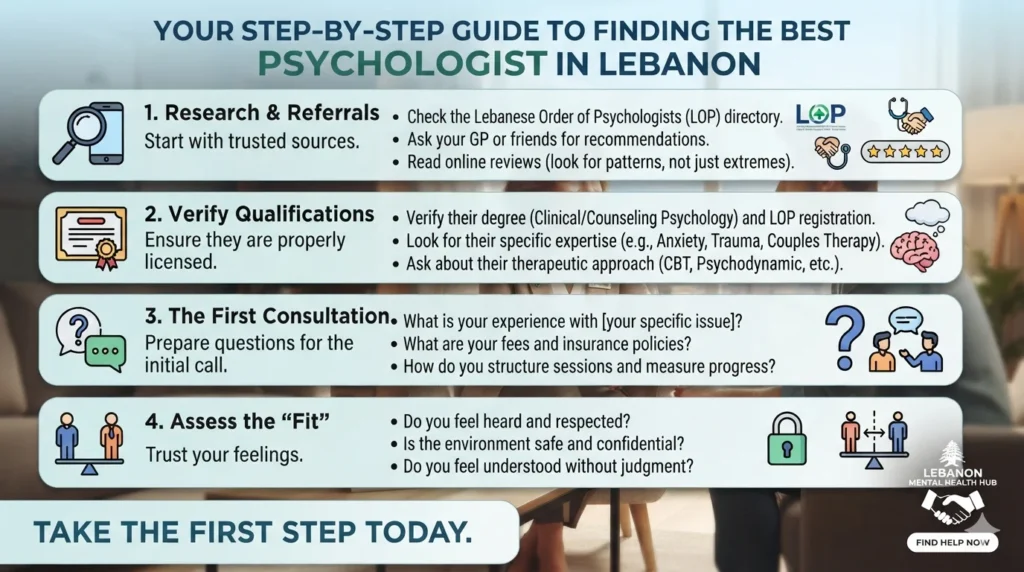
Step One: Define What You Want Help With
Write two or three sentences about what’s been happening, what you’ve tried, and what you’d like to change. It doesn’t need to be polished. This short note makes it far easier to judge whether a psychologist in Lebanon is the right fit, and it saves you from repeating yourself.
Step Two: Shortlist and Reach Out
Pick two or three candidates instead of ten. Many therapists offer a brief introductory call or message exchange. Use it. Notice how quickly and respectfully they respond, whether they answer your questions directly, and how it feels to be in contact with them.
Step Three: Ask the Questions That Matter
A confident professional welcomes questions. Consider asking:
- What is your training, and how long have you worked with concerns like mine?
- What approach would you suggest, and why?
- How will we know whether therapy is helping?
- What are your fees, session length, and cancellation policy?
The way someone answers can matter as much as the content. Clear, calm, non-defensive responses are what you’re hoping for.
Step Four: Treat the First Session as a Two-Way Interview
You’re evaluating them while they assess your situation. After the session, check in with yourself: Did I feel heard? Did I feel judged? Could I imagine telling this person something difficult? You may not feel fully at ease after a single appointment, and that’s normal. But a strong gut reaction in either direction deserves attention. Seeing a second psychologist in Lebanon before settling is not disloyal; it’s due diligence.
In-Person or Online: Which Is Better?
Both work well, and the best psychologist in Lebanon for you might offer either. In-person sessions can feel more contained, which helps if your home is noisy or crowded. Online sessions remove commutes, make it easier to keep appointments through Beirut traffic or power cuts, and open the door to practitioners outside your city. They also let Lebanese living abroad work with someone who shares their language and background.
Privacy is the deciding factor for many people. If you can’t find a quiet corner at home, consider sessions from a parked car, a workplace room you can book, or a friend’s space. A stable connection and headphones go a long way.
Cost, Insurance, and Making Therapy Sustainable
Fees differ based on location, experience, specialty, and format, and economic conditions have made them less predictable than they once were. Instead of quoting numbers that may be outdated, my advice is to ask about the rate and the currency of payment before your first session, and to ask whether a reduced rate is available for students or people facing hardship. Check your insurance policy as well, since coverage for psychological services varies.
If budget is tight, look into NGOs and university-affiliated clinics that offer low-cost counseling. And consider rhythm: a manageable session every two weeks that you can maintain for months often helps more than an intensive schedule you drop after a few weeks. Consistency is what builds change.
How to Tell Whether Therapy Is Working?
Progress rarely arrives as a single breakthrough. More often it looks like small shifts: you recover from a bad day a little faster, you notice a thought pattern before it spirals, you handle a difficult conversation that you’d have avoided last year. Sleep improves. The people close to you may comment that you seem lighter.
Give therapy a fair trial, generally several sessions, before judging. Still, if you’ve been attending for a couple of months and feel stuck, say so. A good practitioner will welcome that conversation and either adjust the approach or help you find a better fit. Voicing doubt isn’t failure; it’s part of how therapy improves.
Frequently Asked Questions About Finding the Best Psychologist in Lebanon
Ask about their degree, where they trained, their years of practice, and any professional registration or association they belong to. Qualified practitioners answer these questions openly. If answers are evasive, treat that as a reason to look elsewhere.
Not necessarily. Price often reflects location, demand, and years of experience, but it doesn’t guarantee a good fit. Plenty of excellent clinicians charge moderate fees, and a high rate says nothing on its own about quality.
If possible, yes. Expressing emotions in the language you think and feel in makes therapy deeper and faster. If you’re comfortable switching between languages, look for someone who can follow you across them.
It’s common and completely acceptable. Tell them honestly if you can, and try someone else. Most therapists would rather you find the right match than stay out of politeness.
Your Next Step
The search for the best psychologist in Lebanon doesn’t end with a ranking. It ends with a conversation in which you feel respected, understood, and safe enough to be honest. Use the qualities and questions above, trust your instincts, and give yourself permission to keep looking until it feels right.
If you’d like to start that conversation, you can book an introductory session or send your questions first. And if this guide made your search a little clearer, share it with someone who is weighing the same decision. If you’re ever in immediate distress, call the Embrace Lifeline at 1564 or go to the nearest emergency room.