

You attend lectures, take notes and spend long evenings studying. Your classmates seem to absorb readings in half the time. You reread pages and still lose the thread, your written work never quite reflects what you understand, or numbers seem to slip away the moment you need them. Eventually a painful thought settles in: “Maybe I’m just not smart enough.” For many university students, that conclusion is wrong. What looks like a lack of ability may be an unrecognised learning difficulty, anxiety, attention problems or a mix of factors that can be identified and supported.
This guide explains what learning difficulties are, why they sometimes surface only at university, the signs to watch for, what else can cause academic struggles, and how a psychological assessment can bring clarity. It draws on Yusra’s experience supporting university students with learning difficulties and performance blocks through her student welfare work.
What Are Learning Difficulties?
“Learning difficulties” is a broad, everyday term for persistent problems with acquiring or using academic skills such as reading, writing or mathematics. Clinicians use more specific language. In the Diagnostic and Statistical Manual of Mental Disorders (DSM-5), these difficulties fall under specific learning disorder, which can affect reading, written expression or mathematics, and is unrelated to general intelligence.
Common Types of Specific Learning Disorder
Difficulties with reading accuracy, fluency or comprehension are often referred to as dyslexia. Difficulties with spelling, grammar, organisation of written work or expressing ideas in writing affect written expression. Difficulties with number sense, calculation or mathematical reasoning are often referred to as dyscalculia. Many students show a mix, and many also have clear strengths in other areas, such as verbal reasoning, creativity or practical problem-solving.
Why Some Learning Difficulties Appear Only at University
The DSM-5 notes that learning difficulties begin during the school years but may not become fully apparent until academic demands exceed a person’s capacities. That is exactly what happens to many students. Bright students often develop strategies at school, such as memorising, relying on class discussion, or simply working much harder than peers. University brings heavier reading loads, faster pace, longer written assignments, more independence and less structure. Strategies that once worked can suddenly fall short, and difficulties that were always there become visible for the first time.
Signs of Learning Difficulties in University Students
Signs of learning difficulties vary, but certain patterns come up repeatedly among students:
- Reading takes much longer than for peers, or must be repeated to be understood.
- Written work is weaker than your spoken understanding of the topic.
- Frequent spelling, grammar or calculation errors despite careful checking.
- Difficulty organising ideas, essays or study material.
- Results that consistently fall below the effort you put in.
Students with learning difficulties often describe exhaustion from studying, a strong sense of being “behind,” and growing frustration or embarrassment. Some begin avoiding certain courses, assignments or exams altogether.
When It’s Not a Learning Difficulty
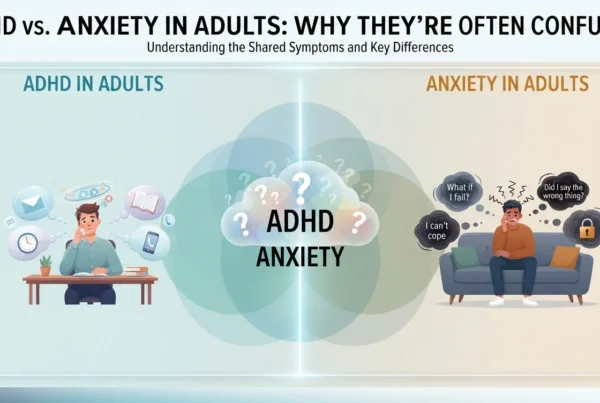
Academic struggles have many possible causes, and a good assessment considers them all rather than jumping to one explanation. Anxiety can disrupt concentration and memory, particularly under exam conditions; our guide to exam anxiety for university students in Lebanon explains that pattern. Attention difficulties such as ADHD can affect reading, organisation and finishing tasks; our article on ADHD vs anxiety in adults explores how those overlap. Depression can slow thinking and sap motivation, and chronic sleep deprivation affects learning and memory. Major life stresses, family difficulties and the transition to university itself can also take a toll.
Often, several factors are involved at once. A student with mild reading difficulties may develop exam anxiety over time; a student with ADHD may also struggle with written expression. Untangling these threads is one of the main purposes of an assessment.
The Language Factor for Students in Lebanon
Many students in Lebanon study in English or French, often alongside Arabic, and may be working in their second or third language at university. Studying in a language you are still mastering can slow reading, affect written expression and make technical vocabulary harder, without any underlying learning disorder. At the same time, a genuine learning difficulty can be overlooked because struggles are assumed to be “just the language.”
Distinguishing between the two requires care. A thoughtful assessment considers your language history, which languages you learned to read in, and whether difficulties appear across languages or only in one. This is one reason why professional judgment matters more than any single test score.
How a Psychological Assessment Can Help?
A psychological assessment for academic struggles aims to answer a simple but important question: what is getting in the way of your learning, and what would help?
What the Assessment Explores?
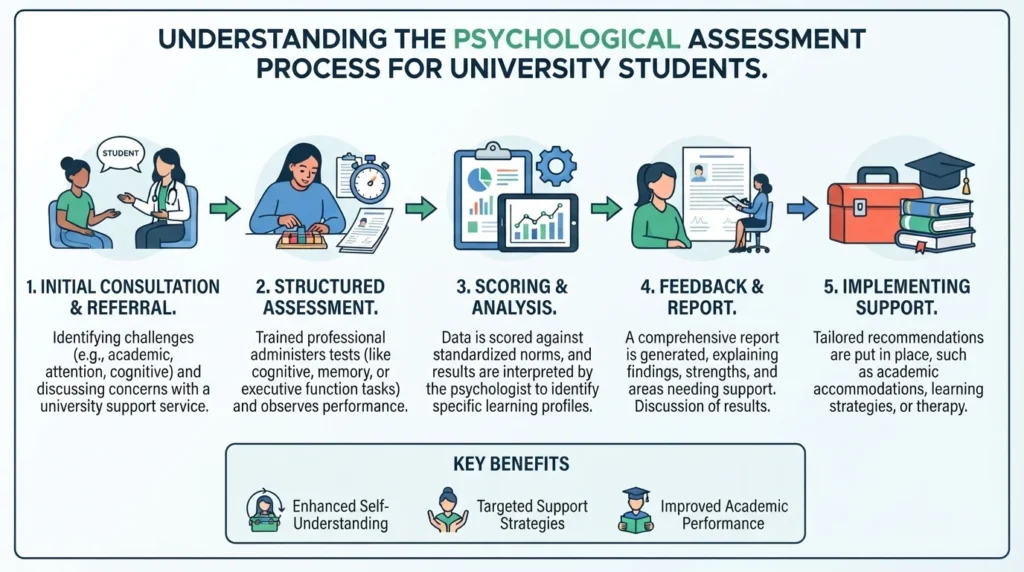
An assessment of learning difficulties in adults typically includes a detailed interview about your educational history, language background, current challenges and wellbeing. It may also include standardised measures of cognitive abilities, such as reasoning, memory and processing speed, which are often assessed using established instruments like the Wechsler intelligence scales. Measures of academic skills in reading, writing and mathematics may be used, along with screening for attention, anxiety and mood. Reviewing school reports and previous evaluations adds valuable context. Depending on the questions involved, some specialised testing may be completed with or referred to colleagues in related fields.
For a general overview of how the process works, see our article on what to expect from a psychological assessment.
What You Gain From It?
The outcome is a clearer understanding of your learning profile, including strengths as well as challenges, and practical recommendations tailored to you. Many students say the most important result is emotional: discovering that their struggles have an explanation, and that they are not lazy or incapable. Our guide to understanding your psychological assessment report explains how to read and use the findings.
What Happens After an Assessment?
The recommendations depend on what the assessment shows. They may include study strategies matched to your profile, such as using audio versions of texts, structured note-taking, breaking assignments into stages or using planning tools. Where a learning difficulty or related condition is identified, a report may support requests for academic adjustments, such as extra exam time, a quieter exam room or permission to use certain technology, depending on your university’s policies and procedures.
If anxiety, low mood or attention problems are contributing, therapy can address them directly. Cognitive behavioral therapy, for example, can help with exam anxiety, procrastination and the harsh self-criticism that often builds up after years of academic struggle. Where medical input is needed, coordinated care with a psychiatrist may also be recommended.
An Illustrative Example
The following is a composite based on common patterns, not a real student. Rita, 19, is in her first year of a business degree in Beirut. At school she was a good student who relied on attentive listening and memorising class notes. At university, she is overwhelmed by long English-language readings and spends hours on a single chapter. Her essays are marked down for organisation and spelling, even though she participates well in class. She has started to dread assignments and is considering changing her major.
An assessment explores her language history, cognitive profile and academic skills, and screens for anxiety and attention difficulties. The findings show strong verbal reasoning and good comprehension when material is read aloud, alongside slow reading fluency and spelling difficulties that appear in both English and Arabic. Rather than a language issue alone, the pattern is consistent with a specific learning difficulty in reading, now accompanied by growing anxiety. Her recommendations include audio texts, extra time for exams, structured essay planning and a few sessions of CBT for academic anxiety. By the end of the year, her confidence and grades have both improved.
The Emotional Side of Learning Difficulties
Learning difficulties are not only an academic issue. Years of struggling, often without explanation, can affect self-esteem deeply. Many students carry beliefs such as “I’m stupid” or “I’ll never be good enough,” which can lead to anxiety, perfectionism, avoidance or low mood. Some hide their difficulties out of shame and try to compensate by working longer and longer hours. If that pressure feels familiar, our article on perfectionism and anxiety may resonate.
Understanding your learning profile is often the first step toward rebuilding confidence. Therapy can help address the emotional impact alongside practical strategies.
When to Consider an Assessment?
Consider an assessment if your academic results consistently fall below your effort and understanding, if reading, writing or mathematics take far more time and energy than they seem to for others, if difficulties have persisted despite trying different strategies, or if academic struggles are affecting your wellbeing or your plans for the future. It is also worth considering if you had similar difficulties at school that were never explained.
An assessment is not a judgment of your intelligence or potential. It is a way to understand how you learn best.
Timing matters too. Many students wait until final year, or until they are close to failing a course, before looking into possible learning difficulties. Seeking an assessment earlier gives you more time to use the recommendations, adjust your study methods and request support before pressure peaks. If you are unsure whether your struggles point to learning difficulties, anxiety or something else, a first consultation can help decide whether a full assessment is the right next step.
Frequently Asked Questions
Yes. Many people are first identified as adults, particularly at university, when academic demands increase. Assessments for adults look at current skills, educational history and other factors that may be affecting learning.
No. Specific learning difficulties affect particular academic skills and occur across the full range of intelligence. Many students with learning difficulties have strong reasoning and creative abilities.
Yes. Anxiety can interfere with concentration, memory and performance, especially in exams. An assessment helps determine whether difficulties come from anxiety, a learning difficulty, attention problems or a combination.
An assessment report may support a request for academic adjustments if it identifies relevant difficulties. Whether accommodations are granted depends on your university’s policies, so it is worth checking their requirements in advance.
It depends on the questions being explored and the measures used. Most involve several sessions, including an interview, testing and a feedback meeting. Your psychologist will give you a clear estimate at the start.
Understanding How You Learn
Learning difficulties at university are more common than many students realise, and they are not a sign of laziness or lack of ability. With a clear understanding of your learning profile, the right strategies and support for the emotional side of the struggle, many university students go on to study with far more confidence and success.
If you are struggling academically despite real effort, an assessment may help you understand why. Learn more about psychological assessment and diagnosis in Lebanon, book a confidential consultation, or send a message on WhatsApp with any questions first.
About this article: This content is for general education and does not diagnose or replace individual assessment or treatment. It was reviewed by Yusra Imad, Licensed Clinical Psychologist and CBT Psychotherapist. Academic accommodation policies vary between institutions. If you are in immediate danger or thinking of harming yourself, contact local emergency services or go to the nearest hospital.
Reviewed by Yusra Imad, Licensed Clinical Psychologist and CBT Psychotherapist in Lebanon.