
When most couples look into considering therapy, they have been grappling with the idea for quite some time. One person proposes it, the other doesn’t like it, and it is postponed until the next quarrel. The reluctance is generally pragmatic. None of them knows what would actually take place in the room and the feeling of being blamed, judged or pressured to say something they’re not prepared to say is enough to put the idea on the shelf.
The fact that you know how the couples therapy works reduces the uncertainty. This guide covers the typical content of the initial sessions, the process that follows them, and therapist’s roles and limitations.
How Many Things Does Couples Therapy Stand For?
Couples therapy is not a test of whether you are the right or wrong person for the job. Its goal is to allow two people to become aware of the pattern that they have gotten in the habit of doing together, even when it isn’t wanted, and create alternative modes of communicating and reacting to one another.
That distinction matters. In most conflicts of long duration both partners are responding to the response of the other. One of them leaves because he/she is criticized by the other and the other criticizes because he/she has left. In couples therapy, a therapist doesn’t take sides, which is what makes it different in several ways.
The book isn’t just for troubled relationships!The book isn’t just for hard relationships!
Many people think that couples therapy is a therapy for the last resort. They meet because for a variety of reasons, in practice, the couples that come come for a variety of reasons: problems with communication, emotional distance, disagreement over family or money, etc., or after a major life change, or even because they feel that they drifted apart without a specific “cataracting” event. Some are especially dedicated in order to deal with matters prior to they get to be “within the rocks.”
It happens, but it doesn’t always happen.The first session: What actually happens.
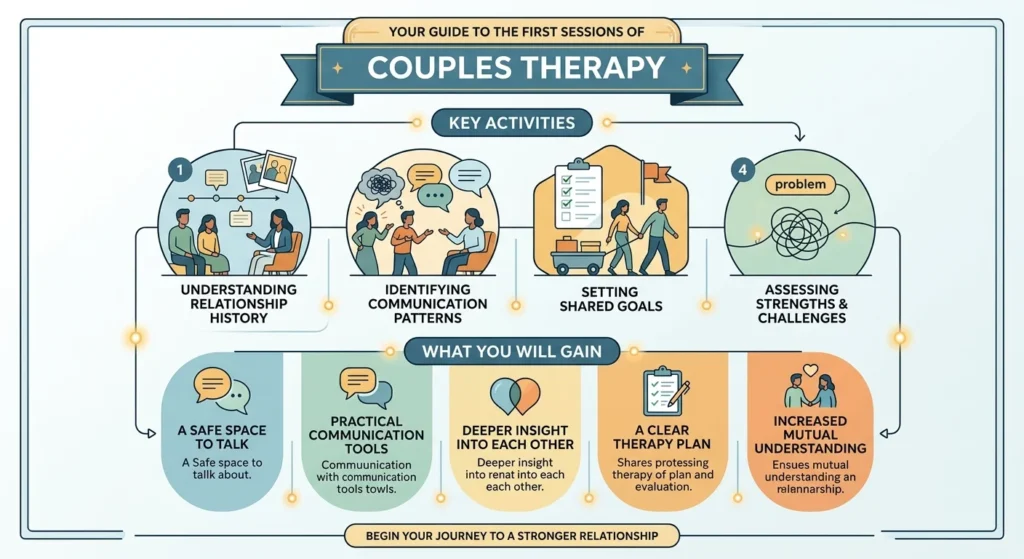
The first session is primarily a knowledge session. The therapist will likely ask you both what led you in, how you both see the difficulty, how long it is there, and what you hope will change. Each of you will likely be given the opportunity to share your thoughts, and the therapist will be listening to what you say, and how you say it.
Don’t need to come with an agenda or a consensus version of events. There may be several definitions of the same problem in the minds of the partners – and this is very useful information for the problem, not an inconvenience.
The first session is often somewhat awkward as well. Speaking about something painful in front of a stranger, always in front of your partner is not normal. A skilled therapist will anticipate this and make the conversation flow in the process.
What does the Therapist Hear?
In general, a therapist is detecting the pattern: who says something, who doesn’t say anything, what does each person want to say before they become upset, and what is each person asking when they grumble from the depths. Anyone who says, “You never listen,” is saying they need to feel they’re valued by the person they’re talking to, and it’s that need which the work finally connects to.
How the Following Sessions will be developed?
In the first sessions, normally the work shifts from describing the problem to comprehending the problem. The therapist assists you to see the pattern clearly and to see your role in it very clearly but not in the blameful way.
Then therapy usually consists of practising alternative means of relationship building or communication, during the course of the therapy session. This can involve learning how to raise a tricky subject without triggering defensiveness, listening long enough to understand the point they are making, or taking note of the initial signs and symptoms of an escalating argument and trying to slow it down. Doing it in a structured space with a facilitator is a lot easier than attempting it for the first time when the two parties are going to be disagreeing.
For the couple, the work can also explore the origins of their responses – for example, family dynamics or previous relationships or expectations of what a relationship is supposed to be. A relational approach (not just current behavior) can enhance the work here.
What Happens Between Sessions?
Change in couples therapy takes place outside of therapy sessions, not during. The therapist might give you things to observe or practice during the week – for instance, how you are felt by in a particular recurring scenario, or a different approach to opening a conversation. These aren’t tests. They’re methods for observing what is known in the room and how it unfolds in the real world.
Life does not unfold in a linear fashion. Sometimes couples enjoy a nice honeymoon period after which they have a challenging week, but this is not a failure of therapy, as they can then have a good stretch again. When things go wrong, it is an indication of/or confirmation of which patterns are still solid and require additional focus.
What is and what is not possible in couples’ therapy?
It can help both parties understand better the reasons behind their difficulties, provide them with some concrete communication tools and help them find a framework to address some issues that are difficult to communicate on their own. That’s all that can change the tone of the relationship for many couples.
It does not guarantee that a relationship will continue, and is not effective if one of the parties is not willing to join it. Therapy can also enable two people to decide with clarity and calm about what they want for their future together – even what they don’t want – including if the relationship is not right for them. A competent therapist strives for clarity for both sides, not an agreed upon end goal.
Roughly how long will it take?
No standard length is given. For other couples, with a well-defined problem, a few sessions may offer sufficient assistance. For others, especially when dealing with patterns that have been in existence for a long time or when multiple issues are interconnected, the lengthier process is beneficial. After the initial few sessions, when the difficulty is more apparent, the therapist should be able to provide a general indication of pacing.
Is It the Right Time to Start?
If communication has become tense, distance has grown, or the same conflicts keep returning without resolution, those are reasonable signs that outside support could help. You don’t need to be certain that therapy will work, and you don’t both need to feel equally enthusiastic at the start. Willingness to attend the first session and see what it involves is usually enough.
To learn more about how this work is approached, see the page on integrative couple therapy.
Frequently Asked Questions
This is very common. Some people are hesitant because they fear being blamed or don’t see the point. It can help to frame the suggestion as wanting to understand the pattern together rather than fix one person. Some individuals also begin with individual sessions to work on their side of the dynamic, though how much that can achieve on its own depends on the situation.
It varies with the couple and the difficulty involved. A focused issue may need fewer sessions, while long-standing or layered problems often need more time. A therapist can give you a clearer estimate once they understand your situation.
A well-trained couples therapist aims to stay balanced and to look at the relationship pattern rather than assign fault to one person. If you ever feel the therapist isn’t being fair, it’s reasonable to raise that directly.
Not necessarily. How sessions are structured, including whether partners are sometimes seen separately, depends on the therapist’s approach and the situation. It’s worth asking about this in the first conversation so you know what to expect.
Yes. Some couples use therapy to try to repair the relationship, and others use it to understand what happened and make a clearer decision. Either way, the aim is greater clarity and a more respectful way of communicating.
Take the Next Step
If you and your partner are wondering whether therapy might help, an initial conversation is a low-pressure way to find out what the process would look like for your situation.
Book a Consultation or reach out to talk with Yusra Imad about couples therapy.