

The condolence visits have ended. People have returned to their lives, and they gently assume you have too. But you still reach for your phone to call them. You still set the table for one more. Some days you function almost normally; other days a song, a smell or an empty chair brings everything back as if it happened yesterday. Grief does not follow anyone’s schedule, and when it feels too heavy to carry alone, grief counseling can offer a place to put some of that weight down.
This guide explains what grief is, why it can look so different from one person to the next, what helps people cope, how to recognise when mourning has become stuck, and how grief counseling and therapy support people through loss. Whatever you have lost, and however long ago, your grief deserves to be taken seriously.
What Is Grief?
Grief is the natural response to losing someone or something we are deeply attached to. It is not a single emotion but a mixture: sadness, longing, anger, guilt, relief, numbness, fear and sometimes even moments of laughter or peace. It affects the body as well as the mind, often bringing exhaustion, disturbed sleep, changes in appetite, difficulty concentrating and a heavy, aching feeling that is hard to describe.
Most people think of grief in relation to death, and bereavement is indeed one of the most painful experiences in life. But grief also follows other losses: the end of a marriage, a miscarriage, a serious diagnosis, losing a job, a home or a country, or watching a loved one change through illness or dementia. All of these involve letting go of something that mattered.
Why the “Five Stages” Don’t Tell the Whole Story?
Many people have heard of the five stages of grief: denial, anger, bargaining, depression and acceptance. They come from psychiatrist Elisabeth Kübler-Ross’s 1969 work with people who were dying, and they have helped many people feel less alone. However, research has not shown that most bereaved people move through fixed stages in order. Feelings tend to come and go, overlap and return. If your mourning does not match a neat sequence, nothing is wrong with you.
How Grief Really Works?
Modern research offers a more flexible picture of how people cope with loss.
Moving Between Loss and Life
Psychologists Margaret Stroebe and Henk Schut proposed the dual process model of coping with bereavement. It suggests that healthy mourning involves moving back and forth between two kinds of activity: facing the loss, such as crying, remembering and missing the person, and attending to life, such as handling practical tasks, taking on new roles and finding moments of rest or distraction. Both are necessary. Constantly focusing on the loss can become overwhelming, while constantly avoiding it can leave grief unprocessed. Most people naturally oscillate between the two, and that movement is part of healing.
Staying Connected to the Person You Lost
Older ideas suggested that people needed to “let go” and move on. Researchers Dennis Klass, Phyllis Silverman and Steven Nickman challenged this with the concept of continuing bonds: the idea that many people maintain an ongoing inner relationship with those who have died, through memories, rituals, conversations, values they carry forward and traditions they keep alive. For many, this connection is comforting rather than a sign of being stuck.
Resilience Is Common
Psychologist George Bonanno’s research has found that many bereaved people show considerable resilience, experiencing deep sorrow while still functioning and gradually adapting. Feeling able to laugh, work or enjoy something soon after a loss does not mean you did not love the person. People grieve in many different, equally valid ways.
Grief, Culture and Faith in Lebanon
Mourning is shaped by culture and belief. In Lebanon, many families gather for condolences in the days after a death, and memorials such as the fortieth-day commemoration are common in different communities. These traditions can provide enormous support, bringing people together and giving shape to the earliest, most disorienting days.
Faith is a central source of comfort and meaning for many people coping with loss. Good therapy respects these beliefs and works within them, never asking anyone to set their faith aside. At the same time, grief can sometimes bring spiritual questions, doubt or anger, and it can help to have a safe space to explore those feelings without judgment.
Loss in Lebanon can also be layered. Many people have experienced losses connected to emigration, economic hardship, public tragedies or conflict, alongside personal bereavements. When grief piles up, or when it is shared by a whole community, it can be harder to find space for your own. Our article on coping with stress in Lebanon looks at this kind of collective strain.
When Grief Is Harder to Carry?
Every loss is painful, but some circumstances tend to make mourning more complicated:
- A sudden, violent or traumatic death.
- Losing a child, or losing a loved one to suicide.
- Several losses close together.
- A relationship that was complicated, conflicted or unresolved.
- Little social support, or grief that others do not recognise.
Psychologist Kenneth Doka described disenfranchised grief: mourning that is not openly acknowledged or socially supported, such as after a miscarriage, the death of an ex-partner or a pet, or a loss others consider minor. Family therapist Pauline Boss described ambiguous loss, where someone is physically absent but psychologically present, or physically present but psychologically changed, as with dementia or a loved one living far away. These kinds of grief can be especially lonely.
When a death was frightening or traumatic, grief can be intertwined with trauma symptoms such as intrusive images, nightmares or intense fear. Our article What Is Trauma? explains how trauma can affect the mind and body.
Prolonged Grief: When Mourning Becomes Stuck
For most people, the intensity of grief gradually softens over time, even though the loss is never forgotten. For a minority, grief remains so intense and disabling that it stops them from re-engaging with life. Clinicians now recognise this as prolonged grief disorder, which was added to the World Health Organization’s ICD-11 and to the American Psychiatric Association’s DSM-5-TR in 2022.
According to the DSM-5-TR, prolonged grief disorder may be considered when, at least 12 months after a death for adults (six months for children and adolescents), a person experiences intense yearning for or preoccupation with the deceased nearly every day, together with other persistent symptoms, such as feeling that part of themselves has died, intense emotional pain, marked difficulty re-engaging with life, emotional numbness, or feeling that life is meaningless, to a degree that significantly affects daily functioning. ICD-11 uses a six-month timeframe. Only a qualified professional can assess this, and these timeframes are not deadlines for how quickly anyone “should” stop grieving.
Grief vs. Depression
Grief and depression can look similar, and they can occur together. In grief, painful feelings often come in waves linked to reminders of the person, and positive memories are usually still present. In depression, low mood and loss of interest tend to be more constant and pervasive, often with feelings of worthlessness. If low mood is persistent and spreading into every part of life, our article What Is Depression? may help clarify what you are experiencing.
Coping With Grief: What Can Help
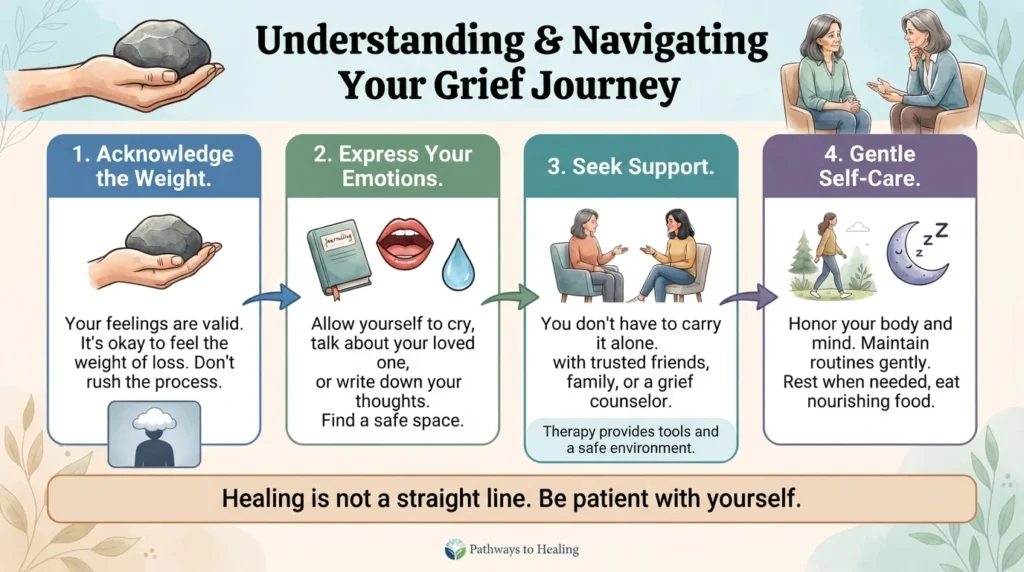
There is no right way to grieve, but some approaches help many people with coping with grief. Allow yourself to feel what comes, without judging it. Keep basic routines for sleep, meals and movement, even when they feel pointless; the body needs care during mourning. Accept practical help and let people support you. Find ways to remember, such as looking at photographs, telling stories, visiting meaningful places or keeping traditions alive. Expect difficult days around anniversaries, holidays and birthdays, and plan for them. Be cautious about using alcohol or other substances to numb pain, and try not to make major, irreversible decisions in the earliest months unless you have to.
It can also help to give yourself permission to have moments of relief or even joy. They are not a betrayal of the person you lost; they are part of how people carry grief and keep living.
Supporting Someone Who Is Grieving
If someone you care about is grieving, your presence often matters more than finding the perfect words. Listening, saying the person’s name, sharing memories and offering specific practical help, such as bringing a meal or handling an errand, are usually more helpful than general reassurance. Try to avoid phrases that minimise, such as “At least they’re no longer suffering” or “You should be moving on by now.” Grief often becomes lonelier after the first weeks, when visits slow down, so continuing to check in months later can mean a great deal.
Children grieve too, though they may show it differently, through play, behavior changes or questions that come up repeatedly. Honest, age-appropriate explanations and reassurance help. When a loss affects the whole household, family therapy can support everyone in adjusting together.
An Illustrative Example
The following is a composite based on common patterns, not a real client. Leila, 46, lives in Beirut. Her mother died suddenly 14 months ago, and her brother, who lives abroad, returned home only briefly for the funeral. Leila handled the arrangements, cared for her father and went back to work within a week. Everyone praised her strength. Now, more than a year later, she finds herself crying every evening, unable to enter her mother’s room, avoiding the café they used to visit and feeling angry with her brother. She feels she “should be over it.”
Through grief counseling, Leila begins to understand that she never had space to mourn; she moved straight into caring for everyone else. With her therapist, she gradually allows herself to remember her mother, writes a letter to her expressing things she never got to say, and starts visiting meaningful places at her own pace. She also explores her anger toward her brother and, eventually, talks with him openly. Her sadness does not disappear, but it changes. She describes it as “carrying my mother with me, instead of carrying a weight.”
How Grief Counseling and Therapy Help?
Many people move through grief with the support of family, friends and faith. Others find that they need more. Grief counseling offers a dedicated space to talk about the person or what you have lost, express feelings you may be hiding from others, make sense of complicated emotions such as guilt or anger, and find ways to continue living while honouring the loss.
Grief and loss therapy may draw on several approaches. Cognitive behavioral techniques can help with avoidance, self-blame and unhelpful beliefs about how grief “should” look. For prolonged grief disorder, specific structured treatments have been developed and studied, including Complicated Grief Treatment, developed by psychiatrist Katherine Shear and tested in randomised controlled trials. In Yusra’s practice, individual psychotherapy combines CBT with the analytical-systemic approach, which pays attention to how a loss reshapes roles, relationships and family patterns. Our article on life transitions and mental health explores how major changes affect families more broadly.
You do not need to wait a certain amount of time, or meet any criteria, to seek support. Grief counseling can be helpful soon after a loss, years later, or at any point when grief feels too heavy to carry alone.
When to Seek Support?
Consider speaking with a psychologist if grief is making it very hard to function months after a loss, if you feel stuck or unable to re-engage with life, if guilt, anger or numbness feel overwhelming, if you are avoiding everything connected to the person, or if you are relying on alcohol or other substances to cope. Support is also important after a traumatic or sudden death, or the loss of a child.
Grief can sometimes bring thoughts of wanting to die or to be with the person who has passed. If you are having thoughts of harming yourself or ending your life, please reach out straight away. In Lebanon, you can call 1564, the national lifeline for psychological support and suicide prevention, available 24/7. If you are in immediate danger, contact local emergency services or go to the nearest hospital.
Frequently Asked Questions
Grief counseling is professional support for people coping with loss. It offers a safe space to talk about the person or what was lost, process difficult emotions and find ways to adjust to life while honouring the loss.
There is no fixed timeline. For many people, the intensity of grief softens gradually over months and years, though waves of sadness may return around reminders and anniversaries. Grief changes over time rather than simply ending.
Prolonged grief disorder describes grief that remains intense and disabling for an extended period, generally at least 12 months after a death in adults according to the DSM-5-TR, and significantly interferes with daily life. A professional can assess whether it applies.
Yes. Anger, guilt, relief and many other feelings are common parts of grief. Talking about them, whether with trusted people or a therapist, can help make sense of them.
Consider seeing a therapist if grief feels overwhelming, if you feel stuck or unable to function, if the loss was sudden or traumatic, or if you simply want support. You do not need to wait a certain amount of time before reaching out.
You Don’t Have to Grieve Alone
Grief is the price of love, and there is no correct way or timetable for carrying it. Whether your loss is recent or long past, whether others recognise it or not, you deserve support. Grief counseling does not take the loss away, but it can help you carry it in a way that leaves room for life, connection and meaning again.
If you are struggling with a loss, support is available. Learn more about individual psychotherapy in Lebanon, book a confidential consultation, or send a message on WhatsApp with any questions first.
About this article: This content is for general education and does not diagnose or replace individual assessment or treatment. It was reviewed by Yusra Imad, Licensed Clinical Psychologist and CBT Psychotherapist. If you are in crisis in Lebanon, call 1564, the national lifeline for psychological support and suicide prevention (available 24/7). If you are in immediate danger, contact local emergency services or go to the nearest hospital.
Reviewed by Yusra Imad, Licensed Clinical Psychologist and CBT Psychotherapist in Lebanon.