
If someone checks your phone or browser, consider reading this on a device they cannot access, and clear your browsing history afterward if it is safe to do so.
Nobody hits you. There are no bruises to show anyone. Yet you have started choosing your words carefully, checking your partner’s mood before you speak, and apologising for things you are no longer sure you did. Friends see you less. You doubt your memory and your judgment. Some days you wonder whether you are the problem. If this sounds familiar, it may help to know that what you are experiencing has a name, and that recognising the signs of emotional abuse is often the first step toward feeling safe and like yourself again.
This guide explains what emotional abuse is, the signs to look for, how it differs from ordinary relationship conflict, how it affects people, and where to find support in Lebanon. It is written for anyone who is unsure about their relationship, and for people worried about someone they love. Please read at your own pace and stop whenever you need to.
If you are in immediate danger, call the Internal Security Forces on 112.
What Is Emotional Abuse?
Emotional abuse is a pattern of behavior in which one person repeatedly uses words, threats, manipulation or control to frighten, belittle, isolate or dominate another. It is sometimes called psychological abuse. The key word is pattern: a single hurtful comment during an argument is not the same as an ongoing pattern designed, consciously or not, to make one person smaller and the other more powerful.
The World Health Organization includes psychological abuse and controlling behaviors within its definition of intimate partner violence, alongside physical and sexual violence. Sociologist Evan Stark used the term coercive control to describe how abusive partners can restrict another person’s freedom through a web of rules, monitoring, threats and humiliation, even when no physical violence occurs.
Emotional abuse in relationships can affect anyone, regardless of gender, age, education, income or religion. It can happen in marriages, engagements, dating relationships and other close relationships, including between family members.
Signs of Emotional Abuse
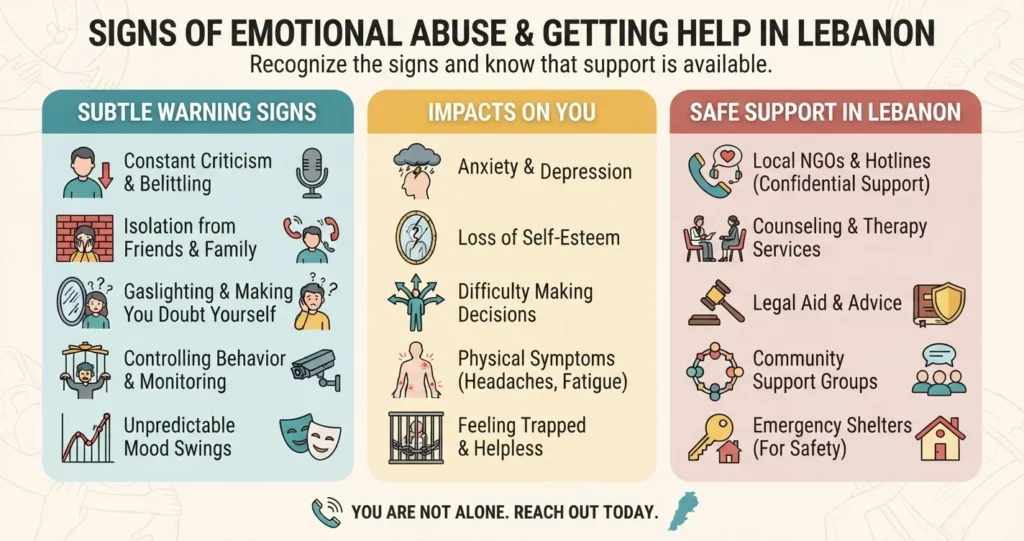
The signs of emotional abuse often develop gradually, which is one reason they can be hard to see from the inside. In summary, warning signs include a partner who:
- Regularly criticises, mocks or humiliates you, in private or in public.
- Controls who you see, where you go, or how you spend money.
- Makes you doubt your memory, perceptions or sanity.
- Uses threats, intimidation or silent treatment to punish you.
- Monitors your phone, messages or location without your agreement.
Criticism, Humiliation and Belittling
One of the most common signs of emotional abuse is constant put-downs about your appearance, intelligence, family or abilities, along with jokes at your expense that you are told to “take lightly,” mocking you in front of others, or comparing you unfavourably with other people. Over time, these messages can become your own inner voice.
Control and Isolation
Common controlling relationship signs include deciding who you can see, discouraging or forbidding contact with friends and family, demanding to know where you are at all times, restricting access to money or work, and making important decisions without you. In emotional abuse, isolation is particularly harmful because it removes the people who might notice something is wrong and offer support.
Manipulation and Gaslighting
Gaslighting, a term taken from the 1944 film Gaslight, describes repeatedly denying or distorting someone’s reality: “That never happened,” “You’re too sensitive,” “You’re imagining things.” Other forms of manipulation in emotional abuse include guilt-tripping, blaming you for the other person’s behavior, or alternating cruelty with sudden affection so that you keep hoping things will improve.
Threats and Intimidation
Threats to leave, to take the children, to expose private information, to harm themselves, or to harm you or someone you love are all forms of emotional abuse. So are shouting, punching walls, breaking objects or using silence as punishment, even if no one is physically touched.
Jealousy and Monitoring
In emotional abuse, excessive jealousy is often presented as love: “I just care about you so much.” In reality, demanding passwords, checking messages, tracking your location or accusing you of infidelity without reason are ways of controlling you, not caring for you.
Ordinary Conflict or Emotional Abuse?
All couples argue, and not every painful argument is emotional abuse. Healthy relationships include disagreement, frustration and sometimes hurtful words. The difference lies in power, fear and pattern. In a healthy relationship, both partners can express disagreement, both feel safe saying no, mistakes are acknowledged and repaired, and neither person controls the other’s life. In an emotionally abusive relationship, one partner holds most of the power, the other is afraid of how they will react, and the same harmful behaviors repeat despite promises to change.
A few honest questions can help. Do you feel afraid of your partner’s reactions? Do you change your behavior to avoid upsetting them? Have you lost contact with people who matter to you? Do you feel like a different, smaller version of yourself than before the relationship began? If several answers are yes, it may be worth speaking with someone you trust or one of the services listed below.
How Emotional Abuse Affects You?
The effects of emotional abuse can be as serious and lasting as those of physical harm. People commonly describe constant anxiety, “walking on eggshells,” low self-esteem, self-doubt, shame, difficulty making decisions, and feeling confused about what is real. Many develop symptoms of depression or anxiety, and some experience trauma symptoms such as intrusive memories, nightmares and feeling constantly on guard. Our articles on PTSD vs stress and low self-esteem explore those effects in more depth.
These reactions to emotional abuse are not a sign of weakness. They are understandable responses to living with ongoing fear and control.
Why Emotional Abuse Is So Hard to Recognise and Leave?
People outside a relationship often ask, “Why don’t they just leave?” The answer is rarely simple. Emotional abuse usually begins slowly, after a period of affection and closeness, so each step feels small. Many people still love their partner and remember who they were at the start. Self-doubt, carefully built over time, makes it hard to trust your own judgment. Practical barriers matter too: financial dependence, children, housing, immigration or residency concerns, and fear of what the other person might do.
Family and social expectations can add further pressure. In many communities, including in Lebanon, people may feel that relationship problems should stay private, that divorce or separation brings shame, or that patience is a duty. These pressures are real, and no one should be judged for how long it takes them to recognise or respond to abuse. Leaving can also be a period of increased risk, which is why speaking with a specialist service before taking major steps can be so important.
Lebanon has a law on the protection of women and family members from domestic violence, Law 293 of 2014. Organisations such as KAFA offer legal information and guidance about what options may be available.
Where to Get Help in Lebanon?
Immediate danger: Internal Security Forces, 112.
KAFA helpline: 03 018 019 (24/7, free and confidential support, including access to legal and social support).
ABAAD Emergency Safe Line: +961 81 78 81 78 (24/7).
Internal Security Forces hotline: 1745, which receives reports of family violence.
Lifeline 1564: 1564 (24/7 emotional support and suicide prevention, run with Embrace).
Numbers checked in November 2026. Services can change, so please confirm details directly with the organisation.
Safety First: Practical Steps
If you recognise the signs of emotional abuse in your relationship, you do not have to decide everything at once. Thinking about safety, even before any decision about the relationship, can help. Specialist services can work with you on a personal safety plan; some general steps people find helpful include:
- Tell one trusted person what is happening, and agree on a code word.
- Memorise or safely store key phone numbers, including a helpline.
- Keep important documents and some money somewhere accessible.
- Use a safe device and check your phone’s location and sharing settings.
- Write down incidents with dates, if it is safe to keep a record.
If you are worried that the situation could escalate to physical harm, please contact one of the services above or the police without delay.
How to Support Someone You’re Worried About?
If you notice signs of emotional abuse in someone you love, your support can make a real difference. Choose a private, safe moment to talk. Tell them what you have noticed without criticising their partner too harshly, which can make them defensive. Listen, believe them and avoid pressuring them to leave immediately; decisions need to come from them, at a pace that is safe. Stay in touch, even if they withdraw, and gently share information about helplines. Being a steady, non-judgmental presence counters the isolation that abuse depends on.
An Illustrative Example
The following is a composite based on common patterns, not a real client. Rasha, 29, married after a whirlwind engagement. At first her husband was attentive and generous. Within a year, he was checking her phone, criticising how she dressed, and becoming cold and silent for days if she visited her sister. When she raised concerns, he told her she was “too emotional” and that no one else would put up with her. She began to believe him.
After a friend gently said she seemed “like a different person,” Rasha called a helpline from a colleague’s phone during her lunch break. For the first time, someone named what was happening as emotional abuse. With the helpline’s guidance, she made a safety plan and, later, began individual therapy. In sessions, she worked on rebuilding trust in her own perceptions, understanding the patterns of control she had experienced, and managing the anxiety that had become constant. The decisions she made about her marriage were hers, taken step by step and with support.
How Therapy Can Help?
After emotional abuse, individual therapy offers a confidential space to make sense of what has happened, rebuild self-trust and self-esteem, manage anxiety, trauma symptoms and low mood, and think through decisions safely. A trauma-informed therapist will move at your pace, never pressure you to leave or stay, and help you connect with specialist services when needed. Cognitive behavioral approaches can help challenge the beliefs that abuse often leaves behind, such as “It’s my fault” or “I can’t trust my own judgment.” In Yusra’s practice, individual psychotherapy combines CBT with the analytical-systemic approach, which can also help people understand how earlier relationships may shape what they come to tolerate; our article on childhood trauma and relationships explores that link.
It is important to know that many specialists advise against couples therapy while emotional abuse is ongoing. Joint sessions can put the person being harmed at greater risk, and the problem is one person’s controlling behavior rather than a shared communication difficulty. Individual support and specialist services usually come first.
If You Recognise These Behaviors in Yourself
Some readers may recognise themselves in the behaviors of emotional abuse described here. Taking responsibility and seeking help is an important and positive step. Change is possible, but it requires honest work with a qualified professional, and the safety of your partner and any children must come first.
Frequently Asked Questions
Common signs include ongoing criticism and humiliation, controlling behavior, isolation from friends and family, gaslighting, threats or intimidation, excessive jealousy and monitoring your phone or movements. The pattern, rather than a single incident, is what defines abuse.
Emotional abuse can cause serious and lasting harm, including anxiety, depression, low self-esteem and trauma symptoms. The World Health Organization recognises psychological abuse and controlling behaviors as forms of intimate partner violence.
Every relationship has conflict, but emotional abuse involves an imbalance of power, fear of the other person’s reactions, and a repeated pattern of control or belittling. If you feel afraid, isolated or no longer like yourself, it is worth speaking with someone.
You can contact the KAFA helpline (03 018 019, 24/7), the ABAAD Emergency Safe Line (+961 81 78 81 78, 24/7) or the Internal Security Forces (112 in an emergency, or the 1745 hotline). A psychologist can also offer confidential support.
Many specialists advise against couples therapy while emotional abuse is ongoing, because it can increase risk for the person being harmed. Individual support and specialist services are generally recommended first.
You Deserve to Feel Safe
Recognising the signs of emotional abuse can be painful, especially when you love the person involved. But noticing what is happening is not betrayal; it is an act of care for yourself. You deserve to feel safe, respected and free to be yourself, and support is available whenever you are ready.
If it is safe for you to do so, you can get in touch confidentially to ask about individual support. If you are in immediate danger, please call 112, or contact KAFA (03 018 019) or the ABAAD Emergency Safe Line (+961 81 78 81 78) at any time.
About this article: This content is for general education and does not replace individual assessment, legal advice or specialist support. It was reviewed by Yusra Imad, Licensed Clinical Psychologist and CBT Psychotherapist. Helpline details were checked in November 2026; please confirm them directly with each organisation. If you are in immediate danger, call 112. If you are in crisis or having thoughts of harming yourself, call 1564 (available 24/7).
Reviewed by Yusra Imad, Licensed Clinical Psychologist and CBT Psychotherapist in Lebanon.