

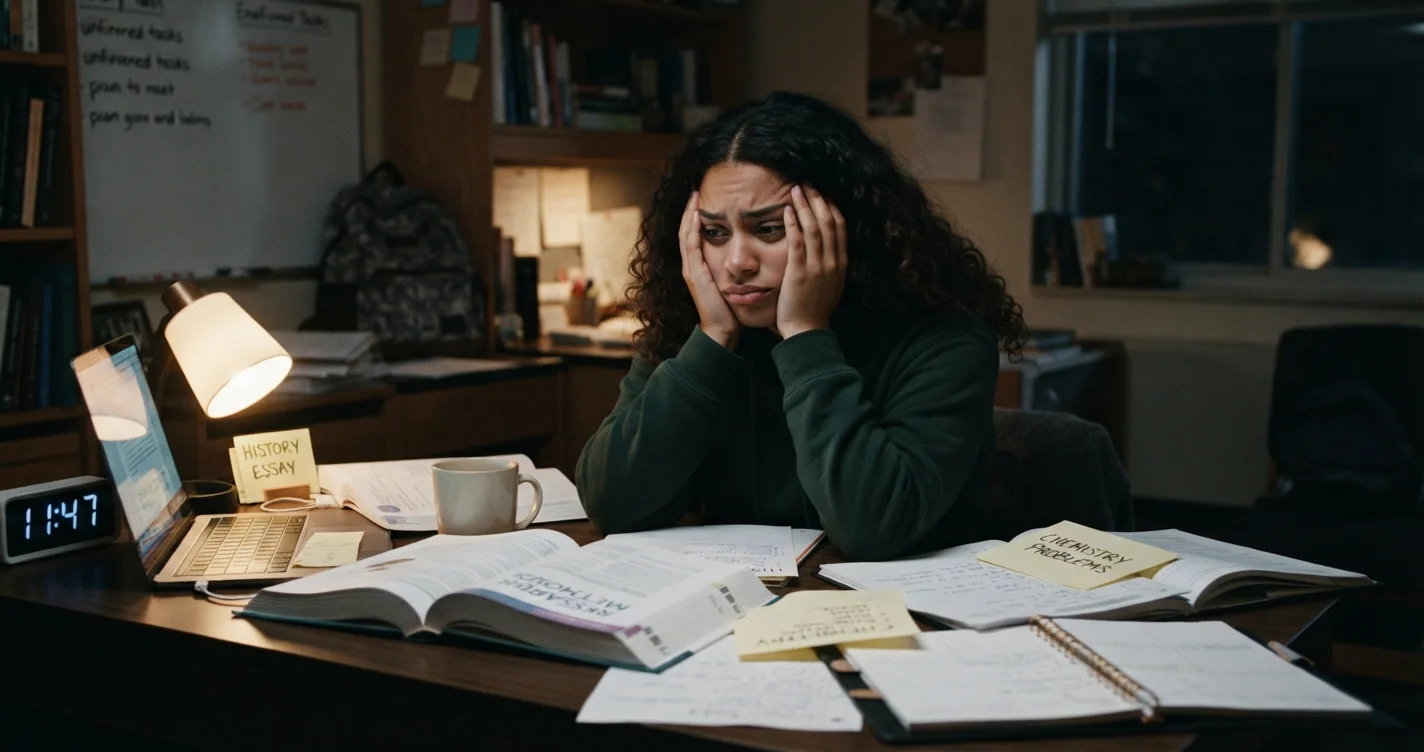
It is 11 p.m. The assignment is due tomorrow. You have opened the document six times today and written two sentences. Instead, you have cleaned your room, scrolled for an hour and promised yourself you will start “after one more episode.” You used to enjoy your degree. Now just thinking about it makes you tired, and the guilt of not starting is almost worse than the work itself. If this sounds familiar, you may be facing more than a bad week. You may be experiencing academic burnout, and procrastination is often how it shows up.
This guide explains what academic burnout is, why it so often comes with procrastination, how to tell it apart from laziness or exam nerves, and practical, evidence-informed steps to recover. It draws on Yusra’s experience supporting university students with performance blocks, exam anxiety and learning difficulties through her student welfare work.
What Is Academic Burnout?
Academic burnout, sometimes called student burnout, is a state of exhaustion and disengagement that develops after prolonged study-related stress without enough rest or recovery. Researchers led by psychologist Wilmar Schaufeli adapted the well-known Maslach Burnout Inventory for students in 2002, describing three core features: emotional exhaustion from the demands of study, a cynical or detached attitude toward one’s studies, and a reduced sense of being effective as a student.
In plain terms, students with academic burnout often feel drained, stop caring about courses they once valued, and start believing that their efforts make little difference. It is not a medical diagnosis, but it is a real and well-studied pattern, and it can affect even highly capable, motivated students.
Academic Burnout vs. Ordinary University Stress
Ordinary university stress tends to rise and fall with deadlines and exams; after a break, motivation returns. Academic burnout lingers. Rest helps less, the sense of pointlessness grows, and even easy tasks feel heavy. Our article on stress vs burnout explains this distinction in more depth. If your main struggle is panic or blanking in the exam room itself, our guide to exam anxiety for university students in Lebanon may be more relevant.
Signs of Academic Burnout
Academic burnout usually builds gradually. Common signs include:
- Feeling exhausted by studying, even after a full night’s sleep.
- Losing interest in subjects you used to enjoy.
- Procrastinating more and more, then cramming at the last minute.
- Feeling cynical: “What’s the point of any of this?”
- Doubting your abilities despite past achievements.
Many students with academic burnout also notice irritability, poor sleep, headaches, skipped classes, withdrawal from friends, or relying heavily on caffeine and energy drinks to keep going.
Why University Students Burn Out?
Academic burnout rarely has one cause. It usually grows from a combination of pressures that, together, outpace a student’s ability to recover.
Heavy workloads, back-to-back deadlines and demanding programmes are an obvious driver of academic burnout. So is perfectionism: students who believe anything short of excellent is failure tend to overwork, then avoid, then overwork again. Our article on perfectionism and anxiety explores that pattern. Lack of rest, irregular sleep and constant connection to group chats and social media leave little room to recharge.
Students in Lebanon often carry additional layers. Many work part-time while studying, some depend on scholarships tied to their grades, and many feel the weight of family sacrifices made to fund their education. Studying in a second or third language, uncertainty about future job prospects, and plans or pressure to emigrate after graduation can all add strain. None of these factors alone causes academic burnout, but together they can make it much more likely.
The Procrastination and Burnout Cycle
Procrastination is one of the most visible signs of academic burnout, and one of the most misunderstood. Students often call themselves lazy. Research suggests something quite different.
Procrastination Is About Feelings, Not Laziness
Psychologists Fuschia Sirois and Timothy Pychyl have described procrastination as a problem of short-term mood repair. When a task triggers uncomfortable feelings, such as boredom, anxiety, self-doubt or overwhelm, putting it off brings immediate relief. The relief is real but temporary, and the task, now more urgent, becomes even more stressful. A large 2007 meta-analysis by psychologist Piers Steel found that procrastination is strongly linked to how aversive a task feels and to how far away its rewards seem, which helps explain why long, uncertain assignments are so easy to delay.
Procrastination and Anxiety
Procrastination and anxiety often feed each other. Anxious thoughts such as “I’ll do it badly” or “I don’t understand this well enough” make starting feel threatening. Avoiding the task eases the anxiety for a moment, but deadlines draw closer, and anxiety returns stronger. Over time, this loop can become one of the main engines of academic burnout.
How the Cycle Keeps Going
The academic burnout cycle often looks like this: exhaustion makes studying feel unbearable, so you avoid it; avoidance leads to guilt and last-minute cramming; cramming means late nights and poor sleep; poor sleep deepens exhaustion; and the next task feels even heavier. Breaking any part of this cycle, by resting differently, starting smaller or responding to yourself more kindly, can begin to loosen it.
Burnout, Procrastination or Something Else?
Sometimes what looks like academic burnout or procrastination has another cause underneath it. Long-standing difficulties with focus, organisation and starting tasks may point toward attention difficulties such as ADHD; our article on ADHD vs anxiety in adults explores how these overlap. Struggles that come specifically with reading, writing or mathematics despite real effort may relate to learning difficulties, explained in our guide to learning difficulties at university. Persistent low mood, loss of interest in everything (not just studies) and hopelessness may suggest depression, which our article What Is Depression? describes. A professional assessment can help untangle these possibilities.
How to Recover From Academic Burnout
Recovering from academic burnout is less about trying harder and more about studying differently, resting properly and treating yourself with more understanding.
Treat Rest as Part of Recovering From Academic Burnout
With academic burnout, rest is not a reward you earn after finishing everything; it is what makes studying possible. Protect regular sleep, take real breaks without screens, and schedule at least some time each week that has nothing to do with university. Sleep plays an important role in learning and memory, so regular all-nighters often cost more than they gain.
Lighten the Load Where You Can
If you are seriously overwhelmed, it may help to talk with your academic advisor about your course load, deadlines or options such as extensions. Many universities also offer student support or counselling services. Asking for help is not a sign of failure; it is a practical step toward finishing your degree in one piece.
Start Smaller Than Feels Necessary
When a task feels overwhelming, the goal is not to finish it but to begin. A few strategies that help many students:
- Commit to just five minutes on a task; momentum often follows.
- Use “if-then” plans, such as “If it’s 4 p.m., then I open my notes.”
- Work in short, timed blocks with brief breaks.
- Break assignments into the smallest possible next step.
- Remove distractions, such as keeping your phone in another room.
“If-then” plans, which psychologist Peter Gollwitzer called implementation intentions, have been studied extensively and are associated with better follow-through on goals.
Respond to Yourself With Compassion
It may sound surprising, but being kinder to yourself about procrastinating can reduce it. In a 2010 study, Michael Wohl, Timothy Pychyl and Shannon Bennett found that university students who forgave themselves for procrastinating before one exam procrastinated less when studying for the next. Harsh self-criticism tends to make tasks feel even more threatening, which fuels further avoidance.
Reconnect With Why You’re Studying
Academic burnout often disconnects students from the reasons they chose their field. Reflecting on what originally interested you, talking to people working in areas you care about, or linking a dull assignment to a longer-term goal can help restore some sense of meaning, even if the work itself is tiring.
Talking to Family About University Pressure
Many students in Lebanon feel unable to tell their families they are struggling, especially when parents have sacrificed a great deal for their education. Yet hiding academic burnout often makes it worse. If you can, choose a calm moment to explain what you are experiencing, focusing on what would help rather than on blame. Parents who notice their child withdrawing, falling behind or seeming constantly exhausted can help by asking how their child is feeling, not just how their grades are.
An Illustrative Example
The following is a composite based on common patterns, not a real student. Rami, 21, is in his third year of a business degree at a university in Beirut. He works evenings at a café to help with fees, and his scholarship depends on keeping his grades up. This semester, he has started skipping morning classes, postponing assignments until the night before and staring at his notes without taking anything in. He tells himself he is just lazy, which only makes him feel worse.
In therapy, Rami maps his academic burnout cycle: exhausting shifts, guilt about falling behind, avoidance, late-night cramming and poor sleep. He identifies a core belief, “If I don’t get top grades, I’ll let my family down,” that makes every assignment feel like a test of his worth. With his therapist, he works on responding to setbacks with less self-criticism, uses five-minute starts and fixed study blocks, and protects two evenings a week for rest. He also speaks with his academic advisor and adjusts his course load for the following semester. Within a couple of months, he describes feeling “tired in a normal way” rather than empty, and he has stopped missing classes.
How Therapy Helps With Academic Burnout
Therapy offers students a space to understand what is driving their academic burnout and procrastination, and to build sustainable habits. Cognitive behavioral therapy is particularly useful for working with the thoughts that make tasks feel threatening, such as perfectionist standards or fear of failure, and for breaking avoidance patterns step by step. You can learn more on our page about CBT therapy in Lebanon.
Because academic burnout is often connected to family expectations, financial pressures and plans for the future, therapy may also explore these wider influences. In Yusra’s practice, individual psychotherapy combines CBT with the analytical-systemic approach. Yusra’s experience in university student welfare, described on her About page, includes supporting students with performance blocks, exam anxiety and learning difficulties.
When to Seek Support
Consider speaking with a psychologist if academic burnout has lasted for weeks despite rest, if procrastination is putting your studies or scholarship at risk, if you feel persistently low, anxious or hopeless, or if university stress is affecting your sleep, health or relationships. You do not need to wait until you are failing courses to ask for help.
If you are having thoughts of harming yourself or that life is not worth living, please reach out straight away. In Lebanon, you can call 1564, the national lifeline for psychological support and suicide prevention, available 24/7. If you are in immediate danger, contact local emergency services or go to the nearest hospital.
Frequently Asked Questions
Academic burnout is a state of exhaustion, cynicism toward studies and reduced sense of effectiveness that develops after prolonged study-related stress without enough recovery. It can affect even highly motivated students.
It can be. Procrastination often increases when students are exhausted, anxious or disengaged. It is usually a way of escaping uncomfortable feelings in the short term, rather than a sign of laziness.
Recovery varies depending on how severe the burnout is and what changes are possible. Many students notice improvement within weeks to months once they rest properly, adjust their workload and change unhelpful study patterns.
Start with very small steps, such as five minutes on a task, use specific “if-then” plans, remove distractions and respond to setbacks with self-compassion rather than criticism. Addressing exhaustion through rest and sleep is also essential.
If burnout and procrastination persist despite rest, affect your grades or wellbeing, or come with low mood or anxiety, speaking with a psychologist can help you understand the causes and build sustainable strategies.
You’re Not Lazy, You’re Depleted
Academic burnout and procrastination can make students feel like they are failing themselves and everyone around them. In reality, they are usually signs of depletion, not lack of ability or character. With rest, smaller steps, kinder self-talk and the right support, it is possible to find your footing again and finish your studies with your health intact.
If university pressure is wearing you down, support is available. Explore cognitive behavioral therapy in Lebanon, book a confidential consultation, or send a message on WhatsApp with any questions first.
About this article: This content is for general education and does not diagnose or replace individual assessment or treatment. It was reviewed by Yusra Imad, Licensed Clinical Psychologist and CBT Psychotherapist. If you are in crisis in Lebanon, call 1564, the national lifeline for psychological support and suicide prevention (available 24/7). If you are in immediate danger, contact local emergency services or go to the nearest hospital.
Reviewed by Yusra Imad, Licensed Clinical Psychologist and CBT Psychotherapist in Lebanon.